
Your belt size is the distance from the buckle fold to the middle hole — not your waist measurement, and not the total strap length. Take that number in centimetres, and you have everything you need to order with confidence. If you do not own a belt to measure, take your body circumference at the point where you intend to wear the belt, then add roughly 5 cm for ease. That single rule, confirmed by Australian leather retailers, resolves most sizing confusion before it starts.
Grab a soft tape measure now. The conversion chart below turns your measurement into the label you should order.
Key takeaways
Your belt size equals the buckle-fold-to-centre-hole working length; measure your body at the intended wearing point and add 5 cm ease to find the label you should order.
| Point | Details |
|---|---|
| Working length is the key measurement | Order the belt size that matches buckle fold to centre hole — not total strap length. |
| Add 5 cm for trouser belts | Use your pants waist size plus 5 cm (2 in). |
| Measure at the wearing point | Waist and hip circumferences differ by 6–18 cm — always measure where the belt will actually sit. |
| Check hole spacing and width | Five holes at 2.5 cm spacing is standard; confirm belt width fits your loops before ordering. |
| Edito’s belt edit | The Tisao Belt by Sessùn is listed with working-length measurements and suits waist wearing over dresses and trousers. |
Table of Contents
- What does a women’s belt size chart actually tell you?
- How to measure yourself at home for waist and hip wearing
- What makes a belt fit well: working length, holes, width and tail
- How sizing differs by belt type
- Edito’s fit and styling notes from our Brisbane boutique
- What to check before buying a belt online in Australia
- Why precise belt sizing is worth the extra two minutes
- Edito’s belt edit: finding the right fit for your wardrobe
- Sources
- FAQ
What does a women’s belt size chart actually tell you?
Belt sizing uses one consistent international convention: the labelled size equals the working length, measured from the buckle fold (where the leather wraps around the buckle pin) to the centre hole. A belt labelled 80 cm should measure exactly 80 cm from that fold to hole three of five. Every other hole gives you adjustment room either side.
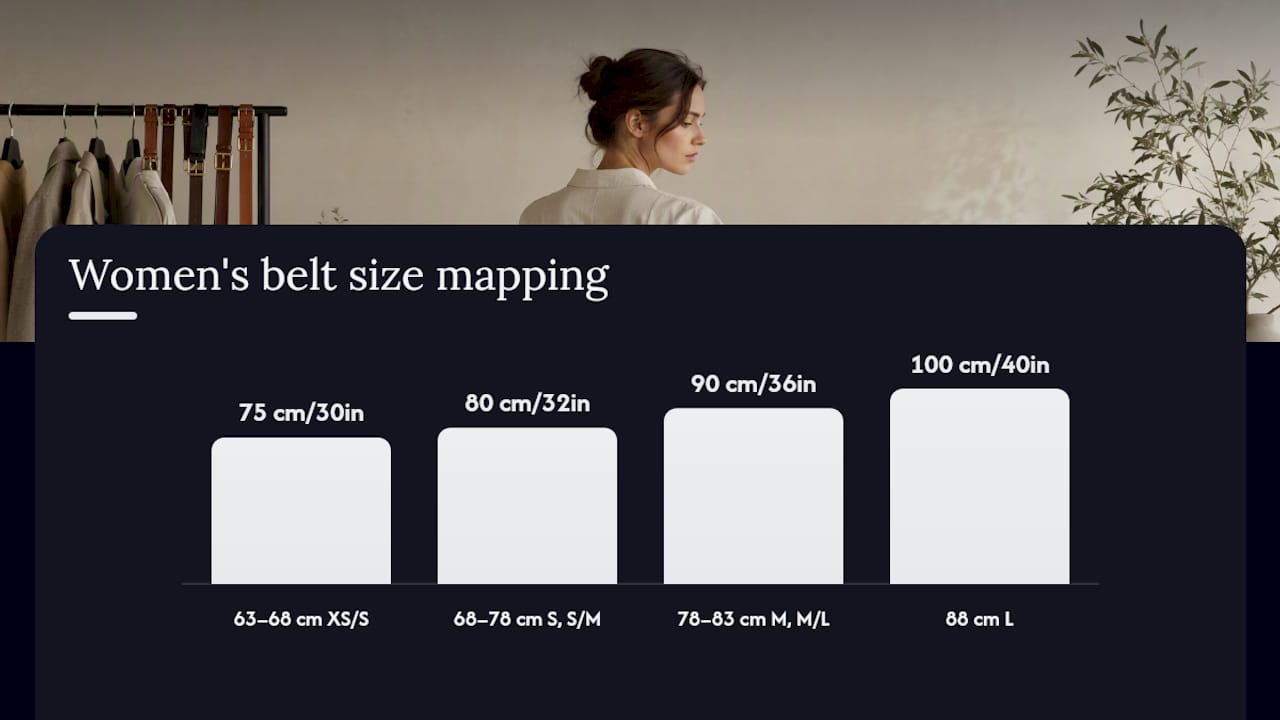
Most women’s belts come in numeric centimetre or inch sizes, or in S/M/L labels that correspond to a centimetre range. The table below maps common body measurements to the belt label you should order, with a small ease allowance already included.
| Body measurement (cm) | Body measurement (inches) | Belt label (cm) | Belt label (inches) | S/M/L equivalent |
|---|---|---|---|---|
| 63–68 cm | 25 in | 75 cm | 30 in | XS/S |
| 68–73 cm | 27 in | 80 cm | 32 in | S |
| 73–78 cm | 29 in | 80 cm | 32 in | S/M |
| 78–83 cm | 31 in | 90 cm | 36 in | M |
| 83 cm | 33 in | 90 cm | 38 in | M/L |
| 88 cm | 35 in | 100 cm | 40 in | L |
Example 1 — waist belt: Your natural waist measures 72 cm. Add 5 cm ease: order an 80 cm belt (size S or 32 in).
Example 2 — hip belt: Your hip circumference is 96 cm. Add 5 cm ease: order a 100 cm belt (size L or 40 in).
Always round up when your measurement lands between sizes. A belt that is slightly long can have an extra hole punched; a belt that is too short cannot be extended.
How to measure yourself at home for waist and hip wearing
The wearing position changes everything. Waist and hip circumferences often differ significantly, which affects sizing., so measuring at the wrong point produces the wrong size.
- Gather your tools. Use a soft fabric tape measure. A piece of string and a ruler work if that is all you have.
- Dress for the occasion. Wear the outfit you intend to pair with the belt, including any tucked-in layers. Belt sizing over a silk blouse differs from sizing over a heavy knit.
- Find your waist point. Stand naturally, breathe out gently, and wrap the tape around your natural waist (the narrowest point, usually 2–3 cm above the navel). Keep the tape level and snug but not tight.
- Find your hip point. For a hip-worn belt, measure around the fullest part of your hips, typically 18–20 cm below the natural waist.
- Record both measurements in centimetres and inches. The difference between them is often larger than expected.
- Measure an existing belt you love. Lay it flat and measure from the buckle fold to the hole you actually use. That number is your working length — the most reliable starting point for ordering online.
Pro Tip: Do two measurements: one on bare skin and one over the outfit. If the difference is more than 2 cm, use the over-outfit figure and add only 3 cm ease instead of 5 cm, so the belt sits firmly without pulling.
For belts worn over dresses or layered clothing, measuring over the garment before you order removes the guesswork entirely.
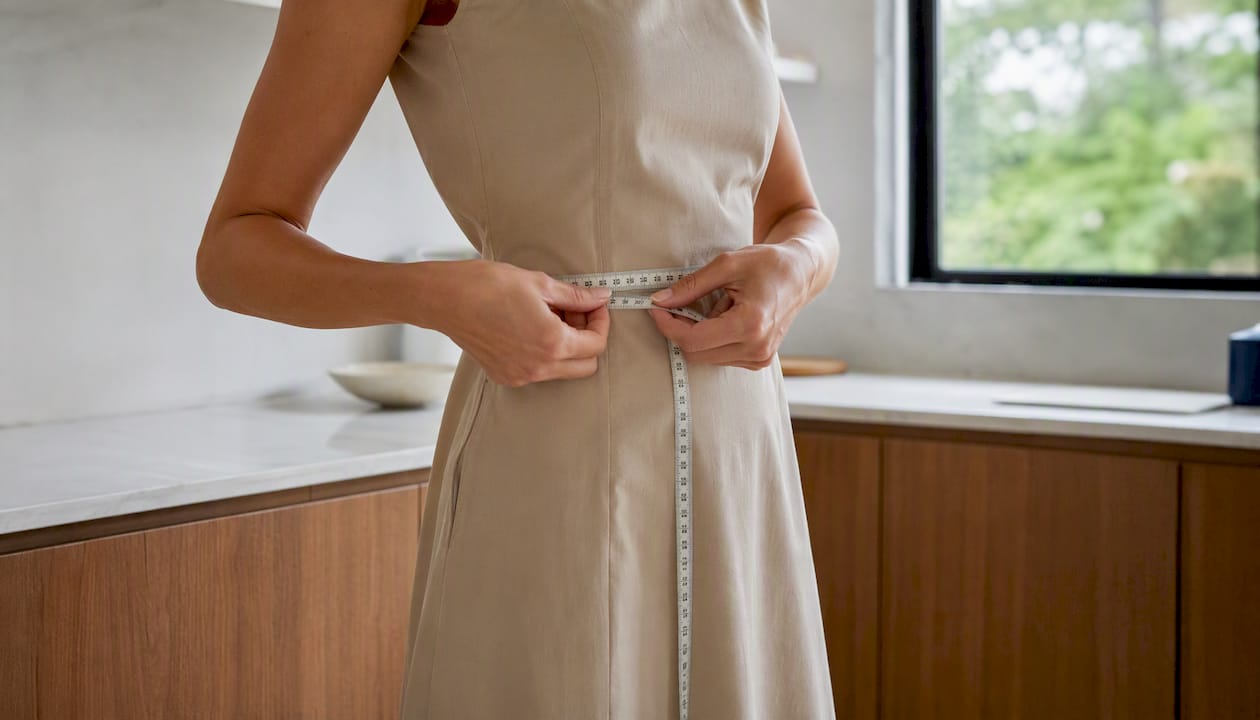
What makes a belt fit well: working length, holes, width and tail
Understanding the mechanics of fit explains why a belt that looks right on the product page can still feel wrong on the body.
Working length is the buckle fold to centre hole distance — the labelled size. Standard belts use five holes spaced roughly 2.5 cm apart, so the centre hole becomes the labelled measurement and the two holes on either side accommodate natural fluctuation in body size or layering. If you consistently use the first or last hole, the belt is the wrong size.
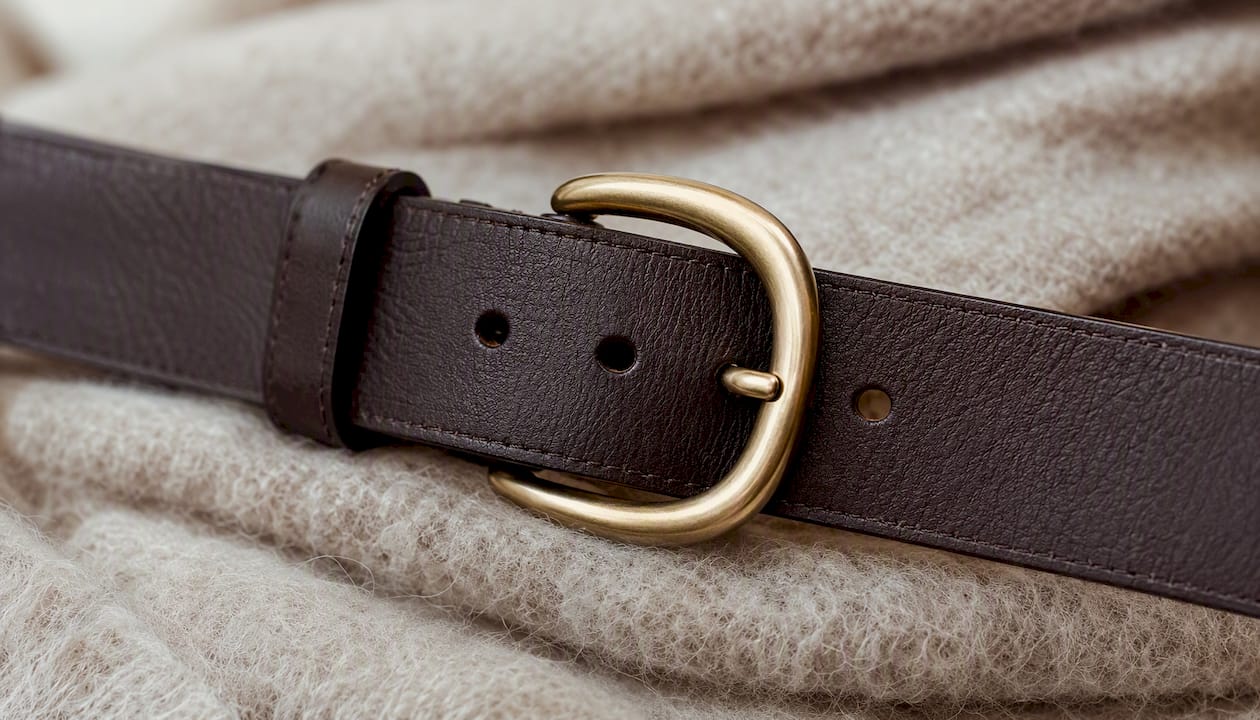
Hole spacing and tail allowance matter as much as the total length. A well-proportioned belt leaves 10–15 cm of tail beyond the buckle when fastened at the centre hole. Too little tail and the belt looks truncated; too much and it flaps.
Width affects both comfort and proportion. Narrow belts (20–30 mm) sit comfortably at the natural waist and thread through dress loops without distorting the fabric. Wider belts (32–38 mm) suit denim loops and create a more structured silhouette.
Leather stretch is real, particularly in softer, full-grain leathers. A new leather belt may feel firm at the centre hole; after a few weeks of wear it often settles one hole looser. Ordering at the correct size from the start, rather than sizing down to compensate, gives the leather room to break in gracefully.
A well-fitted belt should fasten at the centre hole with two holes available on each side. If you reach for the outermost hole every time, size up — the belt is working against you, not with you.
Pro Tip: If you are between sizes and the brand offers only S/M/L, choose a ratchet-closure belt. Ratchet belts adjust in millimetre increments, solving the between-sizes problem that fixed-hole belts cannot.
How sizing differs by belt type
The basic measurement rule shifts depending on what you are wearing the belt with and where it sits on the body.
| Belt type | Wearing position | Sizing rule | Recommended width |
|---|---|---|---|
| Trouser / jeans belt | Hip, through loops | Pants waist size + 5 cm (2 in); add 7.5–10 cm for low-rise | 32–38 mm |
| Fashion / waist belt | Natural waist, over clothing | Body measurement at wearing point + 5 cm ease | 20–30 mm |
| Wide statement belt | Natural waist or high hip | Body measurement + 7–8 cm ease for bulk | 50–80 mm |
| Elastic / ratchet belt | Waist or hip | Body measurement; ratchet adjusts continuously | 25–30 mm |
Quick outfit examples:
- Mid-rise jeans (waist 76 cm): Add 5 cm → order 80 cm / 32 in, width 32–38 mm.
- Wrap dress (natural waist 70 cm): Add 5 cm → order 75 cm / 30 in, width 20–25 mm.
- High-rise tailored trousers (waist 74 cm): Add 5 cm → order 80 cm / 32 in, width 25–30 mm.
Always check the internal width of belt loops before ordering a wide belt. A 50 mm belt will not thread a loop designed for 30 mm.
Edito’s fit and styling notes from our Brisbane boutique
At Edito, the most common fit mistake we see is ordering a belt based on a clothing size label rather than an actual measurement. A size 10 in one European label can correspond to a waist anywhere from 68 to 76 cm depending on the brand’s grading, so the clothing size is never a reliable proxy for belt size.
A few observations that consistently make a difference:
- Waist-defining belts over dresses work best when the belt width does not exceed the dress’s waistband or sash width. A 25 mm leather belt over a fluid midi dress creates élégance; a 50 mm belt on the same dress overwhelms the silhouette.
- Hip-worn belts on jeans benefit from a slightly firmer leather that holds its shape through the loops without rolling or twisting.
- If the fit is almost right but not quite, a cobbler or leather worker can punch an additional hole for a few dollars — far less than a return and reorder.
The Tisao Belt by Sessùn, available through Edito, is designed for waist wearing: its 25 mm width and supple leather make it equally at home over a shirt dress or tucked into high-waisted trousers. It is listed with buckle-fold-to-centre-hole measurements on the product page, so you can match it directly to your tape measure reading.
Pro Tip: For belts worn over structured or layered outfits, measure the circumference of the outfit at the wearing point rather than your bare body. Fabric adds more bulk than most people expect, particularly with heavier weaves or knitwear.
What to check before buying a belt online in Australia
A clear measurement in hand is only half the work. Product listings vary considerably in how they describe size, so knowing what to look for prevents returns.
- Confirm the measurement convention. Does the listed size refer to buckle fold to centre hole (working length), or total strap length? These can differ by 10–15 cm. If the listing is ambiguous, contact customer service before ordering.
- Check hole spacing and number of holes. Five holes at 2.5 cm spacing is standard; some fashion belts use fewer holes or wider spacing, which limits adjustability.
- Note the listed width and compare it to your belt loops if you are threading the belt through them.
- Read the returns policy. Australian Consumer Law provides baseline protections, but many online retailers require items to be unworn and in original packaging. Keep the packaging until you have confirmed the fit.
- Look for ‘cut to size’ options. Some leather belt brands allow the strap to be trimmed to your exact measurement — useful if you fall outside standard sizing.
- S/M/L labels without centimetre measurements are a red flag for online orders. Always ask for the working length in centimetres before purchasing if it is not listed.
The Salvatore Ferragamo size guide and Jimmy Choo’s measurement diagrams are useful references for understanding how premium brands present belt measurements — both show the buckle-fold-to-hole convention clearly.
Why precise belt sizing is worth the extra two minutes
There is a tendency to treat belt sizing as an afterthought — something to approximate and adjust later. In practice, a belt that fastens at the wrong hole changes the entire proportion of an outfit. It pulls fabric, creates uneven tension across a waistband, and shortens the life of the leather at the stress points.
At Edito, we curate European pieces with considered construction and specific wearing intentions. A belt from Sessùn or Sœur is not an add-on; it is a structural element of the look. Getting the size right from the first order means the belt works with the garment’s silhouette rather than against it — and it means you reach for that belt every time, which is the quiet measure of a well-built capsule wardrobe.
Edito’s belt edit: finding the right fit for your wardrobe
Edito carries a carefully chosen selection of European leather belts, each listed with working-length measurements so you can match your tape measure reading directly to the product page. The Tisao Belt by Sessùn is a particular favourite: supple French-crafted leather, a 25 mm width suited to waist wearing, and a clean buckle that works across dresses, tailored trousers and denim alike.
Every belt in the Edito edit includes detailed measurements and a straightforward returns process for Australian customers. If you are unsure whether a specific belt’s working length matches your measurement, the Edito team is available to confirm exact strap dimensions before you order. Browse the full belt selection at Edito or reach out directly for personalised fit guidance.
Sources
- Choosing The Right Sized Belt
- How to Size a Belt for a Woman: Complete Guide
- Women’s waist vs hip wearing for leather belts: fit differences explained
- How to Calculate Belt Sizing | The Top Saddlery
- Belt Size Chart: How to Size Custom Branded Belts
FAQ
How do you size a belt for a woman?
Measure your body circumference at the point where you intend to wear the belt, then add approximately 5 cm for ease. That total is the working length you should order, measured from the buckle fold to the centre hole.
What size is a 75 cm belt?
A 75 cm belt has a working length of 75 cm from the buckle fold to the centre hole, which suits a body measurement of roughly 63–70 cm at the wearing point. It typically corresponds to an XS or S label, or a 30-inch belt size.
What is the Australian women’s belt size chart?
Australian retailers generally follow the international buckle-fold-to-centre-hole convention. A body measurement of 68–73 cm corresponds to an 80 cm belt (size S / 32 in); 78–83 cm corresponds to a 90 cm belt (size M / 36 in). Always confirm whether a listed size refers to working length or total strap length.
What size is a 32 belt for a woman?
A 32-inch belt has a working length of approximately 80 cm from the buckle fold to the centre hole. It suits a body measurement of roughly 68–75 cm at the wearing point and typically corresponds to a size S or S/M in women’s belt sizing.