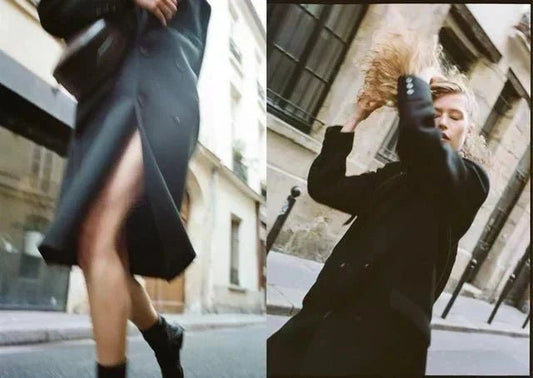

The idea of a French capsule wardrobe is wonderfully appealing.
Fewer clothes. Better pieces. A wardrobe where almost everything works together. Getting dressed becomes simpler, yet somehow you have more possibilities rather than fewer.
Search for the subject, however, and you will quickly encounter a familiar formula.
The trench coat. The striped Breton top. The white shirt. The blazer. Straight-leg jeans. Ballet flats. The little black dress.
Buy these pieces, we are told, and you have created a French wardrobe.
But have you?
There is nothing wrong with any of these classics. Many have earned their place in wardrobes precisely because they are versatile.
But a genuinely useful French capsule wardrobe should not be a costume or a checklist of supposedly Parisian essentials.
It should begin with something much more personal:
your life.
Your climate. Your body shape. Your work. Your weekends. Your personality. The colours you naturally reach for. The silhouettes in which you feel most comfortable.
French style is most interesting when it encourages individuality rather than imitation.
So the objective of this guide isn't to give you a uniform.
It is to help you build a wardrobe with enough coherence to make dressing easier, enough quality to last, and enough personality to still feel unmistakably yours.
What Is a French Capsule Wardrobe?
A capsule wardrobe is a considered selection of clothes that can be combined easily to create multiple outfits.
The concept is often associated with minimalism, but the two are not necessarily the same.
A capsule wardrobe does not have to contain only beige, black and white.
It does not need to consist of exactly 10, 20 or 30 garments.
And it certainly doesn't require you to discard everything you already own.
The more useful principle is coherence.
Your jackets work with your trousers.
Your shirts work with your skirts.
Your knitwear layers over your dresses.
Your shoes work with several silhouettes.
A new piece enters the wardrobe because it creates possibilities rather than because a trend says you should own it.
When we add the word French, another idea enters the equation: personal style.
A French-inspired capsule wardrobe balances practicality with character. The pieces need to work together, but the wardrobe should never become so controlled that the woman disappears from it.
That distinction is important.
A successful capsule wardrobe should simplify your clothes, not simplify your personality.


French Capsule Wardrobe vs Parisian Wardrobe: Is There a Difference?
The terms are often used interchangeably, but they are not quite the same.
A Parisian capsule wardrobe usually refers to an urban aesthetic associated with Paris: tailoring, denim, shirts, coats, understated shoes and an apparently effortless combination of polished and relaxed pieces.
A French capsule wardrobe can be broader.
French fashion extends well beyond Paris and encompasses romantic, artisanal, bohemian, tailored, colourful and globally influenced approaches to dressing.
This matters because reducing French fashion to one Parisian aesthetic misses much of what makes it interesting.
You may love a Sœur jacket but have no interest in ballet flats.
You may gravitate towards the craftsmanship and texture of Sessùn rather than traditional Parisian tailoring.
You may prefer the femininity of Vanessa Bruno, the expression of ba&sh, the restrained silhouettes of Laurence Bras or the artisanal influences of Antik Batik.
All can have a place within a French-inspired wardrobe.
There is no single correct version.
If you're more interested in the broader idea of Parisian dressing, see our Complete Guide to Parisian Style.
Before You Buy Anything, Look at the Wardrobe You Already Have
This is perhaps the most important step, and the one most capsule wardrobe guides skip.
Don't start by shopping.
Start by looking.
Which clothes do you actually wear?
Which pieces make you feel most like yourself?
Which trousers always work?
Which jacket seems to rescue an outfit?
Which dress do you reach for without thinking?
Which colours dominate your wardrobe naturally?
And which purchases seemed like a good idea but somehow never leave the hanger?
Your existing wardrobe contains information about you.
Use it.
A capsule wardrobe built around an imaginary version of your life will fail, however beautiful it looks on a moodboard.
If you rarely wear skirts, you don't need three skirts because a capsule wardrobe checklist tells you that you do.
If you live in Brisbane, a collection of heavy wool coats isn't particularly useful.
If you love print and colour, an entirely neutral wardrobe may make getting dressed simpler while simultaneously making you feel less like yourself.
The objective isn't restriction.
It is clarity.
The 10 Foundations of a French Capsule Wardrobe
There is no mandatory shopping list, but certain categories earn their place because of the number of outfits they can create.
Think of these as foundations rather than rules.
1. A Great Jacket or Blazer
If there is one piece capable of changing the character of an outfit almost instantly, it is a jacket.
It might be a tailored blazer.
An oversized masculine jacket.
A cropped jacket.
A lightweight linen style.
Or something softer and less structured.
What matters is that it works across your wardrobe.
Wear it with denim and a T-shirt.
Over a dress.
With tailored trousers.
With a blouse and skirt.
A good jacket creates structure without requiring the rest of the outfit to be formal.
That tension between polished and relaxed is one of the most useful ideas to borrow from French dressing.
2. The Shirt You Can Wear Five Different Ways
A good shirt earns its place through adaptability.
White is classic, but it isn't compulsory.
Blue, striped, printed, linen or softly coloured versions may work better for you.
Wear it buttoned and tucked into trousers.
Open over a camisole.
Half-tucked into denim.
Layered beneath knitwear.
Or loose over shorts or linen trousers.
One garment. Several attitudes.
That is exactly what a capsule wardrobe needs.
3. Denim That Actually Suits You
Forget the idea that there is one quintessentially French cut of jeans.
The best denim is the denim that suits your proportions and the way you dress.
Straight.
Wide.
Cropped.
Slim.
Relaxed.
Choose the silhouette you repeatedly want to wear rather than the one currently being presented as essential.
Denim brings ease to more refined pieces and is particularly useful in an Australian wardrobe.
Pair it with a French blouse, tailored jacket, beautiful knit or simple shirt and the result feels considered without feeling dressed up.
4. A Pair of Versatile Trousers
Where denim brings informality, a good trouser gives the wardrobe another level of polish.
Again, proportion matters more than convention.
A wide-leg trouser may suit one woman beautifully, while another feels more herself in a narrower silhouette.
Look for a pair that works with shirts, knitwear, jackets and different shoes.
The more relationships a garment has with the rest of your wardrobe, the more valuable it becomes.
5. A Dress That Doesn't Need an Occasion
A useful dress should not spend eleven months waiting for the right event.
Look for one that can change character.
Wear it with sandals in summer.
With boots when the weather cools.
Under a jacket.
With knitwear.
With understated jewellery for daytime or something more expressive in the evening.
A dress becomes a capsule piece when it gives you options.
6. Knitwear Worth Keeping
French wardrobes often make knitwear feel less like a practical necessity and more like part of the silhouette.
A fine knit can sit beneath a jacket.
A relaxed sweater can soften tailored trousers.
A cardigan can replace a jacket in transitional weather.
For Australian women, weight matters.
Fine merino, cotton and lighter blends may prove considerably more useful than the heavy knits associated with a northern European winter.
Buy for your climate, not somebody else's photograph.
7. A Strong Outer Layer
The trench coat is the cliché, but the principle behind it is sound.
Outerwear has enormous influence over proportion.
A long coat can make very simple separates feel intentional.
A lightweight trench can pull together denim and a shirt.
A cropped jacket can completely change the silhouette of a dress or wide trouser.
Choose the outer layer that makes sense for where you live.
For many Australian women, that may mean a lighter jacket rather than a traditional heavy coat.
8. A Simple Base Layer
Not every garment needs a personality of its own.
A good T-shirt, tank, camisole or fine long-sleeve top gives the more interesting pieces somewhere to breathe.
These are the quiet pieces in the wardrobe.
They make the jacket work.
They allow the printed skirt to become the focus.
They sit underneath knitwear without competing with it.
Simplicity is useful when it has a purpose.
9. Shoes That Work with Your Life
Ballet flats may be associated with French style, but you do not need them if you don't like wearing them.
The same applies to loafers, heels or any supposedly essential shoe.
Your capsule wardrobe needs shoes you actually walk in.
Perhaps that means loafers and sandals.
Perhaps sneakers and ankle boots.
Perhaps flats and a low heel.
The important thing is that each pair works with several outfits and feels appropriate to your everyday life.
10. Something That Is Completely You
This may be the most important piece in the entire capsule.
Something unexpected.
A printed blouse.
An extraordinary jacket.
A vintage bag.
A colourful knit.
A piece of jewellery collected while travelling.
A dress with an unusual silhouette.
Without these pieces, a capsule wardrobe can become technically perfect and completely anonymous.
French style is not compelling because every woman owns the same ten things.
It is compelling when familiar pieces become personal.


How Many Pieces Should Be in a French Capsule Wardrobe?
There is no magic number.
Twelve pieces may work for a holiday capsule.
Twenty-five may suit someone with a relatively consistent lifestyle.
Forty may be more realistic for someone balancing work, weekends, events and seasonal changes.
Trying to reach an arbitrary number misses the point.
A better test is this:
Does each piece have a reason to be there?
Can you wear it in several ways?
Does it work with other clothes?
Does it suit your actual life?
Would you miss it if it disappeared?
If the answer is repeatedly no, the problem isn't that your wardrobe contains 37 pieces instead of 30.
The problem is that the piece isn't contributing.
Choose a Colour Palette—but Don't Become a Slave to It
A coherent colour palette makes a capsule wardrobe easier to combine.
This is why neutral shades appear so frequently in discussions of French wardrobes.
Black.
Navy.
White.
Cream.
Grey.
Camel.
Denim.
These colours work together naturally and provide a useful foundation.
But neutral does not automatically mean sophisticated, and colour does not automatically mean difficult.
If red is part of your personality, include red.
If you love green, use green.
If print is something you wear constantly, your capsule should contain print.
A useful approach is to establish several foundation colours and then introduce a smaller number of colours or prints that give the wardrobe character.
Coherence matters.
Uniformity doesn't.

Why Proportion Matters More Than Having the "Right" Pieces
You can own every classic French wardrobe essential and still feel that your outfits aren't working.
Often, the issue is proportion.
A wide trouser may need a more compact top.
An oversized shirt may feel stronger with a narrow skirt or structured denim.
A fluid dress can benefit from a more substantial shoe.
A masculine blazer can become more interesting over something feminine.
French style often works through these relationships.
Structured and fluid.
Masculine and feminine.
Oversized and fitted.
Refined and relaxed.
The tension creates the outfit.
This is also why simply copying a capsule wardrobe from someone else rarely works perfectly.
The clothes have to work with your proportions, not theirs.
Quality Matters—but Price Is Not the Same as Quality
A capsule wardrobe naturally places more responsibility on each garment.
If you are going to wear something repeatedly, fabric, construction and fit matter.
But quality should not be confused with status.
An expensive logo doesn't automatically make a garment useful.
Nor does luxury pricing guarantee that something belongs in your wardrobe.
Look at the fabric.
Look at the seams.
Look at the cut.
Think about how the garment feels when you move.
Ask whether you can imagine wearing it fifty times rather than whether it impresses you for five minutes.
A good capsule wardrobe is built around value in use, not the value other people attach to a label.
Mix Old and New
A French-inspired wardrobe should not look as though it arrived in one delivery.
Some of the most interesting wardrobes develop slowly.
A jacket from five years ago.
New trousers.
A vintage bag.
A shirt you have worn dozens of times.
A beautiful new knit.
Jewellery with a story.
The mixture gives a wardrobe depth.
It also moves us away from the idea that personal style can be purchased all at once.
It can't.
Style develops through wearing, combining, discovering, discarding and occasionally changing your mind.
Your capsule wardrobe is allowed to evolve with you.
French Capsule Wardrobe for Australia: Adapt, Don't Copy
This is where many international capsule wardrobe guides become less useful for Australian women.
Paris and Brisbane do not have the same climate.
Neither do Paris and Sydney, Perth or much of coastal Australia.
A French capsule wardrobe built around heavy wool coats, thick cashmere and multiple winter layers may be beautiful—and completely impractical.
Borrow the principles instead.
Choose linen or lightweight cotton shirts.
Consider an unstructured jacket rather than heavy tailoring.
Use fine knitwear for layering.
Choose dresses that work with sandals as well as jackets.
Allow denim and relaxed trousers to do more work.
Look for breathable fabrics.
Think about transitional pieces rather than building an enormous winter category.
A wardrobe should reflect the environment in which it is worn.
The most French thing you can do is not to copy a French woman's wardrobe, but to understand what works for your own life.
How to Build Your French Capsule Wardrobe Step by Step
STEP 1: Identify What You Actually Wear
Look at the clothes you reached for during the past month.
Those garments are more informative than the clothes you wish you wore.
Identify recurring silhouettes, colours and combinations.
STEP 2: Define Your Foundations
Choose the pieces around which most of your wardrobe operates.
Perhaps denim, trousers, shirts and jackets dominate.
Perhaps you live in dresses.
Your foundations should reflect you.
STEP 3: Identify the Gaps
Only now should you think about what is missing.
Perhaps you have several beautiful blouses but no trouser that works with all of them.
Perhaps you own dresses but lack a useful jacket.
Perhaps you have plenty of basics and nothing with personality.
Buy to solve a problem rather than simply to add another item.
STEP 4: Test Every New Piece Against Your Existing Wardrobe
Before buying something, imagine at least three ways you could wear it using clothes you already own.
If you cannot, ask yourself why.
Occasionally a remarkable piece deserves to break the rule.
But if every purchase requires three additional purchases, you are not building a capsule.
You are building a shopping list.
STEP 5: Add Personality
Once the foundations work, introduce the pieces that make the wardrobe yours.
Colour.
Print.
Texture.
Jewellery.
An unusual silhouette.
A beautiful bag.
Something discovered while travelling.
The capsule should become more recognisably you as it develops—not more generic.
STEP 6: Stop When the Wardrobe Works
This is surprisingly difficult.
Fashion constantly gives us another reason to buy something.
A new season.
A new trend.
A new essential.
A new colour.
But sometimes your wardrobe does not need another piece.
Sometimes it simply needs to be worn.
How French Designers Can Fit Into a Capsule Wardrobe
A capsule wardrobe does not need to be entirely designer clothing.
In fact, we think it is often more interesting when it isn't.
A Sœur jacket can sit beside Australian denim.
A Sessùn blouse can be worn with trousers you have owned for years.
A Vanessa Bruno dress can work with simple sandals.
A ba&sh knit can bring personality to familiar jeans.
A Laurence Bras piece can introduce a different proportion to otherwise understated separates.
An Antik Batik blouse can bring print and artisanal character to a neutral wardrobe.
The designer piece doesn't need to dominate.
It needs to contribute.
This is how we prefer to think about French designer clothing at Edito: not as status objects, but as pieces with a point of view that can become part of an individual woman's wardrobe.
What Not to Do When Building a French Capsule Wardrobe
Don't buy somebody else's personality.
If you hate striped tops, don't buy one because it appears on every French wardrobe checklist.
Don't replace perfectly good clothes simply to create a capsule.
The most sustainable and economical starting point is what you already own.
Don't make the wardrobe so neutral that it loses you.
Beige is not a personality.
Don't confuse timeless with boring.
A piece can have an unusual silhouette, colour or detail and remain relevant for years.
Don't build for an imaginary lifestyle.
Buy for the woman you actually are.
And don't treat the capsule as finished forever.
People change.
Bodies change.
Work changes.
Climate, travel and life change.
Your wardrobe should be allowed to change too.
✦ Notes from Edito
Start with Personality, Not a Shopping List
"If someone walked into Edito wanting to build their first European wardrobe, the most important thing I would recommend is open-mindedness and personality.
Your wardrobe—what you wear—is supposed to tell others about you and your individuality. Don't embrace a style like you follow a fashion trend. Don't be another number.
What I would recommend would always depend on the woman's body shape and what she personally likes.
Be yourself. Stand out from the crowd."
— Mickael Martin, Co-founder of Edito
A Sample French-Inspired Capsule Wardrobe
If you still want a practical starting point, the following provides a flexible framework rather than a prescription:
- 2 jackets or blazers
- 3 shirts or blouses
- 2 simple base tops
- 2 pairs of denim
- 2 pairs of trousers
- 1 skirt, if you genuinely wear skirts
- 2 versatile dresses
- 2 pieces of knitwear
- 1 useful outer layer
- 3 pairs of everyday shoes
- 1–2 bags
- A small selection of jewellery and accessories
- 2–3 pieces chosen purely because they express your personality
That gives you approximately 20–25 core pieces before accessories.
But delete a category if it doesn't suit you.
Add another if your lifestyle requires it.
The number is not the achievement.
A wardrobe that works is the achievement.
The Real Purpose of a French Capsule Wardrobe
The ultimate goal isn't minimalism.
It isn't owning twenty pieces.
It isn't looking Parisian.
And it isn't proving that you can resist fashion trends.
The purpose is to create a wardrobe that gives you clarity without taking away choice.
You open the wardrobe and understand what is there.
The pieces speak to one another.
You can get dressed without starting from zero every morning.
But there is still room for discovery.
For colour.
For an unexpected purchase.
For a vintage find.
For something beautiful that you simply fall in love with.
Because fashion should never become an exercise in efficiency alone.
It should still give you pleasure.
It should still allow you to change.
And it should still say something about who you are.
Perhaps that is the most useful lesson to take from French style.
Don't build the perfect wardrobe.
Build your wardrobe.
Discover French Fashion at Edito
At Edito, we don't believe building a European wardrobe means replacing everything you already own with designer clothing.
We look for pieces with character, versatility and a strong point of view—pieces that can enter an existing wardrobe and make it more interesting.
Our edit of French designers includes Sœur, Sessùn, Vanessa Bruno, ba&sh, Laurence Bras and Antik Batik, each offering a different interpretation of contemporary French fashion.
Explore them for ideas rather than instructions.
Find the pieces that feel like you.
Then wear them your way.
Explore French Fashion at Edito →
For more on the philosophy behind French personal style, continue with:
Why French Women Always Look Effortlessly Stylish →
Or explore:
The Complete Guide to Parisian Style →
French Fashion vs Scandinavian Fashion: Understanding Two Distinct European Styles →
Frequently Asked Questions
What is a French capsule wardrobe?
A French capsule wardrobe is a considered collection of versatile clothing that works together while reflecting the wearer's personal style. Rather than relying on a strict list of Parisian essentials, it focuses on quality, proportion, versatility and pieces that suit your actual lifestyle.
What should be in a French capsule wardrobe?
Useful foundations can include a versatile jacket, shirts or blouses, denim, tailored trousers, knitwear, a dress, an outer layer, simple base tops and everyday shoes. However, the exact pieces should depend on your lifestyle, body shape, climate and personal preferences rather than a prescribed checklist.
How many pieces should a French capsule wardrobe have?
There is no ideal number. Around 20 to 30 core pieces can provide a useful starting point for some women, but a capsule may be smaller or larger depending on work, climate, lifestyle and how much variety you enjoy. What matters more is whether the pieces work together and are genuinely worn.
What colours are best for a French capsule wardrobe?
Neutral colours such as black, navy, white, cream, grey, camel and denim are useful because they combine easily, but a French-inspired wardrobe does not need to be entirely neutral. Colour and print can give a capsule personality, particularly when they coordinate naturally with the wardrobe's foundation colours.
Do I need a trench coat and Breton top for a French wardrobe?
No. Trench coats and Breton stripes are strongly associated with classic French style, but neither is compulsory. A useful French-inspired wardrobe should contain pieces you genuinely enjoy wearing and that suit your climate and lifestyle.
How do I build a French capsule wardrobe in Australia?
Adapt the principles to the Australian climate rather than copying a Parisian wardrobe literally. Consider lightweight tailoring, breathable shirts, versatile dresses, fine knitwear, denim and layers that work across Australian seasons. The wardrobe should reflect where and how you actually live.
Can a French capsule wardrobe include colour and prints?
Absolutely. A capsule wardrobe needs coherence, not uniformity. Prints, colour, texture and unusual silhouettes can prevent a small wardrobe from becoming generic and can help it reflect your individual personality.
Which French brands work well in a capsule wardrobe?
Different French designers offer different possibilities. Sœur is particularly strong for modern separates and masculine-feminine proportions; Sessùn combines versatile clothing with craftsmanship and texture; Vanessa Bruno offers refined everyday pieces; while ba&sh, Laurence Bras and Antik Batik can introduce more expressive, tailored or artisanal elements. The best choice depends on your individual style.