
Take your bust, waist, hip and foot measurements in centimetres before you buy anything. AU and UK numeric sizes are usually identical, with US sizes generally smaller by a couple of numbers though this varies by brand, but that rule bends brand to brand. Compare your centimetres to the garment’s own flat measurements, not just the size label, and use the conversion tables below only as a starting sanity check.
TL;DR:
- Actual garment measurements are more reliable than size labels for fitting, so always compare flat measurements to your own centimetres before purchasing.
- Size conversions vary by clothing category, with bust and hip measurements critical for dresses but waist and inseam vital for jeans and trousers.
- European brands often publish flat measurements and fit notes, helping online shoppers avoid size guesswork and reduce returns.
- Shoe size conversions are best based on foot length in centimetres, especially since EU, UK, and US sizes are not directly comparable.
- Brand-to-brand sizing can differ significantly due to lack of regulation, regional habits, and fabric stretch, making personal measurements essential.
Table of Contents
- How does clothing size conversion work for women?
- How do you measure yourself for accurate sizing?
- Do size conversions change by garment type?
- Why do size charts vary so much between brands?
- How does Edito Boutique approach sizing for European labels?
- What actually matters when you’re buying across borders
- Quick shop: measurement-first pieces to try
- Sources
- FAQ
How does clothing size conversion work for women?
Numeric sizing gives the clearest starting point, though it still needs a measurement check against the actual garment. AU and UK women’s sizes line up almost perfectly across the size range, so a UK 12 and an AU 12 usually describe the same body. US sizing sits apart: a US size 8 corresponds to roughly a UK 12 and an EU 40, a gap that trips up a lot of Australian shoppers browsing American brands for the first time.
The table below uses representative bust and hip ranges rather than one brand’s exact chart, since every label maps to a range rather than a fixed point.
For bottoms and denim, waist and inseam carry more weight than the number on the tag. Jean sizing often uses its own numbering entirely (a “27” or “29” waist, for instance), so treat the chart below as a rough EU/UK/US bridge rather than gospel.
Letter sizing (XS to 3XL) is common on knitwear, activewear and relaxed silhouettes, generally corresponding to a range of numeric sizes.
| Letter Size | Approx. AU/UK Numeric | Bust (cm) |
|---|---|---|
| XS | 6–8 | 79–86 |
| S | 10–12 | 87–95 |
| M | 14–16 | 96–105 |
| L | —–20 | 106–115 |
| XL | 22–24 | 116–125 |
| 2XL–3XL | —–30 | 126–140+ |
Shoes convert most reliably from foot length in centimetres rather than the printed number, because EU, UK and US shoe scales are built on different base units and rounding conventions.
When you’re converting an EU shoe size to AU, treat these as the same scale as UK sizing, since Australian shoe sizing follows the UK system almost exactly.
How do you measure yourself for accurate sizing?
Get these four measurements right and you’ll avoid most sizing mistakes before you even open a size chart.
- Bust: Wear a non-padded bra, wrap the tape around the fullest part of your bust, keeping it level and snug but not compressing.
- Underbust: Measure directly beneath the bust, still level around the ribcage, useful for bra sizing and fitted dresses.
- Waist: Find your natural waist (usually just above the belly button where you bend slightly to one side) and measure without pulling the tape tight.
- Hip: Stand with feet together and measure around the fullest part of your hips and seat, roughly 20cm below your waist.
- Inseam: Measure from the crotch seam of a well-fitting pair of trousers to the hem, or have someone measure from your crotch to your ankle bone.
- Foot length: Stand on a piece of paper, mark your heel and longest toe, then measure the distance in centimetres, ideally in the afternoon when feet are slightly swollen.
Standing naturally with even weight on both feet, and keeping the tape parallel to the floor, matters more than most shoppers realise for repeatable measurements.
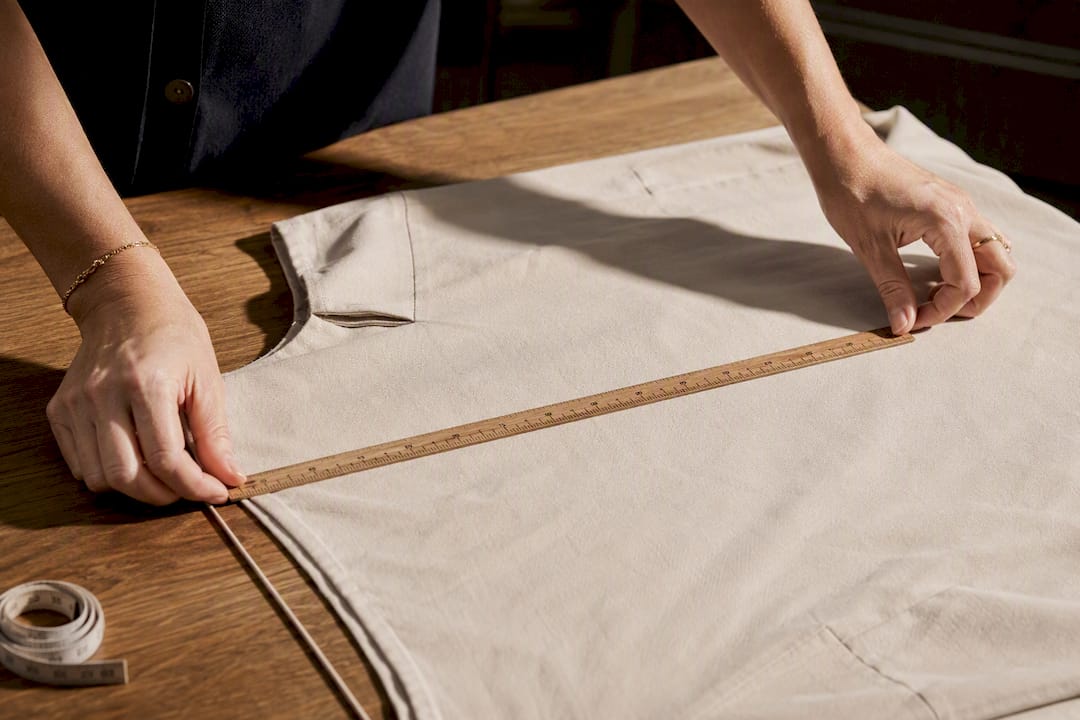
Once you have your numbers, compare them against the garment’s flat measurements, not the size label. A product page listing “bust 92cm” is telling you the actual garment width doubled and measured flat, so hold your own tape to that figure directly.
If you sit between two sizes, check the fabric content first. A cotton poplin shirt with no stretch behaves very differently from a viscose blend with 5% elastane, and fabric stretch, silhouette and the retailer’s return policy should all factor into whether you size up or down.
Pro Tip: Before checkout, run through this quick list: measure yourself in centimetres, compare to the garment’s flat measurements (not the label), check the fabric composition for stretch, and skim the fit notes or reviews for “runs small” or “true to size” comments.
Do size conversions change by garment type?
Yes. A blanket AU to UK to US chart works fine for jeans but can mislead you badly for bras or fitted knitwear, because each garment category has its own fit priorities.
- Dresses and suiting: Bust, hip and garment length matter most. Check the model’s height against the listed length, and note whether the cut has generous or minimal ease.
- Jeans and trousers: Waist and inseam decide the fit. With stretch denim, only size down one size if reviews specifically confirm the fabric gives with wear.
- Knitwear: Ease allowances run larger, and letter sizes (XS to L) often translate more consistently across brands than numeric labels for this category.
- Bras: Band and cup work as a pair, not a single number, and dress-size conversions are unreliable for bras because cup volume doesn’t scale the same way bust circumference does.
- Shoes: Convert from foot length in centimetres every time, and factor in last shape and width, since a “true to size” EU 39 can still feel narrow if the last is cut slim.
Why do size charts vary so much between brands?
Charts vary because sizing is a voluntary business decision, not a regulated standard. No law forces brands to follow a single sizing system; each label sets its own fit block, then grades sizes up and down from that base by however many centimetres it chooses. Two size 12 dresses from different brands can differ by noticeable amounts in bust measurement, simply because their base blocks and grading rules were never meant to match.
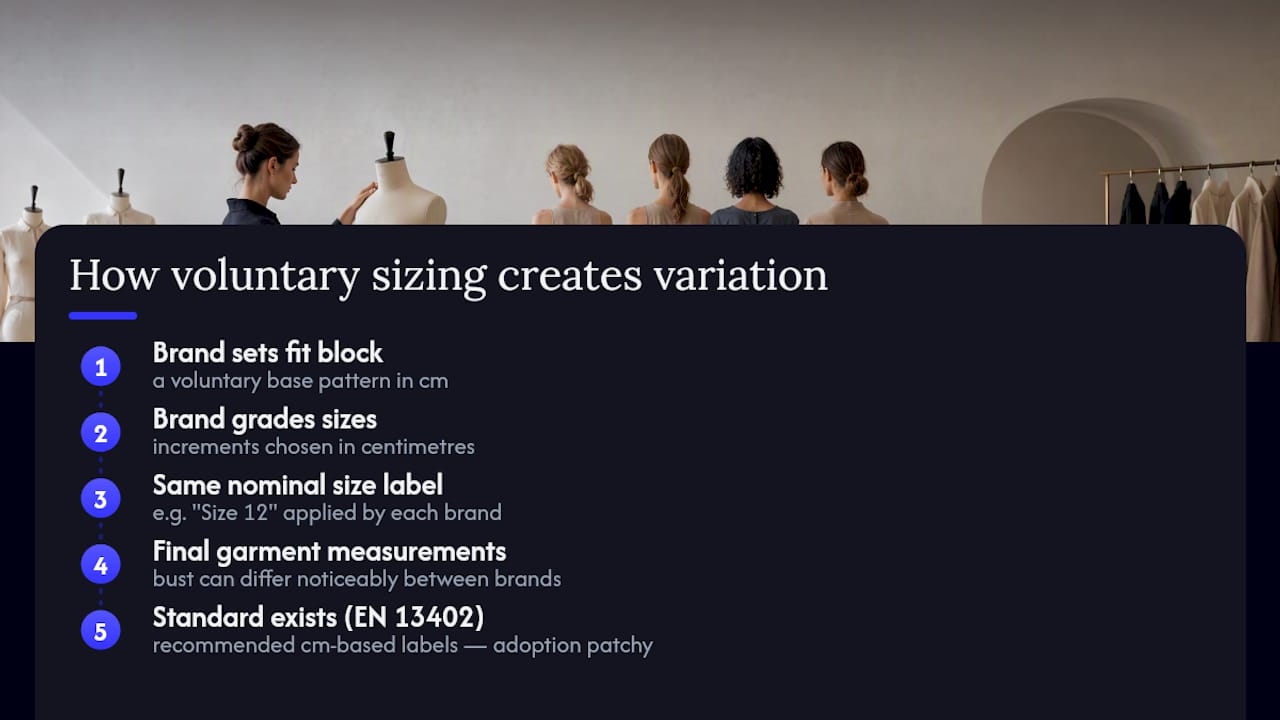
The EN 13402 standard tried to fix this by recommending labels based on actual body measurements in centimetres rather than arbitrary numbers, using pictograms to show which dimension matters most for a given garment. It’s a sound idea conceptually. Its adoption remains patchy because it’s voluntary, so plenty of European brands still use their own numbering alongside or instead of it.
Vanity sizing, regional grading habits, fabric stretch, and measurement units contribute to variation between brands.
Publishing exact garment measurements for every item, rather than relying on a generic conversion chart, is the change NN/g’s ecommerce usability research points to as most effective for cutting sizing related returns.
Use conversion charts for a rough first pass, and let the garment’s own measurements make the final call.
How does Edito Boutique approach sizing for European labels?
Edito publishes flat garment measurements and fit notes on every product page, which matters when you’re shopping European labels with different fit blocks to what you’re used to. For pieces like the Elorina Dress in Navy or the Bonnie Skirt, check the listed bust, waist and length figures against your own centimetre measurements before you rely on the EU size number alone. Edito presents this detail favouring transparency over a generic conversion badge. If a piece sits between two sizes, review the fabric composition and Edito’s returns process, so you can order with genuine confidence rather than a guess.
What actually matters when you’re buying across borders
Most sizing advice treats conversion charts as the answer, when they’re really just a coarse filter. The research here backs a plainer view: a chart indicates where to start, but real garment measurements, model height, and fit notes provide more reliable guidance, which is why I’d rather see shoppers spend thirty seconds with a tape measure than five minutes cross-referencing three different size guides.
Conventional advice also underplays fabric. A size 12 in stiff cotton twill and a size 12 in a viscose jersey are not the same purchase decision, yet most charts treat every garment as if it behaves identically. If you take one thing from this guide, take the habit of checking flat measurements first and treating the size label as background information, not instruction. Keeping a running note of how specific European brands fit you, rather than trusting a universal chart, pays off more with every subsequent order.
— Mickael Martin
Quick shop: measurement-first pieces to try
Edito is the alternative to guessing your size from a label. Every product page lists flat garment measurements and fit notes, so you’re converting from real numbers, not assumptions.
A handful of pieces worth checking with tape in hand: the Florisse Blouse in Grenat and Felicie Blouse in Azur both list bust and shoulder measurements to compare against your own. The Button Front Belted Shirt Dress shows length and hip figures worth checking against your height. For accessories that skip the sizing guesswork entirely, the Mini Albertine Silk Scarf in Bordeaux, Mini Capucine Silk Scarf in Fuchsia and Diamond Arrow Hoops round out a considered edit. Scroll to the measurements panel on any product page before adding to cart, and remember Edito’s returns process is there if the fit still isn’t quite right.
Sources
FAQ
What is the Australian women’s clothing size chart based on?
Australian women’s sizing uses numeric labels (8, 10, 12 and so on) that track closely with UK sizing and correspond to bust, waist and hip ranges rather than a single body measurement.
Is a size M the same as a 12 or a 14?
M typically covers AU/UK sizes 14 to 16, though it varies enough between brands that checking the garment’s actual bust and hip centimetres is more reliable than assuming M equals one specific number.
What dress size does a 70kg woman typically wear in Australia?
Dress size depends on height and body shape, not weight alone, so there’s no fixed number a given weight maps to. Bust, waist and hip measurements in centimetres, checked against the garment’s own chart, give a genuine answer.
Is a size 10 considered small in Australia?
A size 10 sits toward the smaller end of the standard AU/UK range, with waist and bust measurements in that lower range, though “small” is relative to the wider range a brand stocks.
How do I convert an EU shoe size to AU?
Measure your foot length in centimetres and match it against a EU to AU/UK conversion table, since Australian shoe sizing follows the UK scale closely and foot length in centimetres is more reliable than comparing numeric labels directly.