
Sœur sizing is French, runs from 34 to 42 in most ready-to-wear, and is cut with an easy, relaxed hand. As a rule of thumb, a French 36 sits close to an Australian 8, a 38 to a 10 and a 40 to a 12. Most pieces are forgiving, but the ones with shirring, dropped shoulders or puff sleeves reward precision. This guide explains how to choose between your usual size and one size down, garment by garment, and how to read the details that matter before you order from Australia.
TL;DR
- Soeur uses French sizing (34 to 42). Treat the conversion to Australian sizes as a starting point, then confirm against the measurements on the product page.
- Many Soeur pieces are cut generously. Your usual size gives the intended, slightly oversized line; one size down gives a cleaner, more tailored look.
- For tops, prioritise shoulder width. For trousers and jeans, prioritise the hip. Length and waist can be adjusted more easily than either.
- Shoes follow European numbering, so check your Australian size against the EU equivalent, and consider half-size questions with the leather in mind.
- Not sure? Look at the fit notes on each Edito product page, or visit us in Brisbane to try pieces on.
Table of Contents
- How Soeur sizing works
- Does Soeur run true to size?
- Choosing by garment
- How to measure yourself
- When to size up, when to size down
- Our perspective on Soeur fit
- Shop Soeur at Edito
- Reading the season: what changes in the sizing
- Common sizing mistakes to avoid
- FAQ
- Sources
How Soeur sizing works
Sœur is a French label, and its ready-to-wear is numbered in the French system: 34, 36, 38, 40 and 42, sometimes shown alongside XS to XL. That is the first thing to settle, because an Australian 10 is not a “10” on a Soeur label. It is a 38.
The commonly used equivalence looks like this:
| French (Soeur) | Letter | Australian / UK |
|---|---|---|
| 34 | XS | 6 |
| 36 | S | 8 |
| 38 | M | 10 |
| 40 | L | 12 |
| 42 | XL | 14 |
Treat this as a guide rather than a guarantee. Garments are cut differently across a collection, and a size 38 in a fluid viscose dress will not behave like a 38 in a structured denim jacket. The measurements and model details on each product page are the more reliable reference, and the brand’s own size chart, which gives body measurements at the bust and hip, is the document to check when you sit between sizes.
One practical note for Australian shoppers: a European label does not know that you buy in Australian sizes. If you are a 10 in most Australian brands but a 12 in others, you are already used to translating. The same habit applies here. Go by your measurements first and the label second.
Does Soeur run true to size?
Mostly, yes, with one important qualification: true to size does not mean close-fitting. Soeur’s aesthetic is relaxed Parisian tailoring, so many pieces are designed with ease through the body, a slightly dropped shoulder or a fuller sleeve. That is the intention, not a sizing error.
Reviewers who have tried the label tend to say the same two things. A fit-focused writer who tried on a range of pieces found a cotton jacket ran large and recommended going down one size for a more tailored look, while keeping true to size for a looser, layered effect. Her try-on notes are a useful reminder that the answer depends on the silhouette you want, not only on your body.
A stylist-led fit guide makes a complementary point: the relaxed cut can tempt shoppers into careless choices, yet shirring, dropped shoulders and puff sleeves need accuracy to land well. The same guide advises treating size charts as a starting point, watching shoulder width on tops and hip room on trousers, so the garment does not swamp the frame.
The practical conclusion is simple:
- Decide the look first: lived-in and oversized, or defined and tailored.
- Choose your usual size for the first, one size down for the second.
- Override that rule whenever the shoulder or hip measurement says otherwise.
Choosing by garment
Shirts and blouses
Shirts are where Soeur’s ease is most evident. Many are cut straight with a slightly oversized finish and a curved hem, designed to be worn untucked, half tucked or open over a tee. Your usual size is usually the right call if you like the shirt to hang away from the body. If you prefer it neat, with the sleeve seam closer to your natural shoulder, consider going down.
What to check:
- Shoulder seam. It should fall at or slightly beyond the edge of your shoulder, not halfway down the upper arm unless the style is deliberately dropped.
- Sleeve length. Cuffs are often worn pushed up, so a longer sleeve is rarely a problem.
- Bust. If you are fuller through the bust, size by the bust and let the rest of the shirt fall loose, as this is the part that cannot be altered.
You can see how this plays out in our Soeur tops, and shirts such as the Austin Shirt in Stone or the Emeline Shirt in Brown/Black are good places to apply the shoulder test.
Dresses with shirring or puff sleeves
This is the category where precision pays. Shirred bodices stretch within a range, but a size too large leaves the smocking slack and the waist falling in the wrong place. Puff sleeves rely on the seam sitting where the designer intended, which means shoulder width matters more than the label. If you are between sizes here, the smaller size usually keeps the architecture intact, provided it does not pull across the bust or hips.

Browse our dresses and read the model details: they tell you which size the model wears and her height, which helps you judge hem length. If you are taller than the model, expect a shorter hem. If you are shorter, a midi can become a maxi, and a tailor can adjust that more easily than a shoulder.
Trousers, jeans and denim
For anything with a waistband, the hip is the measurement to trust. A Soeur trouser is generally cut with room through the hip and thigh, then tapers or falls straight. If the hip fits and the waist is a little generous, a belt or a small alteration solves it. If the waist fits and the hip is tight, nothing will make the trouser hang properly.
Length deserves its own attention. One reviewer who is 5’6" found a pair of the brand’s trousers very long compared with the model, who is 5’10", and said they would need hemming by 2 to 4 inches depending on how she wore them. Her try-on is a fair warning for anyone under about 170 cm: budget for a hem, or plan to wear the trousers with a block heel.
Denim sizing follows the same logic, with a few extra variables: the wash, the rigidity of the cotton and whether the pair is a relaxed or straight cut. The Calvin Jean in Blush and our wider Soeur pants selection are worth reading closely for fit notes.
Knitwear
Fine knits are the easiest category to size. A merino jumper is designed to be worn close to the skin or under a jacket, and the stretch forgives small variations. Go with your usual size if you want a classic fit, or one up if you intend to layer a shirt underneath. Brisbane winters are mild enough that a fine merino can be worn on its own from May through August, and in cooler Southern Queensland evenings it layers under a coat without bulk.
Jackets and outerwear
Jackets are cut to sit over other layers, so the ease can be considerable. The question is what you will wear beneath. If it is a fine tee or a shirt, your usual size gives a relaxed line, and one size down gives the tailored finish many people prefer. If you plan to layer with knitwear, stay with your usual size. Always check the shoulder first.
Shoes
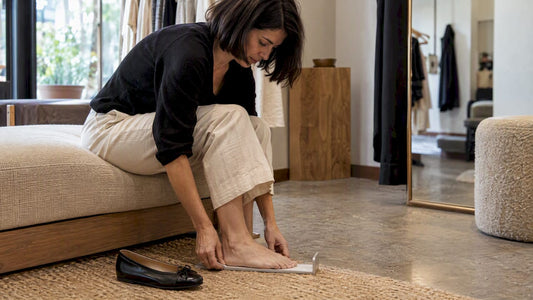
Soeur footwear is sized in European numbers, and most reviewers describe the brand as fitting generally true to size, with a design philosophy built around comfort and the natural shape of the foot. A typical conversion places a European 38 at about an Australian 5 and a 39 at about 5.5 or 6, though charts differ slightly between sources, so confirm with the brand’s chart for the style you are buying.
A few points specific to leather:
- Leather softens. Sandals and loafers give a little with wear, so a snug fit across the width is acceptable, but a pinching toe is not.
- Half sizes. If you are between sizes, and the shoe is a closed loafer or flat, the larger size with an insole is often more comfortable. For a sandal with a strap, the smaller size can hold the foot better.
- Socks and tights. If you will wear loafers with socks in cooler months, try them with the sock you plan to use.
Our Soeur shoes collection lists each style so you can compare.
How to measure yourself
A size chart is only useful when you have numbers to compare it with. Spend five minutes with a soft tape measure and wear light clothing.
- Bust: around the fullest part, keeping the tape level across the back.
- Waist: at the narrowest point, usually just above the navel.
- Hips: around the fullest part, usually 20 cm or so below the waist.
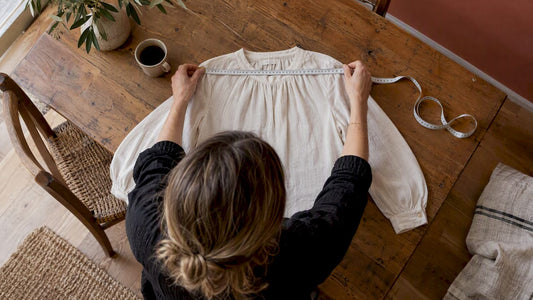
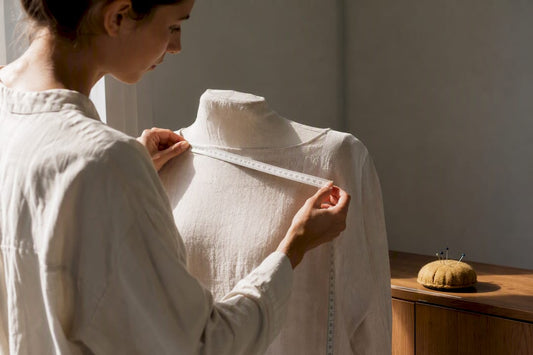
- Shoulder width: from the edge of one shoulder to the other across the back. Compare it with the garment’s flat measurement if it is listed.
- Height and inseam: these tell you how a hem will fall relative to the model.
Then put these numbers beside the body measurements on the size chart rather than the garment measurements. They are different things: a chart based on body measurements tells you who the garment is intended for, and garment measurements tell you how much ease it has.
When to size up, when to size down
A short decision guide, drawn from the patterns above:
| If you want | Choose | Best for |
|---|---|---|
| An intentionally relaxed, oversized line | Your usual size | Shirts, jackets, shirt dresses |
| A cleaner, more defined silhouette | One size down | Jackets, shirts, relaxed knits |
| Room to layer | Your usual size, or up in knitwear | Winter tailoring, coats |
| A precise fit through the bodice | Size by bust and shoulder | Shirred dresses, puff sleeves |
| A trouser that sits properly | Size by hip, alter the waist | Trousers, jeans |
If you are between sizes on a piece with a fixed structure, such as a fitted bodice or a sleeve with a set seam, choose the one that fits at the shoulders and bust. If you are between sizes on a loose piece, choose by the silhouette you want.
Our perspective on Soeur fit
We stock Soeur because the label has a clear point of view: considered fabrics, harmonious colour and a cut that feels worn-in from the first day. Good Housekeeping described it as a French label run by two sisters who think about everything from fabric choice to colour harmony, and that attention shows in how the pieces drape.

The flip side of that ease is that sizing is a question of intention rather than arithmetic. The most common mistake we see is treating a relaxed cut as an excuse to buy whatever is available. A shirt that is two sizes too large does not look décontracté; it looks borrowed. The reverse is also true. A piece with a considered volume in the sleeve or hem can feel lost if you choose too small, because the proportions are part of the design.
Our advice is to begin with the shoulder and hip, decide how much ease you want, and then choose accordingly. For Australian wardrobes, we also think about the climate: a cotton shirt in a Brisbane summer benefits from a little extra room for air, while a merino knit for a Melbourne winter is better close to the body so it layers cleanly. And if you are unsure, you are welcome to come to the boutique in Brisbane and try a few sizes side by side. It is the quickest way to learn what a French 38 means on your frame.
— Mickael Martin
Shop Soeur at Edito
Our Soeur collection brings together the label’s clothing, shoes and accessories in one place for Australian customers. Each product page carries the fit information we have for that piece, and orders come with fast shipping and easy returns, so you can choose with confidence. For a wider view across labels, explore our clothing range.

Reading the season: what changes in the sizing
The collection you are buying from matters, because fabrics and silhouettes change by season. Lightweight cottons and viscose in spring and summer pieces tend to be airy and flowing, so the same size can feel roomier than in a structured autumn jacket or a heavier denim. If you are comparing seasons, our editorial pages on Soeur Spring Summer 2026 and Soeur Autumn Winter 2026 show the silhouettes in context, which helps when you are deciding how much ease you like.
A useful habit is to note what you buy and how it fits. If a French 38 shirt and a French 36 jacket both work for you, that tells you something about how you like to wear Soeur: a relaxed top half and a more defined outer layer. Over a few purchases, you will build your own size key, which is more reliable than any chart.
Common sizing mistakes to avoid
- Going by the letter size. An “M” in one collection is not necessarily the same as an “M” in another. Use the French number and the measurements.
- Ignoring the model’s height. If the model is 5’10" and you are 5’4", the hem will fall differently. Check her size and height listed on the page.
- Sizing down for everything. The advice to size down applies to oversized jackets and shirts, not to every item. Fitted bodices and structured sleeves need accuracy rather than reduction.
- Forgetting alterations. Hems, waistbands and sleeve lengths are straightforward for a tailor. Shoulders and bust are not. Choose the size that fits there.
- Assuming one fit across fabrics. Cotton, linen, viscose and merino each relax or hold shape differently over a day of wear.
FAQ
What size is a Soeur 38 in Australia?
A Soeur 38 usually corresponds to an Australian size 10, with a 36 matching an 8 and a 40 matching a 12. Charts vary slightly between garments, so check the measurements on the product page before you buy.
Should I size down in Soeur?
Only if you want a more tailored look. Many Soeur pieces are designed with a relaxed, slightly oversized fit, so your usual size gives the intended silhouette. Sizing down suits jackets and shirts when you prefer a cleaner line, but not shirred or fitted pieces.
Does Soeur run small or large?
It tends to run generous in shirts, jackets and relaxed trousers, and closer to true in knitwear and fitted dresses. Reviewers have found some outerwear roomy enough to suggest going down a size. Check the shoulder and hip against your own measurements to be certain.
How do Soeur shoes fit?
Soeur shoes are sized in European numbers and are generally described as fitting true to size. Leather styles soften with wear, so choose a comfortable length and a snug but not tight width. If you are between sizes, a closed flat often suits the larger size, while a strappy sandal may suit the smaller.
Can I return Soeur pieces if the size is wrong?
We offer easy returns on our orders, so you can order with confidence. Check the returns terms at checkout for the specific conditions, and if you are in Brisbane you can try pieces in the boutique first.