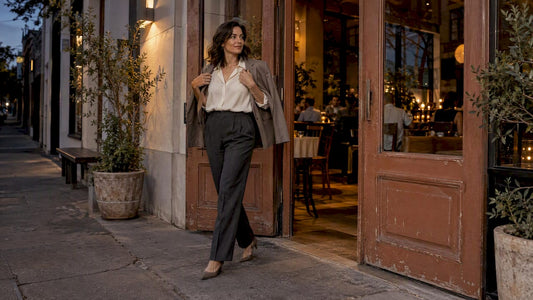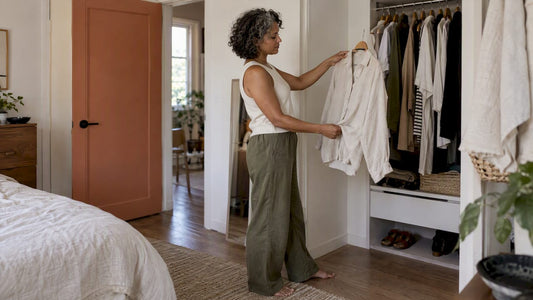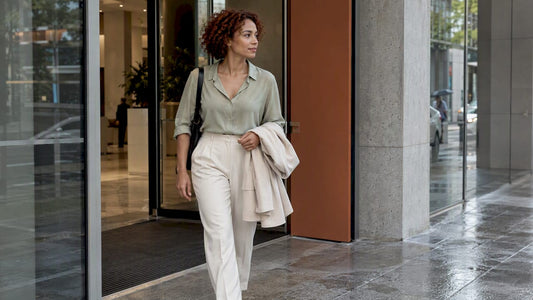

The best Brisbane summer workwear is lightweight, loosely cut and made from natural or naturally derived fibres, with one removable layer for the air-conditioning. Think a linen-blend blazer over a silk or cotton top, wide-leg trousers, or a midi dress, all in colours and cuts that stay composed at 4 pm in January. Below, we walk through the fabrics, silhouettes and outfit formulas that hold up in a subtropical summer, and how to keep the polish the office expects.
TL;DR
- Brisbane summers are hot and humid, so choose breathable natural fibres (linen, cotton, silk) or linen-viscose blends over tightly woven synthetics.
- A slightly looser cut usually feels better than a fitted one in the same fabric. Ease is also what reads as élégance.
- Build around one lightweight base outfit, then add a thin blazer, overshirt or cardigan for cold, air-conditioned rooms.
- A good test for any outfit: would it suit a client meeting? If yes, it is polished enough.
- Five or six considered pieces, mixed well, will carry you through the whole season.
Table of Contents
- What a Brisbane summer asks of your wardrobe
- Fabrics that keep you cool and composed
- Cut and silhouette: ease over tightness
- Six polished summer work outfits
- The air-conditioned office: dressing for two climates
- Shoes and accessories
- Keeping summer workwear fresh through the season
- Our perspective: a smaller, better summer wardrobe
- Build your summer work edit with Edito
- FAQ
- Sources
What a Brisbane summer asks of your wardrobe
Brisbane has a subtropical climate, and average summer temperatures from December to February run from a 21°C minimum to a 30°C maximum. The number on the forecast is only part of the story. Humidity is the real variable: afternoon humidity in January can exceed 70%, which can make a 30°C day feel like 35°C or more.
That changes how you shop for work. In a drier city you might choose a summer outfit for the temperature. Here you choose for how fabric behaves against skin when the air is already saturated: how quickly it releases moisture, whether it clings, whether it creases within the first hour of the commute.
The working day also has two climates. There is the walk from the car park, train or ferry, and there is the office, often cooled firmly. A summer work wardrobe in Brisbane is really a wardrobe for moving between the two, which is why the layering section below matters as much as the fabric one.
One practical note for anyone who works partly outdoors or on site: Queensland Health says sun protection is needed when the UV Index is 3 or above, and recommends loose-fitting, lightweight fabric with as much skin coverage as possible. Long, light sleeves and a hat are not a compromise on style. They are simply good dressing for this climate.
Fabrics that keep you cool and composed
Fabric does most of the work. Natural fibres such as linen, cotton, silk and hemp absorb sweat and let air through, and viscose, rayon, Modal, bamboo, Tencel and cupro also tend to be absorbent and breathable. The same ABC piece advises avoiding tightly woven synthetics such as polyester or nylon, which can trap sweat and leave you hotter.

Linen, and what to blend it with
Linen is the classic, and its tendency to crease is part of its character. For the office, though, many women prefer to soften it. Linen-rayon or linen-viscose blends absorb moisture and wrinkle less than linen on its own, which makes them a sensible choice for a blazer or trousers you need to wear from a morning meeting through to the evening.
If you want a deeper look at how fabric choices play out in an office setting, this summer office fabrics guide covers the common wardrobe mistakes. For our own take on linen tailoring, see our linen blazer outfits and six-piece capsule.
Silk, cotton and fine knits
Silk is often assumed to be a winter fabric, yet a lightweight silk or silk-blend blouse is one of the most comfortable options on a humid day, provided the cut is easy and the colour forgiving. Fine cotton poplin and voile offer a crisper finish for shirting. Both pair well with a trouser in a heavier linen blend, so the outfit has structure without weight.
For a wider guide to fabrics, colour and silhouette in humidity, our humid weather outfits guide goes further.
Colour matters too
When the heat is serious, ABC Emergency recommends light-coloured, loose-fitting clothing in natural fibres. Ivory, sand, soft blue, sage and pale stone all work for the office. If you prefer deeper tones, keep the fabric airy and the cut generous. We cover this in more detail in our notes on colour choices that keep you cool.
Cut and silhouette: ease over tightness
A fabric can be perfect and the garment still wrong if it fits like a second skin. In humid weather, a slightly looser cut often feels better than closely fitted clothing in the same fabric, because air can circulate between cloth and body.
This is also where European dressing has an advantage. The French and Belgian approach to the wardrobe favours aisance, a kind of ease that looks deliberate: a shoulder that is relaxed but defined, a trouser that falls rather than clings. Scanlan Theodore’s brand head Monique Santos told the Sydney Morning Herald that heat-friendly office dressing works best through effortless silhouettes and natural fibres rather than body-conscious construction.
A few cuts to look for:
- Button-front blouses. They let you adjust airflow, and a slight A-line cut or tie waist gives room to move without looking shapeless.
- Wide-leg or straight trousers with a relaxed rise, which move air around the legs.
- Midi dresses with a defined waist or a gentle drape, never clinging at the hip.
- Unstructured jackets with no heavy lining or shoulder padding.
Our guide to getting the silhouette right without looking shapeless explains how to keep volume looking intentional.
Six polished summer work outfits
The Guardian’s Australian office-style advice describes the target as “polished but easy”, and recruitment specialist Nicholas Cox suggests a client-meeting standard: no gymwear, thongs, see-through fabric or excessively short hems. It is a useful filter when you are standing in front of the wardrobe at 7 am. Here are six formulas that meet it.
- The midi dress and flats. A lightweight midi dress, flat shoes and a blazer you can remove. One decision, finished look. Browse our dresses.
- Wide-leg trousers and a breathable blouse. Lightweight trousers with a breathable blouse are a dependable pairing. Choose a button-front blouse and tuck it loosely. See our pants and tops.
- The tailored co-ordinate. Australian designers recommend tailored co-ordinated sets alongside linen, cotton or silk shirting. A matching trouser and jacket in a linen blend is a wardrobe workhorse, because each piece also works on its own.
- Midi slip or tailored maxi skirt with a tank. Vogue Australia suggests a midi slip or tailored maxi skirt, with chic tanks or breezy button-ups layered under light jackets. Add a fine cotton shirt over the top if the office is formal.
- Tailored shorts, if your office allows. The same Vogue piece says tailored, properly hemmed shorts can work depending on the workplace, worn with a belt and sandals or mules. Treat this as a Friday option rather than a default, and read your office’s unwritten code first.
- Linen trousers, relaxed. Linen trousers with a crisp shirt and a loafer or flat. We have gathered ten linen pants outfits if you want variations.
The same capsule logic applies from the desk to the evening. Many of these pieces move naturally into Brisbane dinner outfits with a change of shoes and jewellery.
The air-conditioned office: dressing for two climates
The solution is simple, and it is the part most summer wardrobes miss: a lightweight base outfit plus one very light cardigan, overshirt or unstructured blazer for the air-conditioned office. Dress for the hottest part of the day, then add warmth indoors.
This is not only a style tip. SafeWork NSW treats clothing as a thermal-comfort control: workers should be able to add or remove layers, and employers can allow reasonable variations such as a personal cardigan or jacket. That guidance comes from New South Wales, but the principle holds anywhere an office is cooled well below the outdoor temperature.
Some ways to make the extra layer earn its place:
- Keep it in a natural or semi-natural fibre so it does not trap heat when you step outside.
- Choose a colour that works with most of your base outfits, so one layer serves all week.
- Fine-gauge knitwear folds small and travels well in a tote.
Our note on layering and accessories for moving between outdoors and air-conditioning goes into more detail.
Shoes and accessories
Footwear is where a summer outfit is either finished or undone. Vogue Australia’s advice is simple: flats or heels, with sandals or mules for tailored shorts, and Mary Jane flats among its picks. For a smart-casual office, SEEK’s guide lists loafers, flats, low heels and minimal sneakers as suitable options, and notes that shorter hems or denim depend on local workplace expectations.
Brisbane adds two practical points. Summer storms arrive quickly, so choose walkable shoes and keep one pair that tolerates getting wet. And in closed shoes, socks matter: BlueCare’s heat safety guidance says merino or bamboo socks are better than cotton, which can hold moisture.

For the finishing touches, Vogue suggests statement jewellery, a belt or a sizeable tote. A tote is particularly useful in summer: it carries the spare layer, the water bottle and the commute shoes. Explore our accessories for belts, jewellery and scarves that sharpen a simple outfit.
Keeping summer workwear fresh through the season
A summer wardrobe is worn hard, often on repeat, so what you buy should suit your routine. SEEK’s advice is to choose quality fabrics such as linen, cotton or silk, keep them wrinkle-free and look for care instructions that fit your routine.
In practice, that means reading the care label before you buy, not after. If you will never hand-wash a silk blouse, choose a washable silk blend or a fine cotton instead. Rotate pieces so none is worn on consecutive days, let garments air before the next wear, and always follow the maker’s label.
Our perspective: a smaller, better summer wardrobe
At Edito, we approach work dressing in a hot climate as an exercise in editing. The instinct in summer is often to buy many inexpensive pieces, wear them a handful of times, and find they have lost their shape by February. We prefer the opposite: a few garments with good fabric, honest construction and a cut that flatters without effort.
The European labels we select, among them Sœur, Sessùn, BA&SH and Vanessa Bruno from France, Sita Murt from Spain and Essentiel Antwerp from Belgium, share a philosophy of savoir-faire and wearability rather than seasonal novelty. That sensibility suits Brisbane well, because ease is not the enemy of polish here, it is the condition for it.
Our advice is to start with one linen-blend jacket, one pair of relaxed trousers and one dress that you reach for without thinking. Add silk or cotton tops in two or three light colours, a pair of flats you can walk in, and a tote. Everything should work with at least three other things. A wardrobe built that way gets easier each week, not harder.
— Mickael Martin
Build your summer work edit with Edito
If you would like to start with pieces designed for ease and longevity, our curated edit of French and European designer fashion is shipped Australia-wide from Brisbane, and you are welcome to visit the boutique to try things on in person. Begin with our clothing collection, or go straight to dresses and pants.

For a longer read on assembling a capsule for humid weather, see our humid weather capsule from Edito’s edit.
FAQ
What should I wear to work in Brisbane in summer?
Choose breathable fabrics such as linen blends, cotton and silk in a relaxed cut, and dress for the hottest part of the day. A midi dress, or wide-leg trousers with a button-front blouse, are reliable starting points. Keep a light blazer or cardigan at work for the air-conditioning.
Can I wear shorts to the office in summer?
It depends on your workplace. Vogue Australia says tailored, properly hemmed shorts can work in some offices, worn with a belt and sandals or mules. If you are unsure, check the dress code or follow what senior colleagues wear, and use the client-meeting test as a guide.
Is linen too creased for the office?
Not necessarily. A linen-viscose or linen-rayon blend wrinkles less than pure linen while still absorbing moisture. A little softness in linen is accepted in most offices, particularly when the cut is tailored and the shoes and accessories are neat.
How do I stay comfortable in a cold, air-conditioned office?
Wear a lightweight base outfit and keep one thin layer at your desk, such as an unstructured blazer, overshirt or fine cardigan. Pick a natural fibre so it does not overheat you on the walk in. Choose a neutral colour so it works with several outfits.
Which colours are best for Brisbane summer workwear?
Light colours are the most comfortable in strong heat, and official heatwave advice recommends light-coloured, loose-fitting clothing. Ivory, sand, soft blue and sage all look polished at work. Darker tones can work if the fabric is airy and the cut is generous.
Sources
- Tips and FAQs, Visit Brisbane
- Sydney vs Brisbane Weather comparison, StudyAU
- Sun safety in outdoor settings, Queensland Health
- Five ways to avoid sweating through your clothes, ABC News
- Fabrics that minimise sweat and body odour, ABC News
- Staying well during a heatwave, ABC Emergency
- Summer workwear trends, Sydney Morning Herald
- How to Choose the Right Women’s Blouse Tops, Norvadel
- Polished but easy: how to dress for the office, The Guardian
- What to Wear in Brisbane in Summer, WhatToWear
- Summer Work Outfit Ideas, Vogue Australia
- Maintaining thermal comfort in indoor work environments, SafeWork NSW
- Your complete guide to smart casual work attire, SEEK
- Heat safety: the best clothing for hot weather, BlueCare
- Summer office fabrics guide