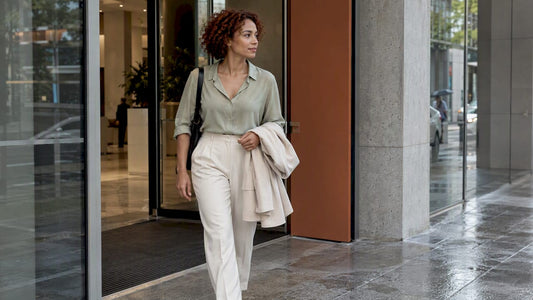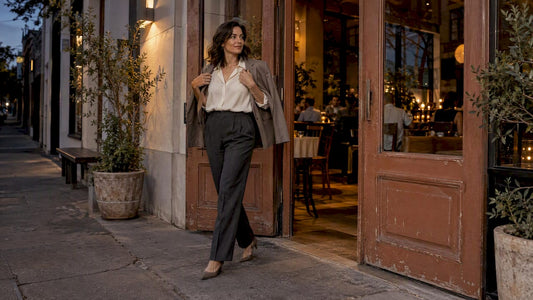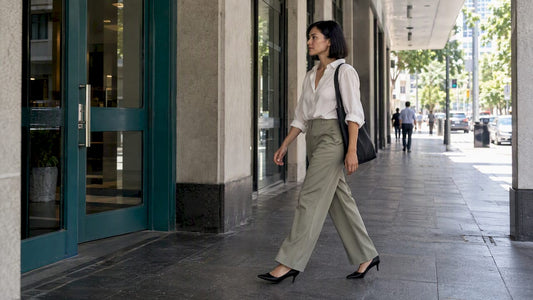

In Brisbane’s humidity, wear loose, lightweight clothes in breathable natural or plant-based fibres such as linen, cotton and cupro, in light colours, with a cut that skims the body rather than clinging to it. Add a hat and sun protection, shoes you can walk in, and one light layer for the air-conditioning. That is the whole formula. The art lies in making it look considered, and that is where European tailoring and fabric knowledge earn their place.
TL;DR
- Humidity is highest from January to March, when Brisbane averages around 65 to 70%, so build your wardrobe around fabric and fit rather than around temperature alone.
- Choose linen, cotton, silk, cupro, Tencel or lightweight viscose, and avoid dense synthetics and tight cuts.
- Light colours and relaxed silhouettes (a shirt dress, wide-leg trousers, a loose midi) feel cooler and look more composed.
- Sun protection is a daily matter in Queensland, so a wide-brimmed hat and closely woven cover are part of the outfit.
- Carry one light layer, because Brisbane interiors are often cold compared with the street.
Table of Contents
- How humid does Brisbane actually get?
- Fabrics that work, and the ones that do not
- Fit and silhouette: ease without looking shapeless
- Colour: lighter is cooler, with one exception
- Sun, rain and the Brisbane afternoon
- The air-conditioning problem
- Footwear and accessories
- Three humid-day outfits, worked through
- What about October and the shoulder months?
- Our view: dress for the climate, not against it
- Shop the humid-weather edit
- FAQ
- Sources
How humid does Brisbane actually get?
Very, for part of the year. Tourism Australia puts average humidity at around 65 to 70% in January, February and March, against about 50% in winter. February is the most humid month and September the least. If you have lived here for a while, you will know that the number alone understates it: it is the combination of warmth, moisture and little breeze that makes a walk from the car to the office feel like an event.

There is a physical reason clothing matters so much. Metro North Health explains that humidity makes it harder for the body to cool itself, and that clothing which impairs sweat evaporation raises the risk of heat-related illness. Breathable garments and moving air are not merely a comfort preference. They are the practical basis of dressing well in this climate.
Temperature gives context too. According to Visit Brisbane, summer (December to February) averages run from 21°C to 30°C, and winter (June to August) from 10°C to 21°C. The humid months are therefore also the warm ones, and the wardrobe that serves them is quite different from the one you reach for in July.
Fabrics that work, and the ones that do not
Fabric decides more than any other single choice. Fashion and textiles experts quoted by ABC News recommend linen, cotton, silk or hemp, and also absorbent, breathable regenerated fibres such as viscose, rayon, Modal, bamboo, Tencel and cupro. The same piece suggests looking for fabrics that let air through and steering away from tightly woven synthetics.
Linen and its blends
Linen remains the classic answer, and for good reason. ABC News, citing an RMIT senior lecturer, notes that cotton and linen absorb moisture and are generally less odorous than synthetics. Its weakness is creasing, which is why linen blended with viscose or rayon is often a smarter buy: the same article notes these blends keep their absorbency while wrinkling less. A blend can also give a shirt or trouser a little more shape, which matters if you are dressing for work.
Cotton, with a caveat
Cotton is excellent when it is thin. The same RMIT expert, in a December 2025 ABC guide to summer fabrics, says lighter cotton lets sweat disperse and air pass more readily, but that once saturated it can become heavy and wet. So a fine poplin or voile blouse suits a humid afternoon far better than a thick jersey tee.
Silk, cupro and fluid viscose
These fabrics drape rather than cling, which in humidity is half the battle. A cupro or viscose dress moves with the air around it. Silk is lovely but marks with perspiration, so it suits air-conditioned evenings better than a long outdoor day.
Synthetics: not an automatic no
The ABC reports on fabrics that minimise sweat and odour that polyester and polyester blends can feel sweatier and smellier, citing University of Otago research in which polyester rated highest for odour among the fabrics tested. Yet the RMIT experts in the earlier piece make a fair point: comfort depends on moisture behaviour and construction, not simply on whether a fibre is natural. Thick or tightly woven cloth traps heat in any fibre, and polyester can work well in breathable knitted activewear. For everyday dressing, though, a dense woven polyester blouse is the item to leave on the hanger.
A quick test before you buy: hold the fabric up to the light. If you can see the weave and feel air pass through it, it is likely to be comfortable. Weight, weave and lining count as much as the fibre name on the label.

Fit and silhouette: ease without looking shapeless
The ABC’s advice is to choose relaxed or even oversized cuts, flowy dresses, loose T-shirts and skirts, and to avoid tight bodycon outfits and skinny jeans. Outdoor-clothing specialists at REI put it neatly: in humidity, clothing should hang slightly away from the body, and lightweight woven or textured fabrics and looser fits reduce cling.
The risk, of course, is looking as though you have given up. This is where the French and European approach is instructive. The principle is l’aisance, ease with intention: one generous element balanced by one precise one. A voluminous linen shirt over a slim, cropped trouser. A fluid midi dress with a defined shoulder or a neat collar. Wide-leg pants with a fitted, fine knit tank. The eye reads shape, and the body gets its air.
Some proportions that work in Brisbane’s heat:
- Shirt dress or shift dress. Falls from the shoulder, needs no waistband, and works from a morning meeting to a late lunch.
- Wide-leg or straight trouser in a light weave. Air circulates around the legs, and the line is more elegant than a short skirt that rides up in the heat.
- Breezy blouse with sleeves. A sleeve that stands away from the arm is cooler than a clinging sleeveless knit, and it covers your shoulders from the sun.
- Midi skirt in a fluid fabric. Keep the hem clear of the ground, since a very long hem soon gets wet in a sudden downpour.
Colour: lighter is cooler, with one exception
Both Queensland Health’s heat advice and ABC Emergency recommend light-coloured, loose clothing made from natural fibres in hot weather. Ecru, chalk, sand, soft sage, pale blue and stone all read as cool and as quietly sophisticated. They also show a very French restraint: a tonal palette looks expensive.
The practical catch is that pale shades show perspiration marks and can be sheer. Choose a lining or a thicker weave in white, and consider mid-tones, such as dusty blue or soft terracotta, when you will be on your feet all day. Print is a useful ally here, since a small-scale pattern or a painterly floral hides creases and moisture far better than a plain pastel.
There is one exception, and it concerns the sun rather than the heat. Cancer Council Australia says that when a garment has no UPF label, lightweight, closely woven, dark-coloured clothing offers better protection, with long sleeves and collars preferred for coverage. So for a long day outdoors, the answer may be a closely woven mid-tone shirt instead of a gauzy white one. Know which job the outfit has to do.
Sun, rain and the Brisbane afternoon
Queensland dressing is sun-aware dressing. Queensland Health states that sun protection is needed when the UV Index is 3 or above, and that in Queensland this occurs year-round, winter included. Cancer Council Australia recommends combining clothing, sunscreen, a broad-brimmed hat, shade and sunglasses, and describes UPF 50 or higher as excellent protection, blocking at least 98% of UV. Visit Brisbane suggests a shirt, hat, sunglasses and SPF30+ sunscreen, reapplied through a full outdoor day, and staying out of the midday sun when possible.
In practice, that means:
- A wide-brimmed hat in a natural straw or soft cotton, which works with almost any outfit.
- Sleeves, even short ones, and a collar that can be turned up on a shirt.
- Sunglasses with proper UV protection.
- Sunscreen applied before you dress, not after.
Summer storms arrive quickly. Rather than a heavy raincoat, which is miserable in humid heat, carry a compact umbrella and wear shoes that tolerate a wet footpath. A light, packable shell is worth it only when the forecast warrants it.
The air-conditioning problem
It is a peculiarly Brisbane experience: you leave a warm, sticky street and walk into a cold office, cinema or restaurant. This is why one light layer is part of every humid-weather outfit. A fine cotton cardigan, a linen overshirt or an unstructured blazer weighs almost nothing in a tote bag and rescues a sleeveless dress in a chilly venue. It also gives a casual look a more polished finish, which is useful for the CBD or an evening along the river.
The rule is a layer that is as breathable as the garment beneath it. A heavy knit worn indoors for twenty minutes then carried through the heat is a poor trade. Think fine-gauge, open weave, and natural fibre.
Footwear and accessories
Walk first, look second. In a city of footpaths, ferry terminals and riverside paths, a comfortable flat sandal, a loafer, a leather slide or a clean, low sneaker will serve you for hours. Leather and other breathable uppers are preferable to closed synthetic ones, and a pair that tolerates a wet pavement is wise through the storm season.
Bags should be light and secure: an unlined leather or woven tote, or a small crossbody that sits flat against the body. Heavy hardware and structured bags become uncomfortable quickly in the heat. Keep jewellery minimal. Fine metal can feel hot against the skin, and a single considered piece reads as more elegant anyway.
If your hair is part of the battle, as it is for many of us in humidity, there are some useful summer favourites for curly hair to consider. A loose twist, low knot or soft plait also keeps the neck cool and goes well with a collared shirt.
Three humid-day outfits, worked through
The working day in the CBD. A shirt dress in a linen-cotton or viscose blend, a fine cardigan over the arm, flat loafers or leather sandals, and a roomy tote. The dress needs no styling, and the cardigan manages the lift lobby and the meeting room.
Lunch along the river. Wide-leg trousers in a pale, light weave with a crisp, loose cotton blouse, a straw hat and flat sandals. Tuck the blouse only at the front if you want shape.
An evening out. A fluid midi in cupro or viscose, perhaps with a printed pattern, with a light wrap for the air-conditioning and an easy block heel or slide. Nothing clings, and nothing needs adjusting all night.
If you want to see more outfits assembled along these lines, our guide to humid weather outfits walks through eight of them, and the section on which fabrics actually work in humidity goes further on cloth.
What about October and the shoulder months?
Spring in Brisbane can fool you. The Bureau of Meteorology’s Brisbane climate averages give a mean October maximum of 25.6°C and minimum of 16.0°C, with about 80.6 mm of rain across the month. But an individual month can differ markedly: the Bureau recorded a mean maximum of 29.4°C and 107.2 mm of rain in October 2025. So October dressing means the summer formula with a safety margin: breathable fabrics, one light layer for cooler mornings and evenings, and an umbrella in the bag.
September is the least humid month, which makes it the season for leaning on cotton knitwear and light trousers, while the stickier months from January through March call for the lightest weaves you own.
Our view: dress for the climate, not against it
We have never believed that dressing for heat means dressing down. The European houses we choose to stock were designed for warm summers around the Mediterranean and beyond, and the best of them share a certain savoir-faire: they treat fabric weight, cut and proportion as the foundation of ease. A well-made linen blend or a fluid viscose dress does the cooling work quietly, and leaves you free to look like yourself.
Our advice to Brisbane women is to buy fewer, better pieces designed for this climate. One excellent shirt dress will be worn weekly from October to April. A pair of wide-leg trousers in a breathable weave replaces three pairs of ill-suited ones. And a light layer that goes with everything means you will never again shiver through a lunch.
When we edit a collection, we look at hand-feel, drape and construction as closely as we do at the name on the label, and we describe each house according to its actual heritage: Sœur, Sessùn, BA&SH and Vanessa Bruno are French, Sita Murt is Spanish, and Essentiel Antwerp is Belgian. That nuance is part of the pleasure. Different traditions solve the problem of heat in different ways.
— Mickael Martin
Shop the humid-weather edit
If you are building a wardrobe for Brisbane’s warm months, begin with the pieces that do the most work. Our dresses offer easy shapes that need no styling, our tops include blouses and shirts for pairing with light trousers, and our pants are where to look for the relaxed, wide leg that moves with the air. We ship across Australia, and you can also visit us in our Brisbane boutique to feel the fabrics for yourself.

For a wider view, browse the full clothing collection or our accessories, and read how we approach a humid weather capsule built from a handful of pieces.
FAQ
Does it get humid in Brisbane?
Yes. Tourism Australia reports average humidity of around 65 to 70% from January to March, compared with about 50% in winter. February is the most humid month, and September the least.
What is the best fabric to wear in Brisbane humidity?
Linen, lightweight cotton, silk and breathable regenerated fibres such as cupro, Tencel and viscose are the usual recommendations. Linen blended with viscose or rayon wrinkles less while staying absorbent. Avoid dense, tightly woven synthetics, which trap heat.
Should I wear light or dark colours in Brisbane’s humidity?
Light colours feel cooler and are recommended for hot weather by Queensland and ABC Emergency guidance. For long hours in strong UV, Cancer Council notes that closely woven, dark-coloured clothing protects well when a garment has no UPF label, so choose according to how long you will be outdoors.
What should I wear in Brisbane in October?
Think of it as early summer. The long-term mean is about 25.6°C for the maximum, though some Octobers run much warmer and wetter. Wear breathable fabrics, carry a light layer for mornings and air-conditioning, and keep an umbrella handy.
Do I need a jacket in Brisbane in summer?
Not for the weather, but a very light cardigan, overshirt or blazer is useful for heavily air-conditioned offices, restaurants and cinemas. Choose a breathable fabric so that carrying it outdoors is not a burden.
Sources
- Weather in Brisbane, Tourism Australia
- Heatwave workplace guide, Metro North Health
- Tips and FAQs, Visit Brisbane
- Five ways to avoid sweating through your clothes, ABC News
- Fabrics that minimise sweat and body odour, ABC News
- Best fabrics and fibres for summer, ABC News
- How to dress for humidity, REI
- How to keep cool and stay hydrated, Queensland Government
- Staying well during a heatwave, ABC Emergency
- Sun protection, Cancer Council Australia
- Sun safety in outdoor settings, Queensland Health
- Brisbane climate statistics, Bureau of Meteorology
- Brisbane in October 2025, Bureau of Meteorology
- Summer favourites for curly hair