
The most breathable summer wardrobe in Brisbane is built on loose, lightly woven pieces in natural fibres such as linen and cotton, cut to let air move around the body, in colours and weaves that also respect the sun. Humidity, more than raw temperature, is what makes the city’s summers demanding, so the fibre, the weave and the silhouette all matter together. Below we explain how to read each of them, and how to keep an outfit looking composed when the air is heavy.
TL;DR
- Brisbane summer (December to February) is warm, humid and wet, so choose fabrics that let air through and cope with sweat: linen, cotton, and well-made lightweight blends.
- Cut matters as much as fibre. Loose, unstructured shapes such as shift dresses, wide-leg pants and relaxed shirts keep air circulating.
- Very sheer, loosely woven cloth offers less sun protection, so look for a tight weave, add a hat and sunglasses, and treat a light overshirt as a sun layer.
- Check the composition label before buying: fibre content tells you more than the word “summer” on a product title.
- Build around a few considered pieces, then add one light layer for air-conditioned offices and restaurants.
Table of Contents
- What Brisbane summer actually asks of your clothes
- Choosing the fibre: linen, cotton and the rest
- Cut and silhouette: how air moves
- Weave, colour and the sun
- Polished and cool: outfits for Brisbane days
- Reading a product page before you buy
- Our perspective: ease is a form of élégance
- Shop the breathable edit
- Building a small, hardworking summer capsule
- Caring for breathable fabrics through a humid season
- FAQ
- Sources
What Brisbane summer actually asks of your clothes
Brisbane’s summer runs from December to February, with average temperatures of 21 to 29.8°C, and it is also the city’s wettest season, averaging 426.6 mm of rain, according to Tourism Australia. The same source puts average humidity at 65 to 70 per cent across January, February and March, with February the most humid month on average.
That combination explains why a dress that feels cool in a dry climate can feel clinging here. When the air is already saturated, sweat evaporates slowly, so the fabric next to your skin has to do some of the work: absorb moisture, release it, and not cling. Brisbane’s climate is often described as humid subtropical, meaning warm to hot, muggy and wet summers, a description echoed in Virgin Australia’s destination guide.
For the wardrobe, this sets out three practical questions:
- Does the fibre breathe and handle moisture?
- Is the shape loose enough to move air?
- Does the outfit still protect you from the sun and still look intentional after a day of heat, a sudden storm and an over-cooled office?
Choosing the fibre: linen, cotton and the rest
The fibre is the starting point, though not the whole story. ABC’s guide to the best summer fibres and fabrics is a useful reference, and its main findings are summarised here alongside how we think about them when we choose pieces.
Linen
Linen is highly breathable, and it typically costs more than other plant-based fibres, according to the same ABC guide. That is a fair reflection of how we see it: a well-made linen piece is something you wear for many summers, and its natural crumple is part of its allure. In the savoir-faire of European tailoring, linen is rarely pressed into perfection. The relaxed texture is the point, and it reads as ease rather than neglect.

If you dislike creasing, look for linen in a looser cut or a blend, and choose a mid-weight cloth over a very fine one, which tends to crease more visibly and may be more transparent.
Cotton
Cotton is hydrophilic and breathable. It absorbs sweat from the skin, which helps cool the body, though it can become heavy and slow to dry once it is fully saturated, per the ABC guide. In practice, that makes cotton an excellent choice for a day that is hot but not drenched, and a good reason to pick a poplin shirt or a cotton-blend top with some structure that lifts away from the body rather than a close-fitting jersey.
Viscose and other lightweight fabrics
Viscose is lightweight and moisture-wicking, but it can shrink, wrinkle and weaken when wet, according to the same source. Fluid viscose dresses are lovely in motion, so the sensible approach is to follow the care label closely and avoid wearing them on days when you expect to be caught in a downpour. Polyester can be engineered into thin, quick-drying fabrics, but may hold odours, which is worth remembering for pieces worn close to the skin.

Wool and silk
It surprises many readers, but wool can absorb water without feeling wet and is also highly breathable, per ABC. We would not suggest a heavy knit in January, but it is a reminder that fibre behaviour is more nuanced than “natural equals cool”. Silk is also named among suitable fibres in BlueCare’s heat safety advice, alongside cotton and linen, because loose-fitting clothes in these fibres allow air to circulate and sweat to evaporate.
A quick comparison
| Fibre | Breathability | Worth knowing | Best suited to |
|---|---|---|---|
| Linen | Highly breathable | Typically costs more than other plant fibres; creases naturally | Shirts, wide-leg pants, relaxed dresses |
| Cotton | Breathable, absorbs sweat | Heavy and slow to dry when saturated | Poplin shirts, tops, shift dresses |
| Viscose | Lightweight, moisture-wicking | Can shrink, wrinkle and weaken when wet | Fluid dresses and blouses for dry days |
| Polyester (thin weaves) | Quick-drying when lightweight | Can hold odours | Occasional layering pieces |
| Wool (fine) | Highly breathable | Absorbs water without feeling wet | Light cover-ups on cooler evenings |
Source for the table: ABC, A quick guide to the best fabrics and fibres for summer.
Cut and silhouette: how air moves
A breathable fabric in a tight cut is a missed opportunity. Health guidance for hot weather consistently points the same way: for severe heatwave conditions, Metro North Health advises lightweight, loose clothing made of breathable fabric such as cotton or linen.
Translated into a wardrobe, that looks like this:
- The shift or relaxed midi dress. It skims rather than clings, which leaves a channel of air between fabric and skin. Our dresses collection is where we start for this shape, and the Blue Crush Shift Dress in Yamba is one example of the easy, unfitted line we mean.
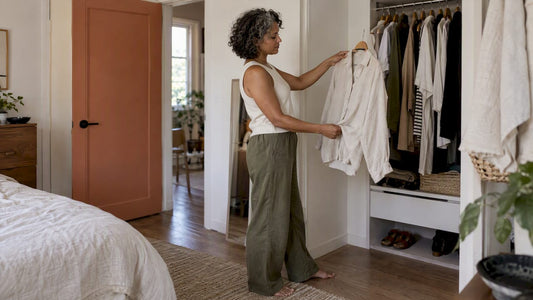
- Wide-leg and straight pants. Volume at the leg keeps fabric away from the skin. Browse the pants for lengths that stop at or just above the ankle, which suit sandals and flats.
- The open-neck shirt or blouse. A relaxed shoulder, sleeves that can be pushed up, and a hem you can wear out or tucked. See tops.
- Sleeve and neckline choices. A short or three-quarter sleeve can protect your shoulders while keeping the underarm open, which is where most heat accumulates.
The principle is simple: ease in the garment, structure in the details. A clean collar, a good button, a precise hem, and the loose cut looks designed rather than casual.
Weave, colour and the sun
Breathability and sun protection can pull in different directions, and it helps to know where. According to ABC’s guide, quoting Dr Van Amber, the best UV protection comes from looser-fitting, darker-coloured, tightly woven fabrics, though darker colours can feel warmer. Lightweight or loosely woven fabrics may also be more transparent and offer less UV protection.
For most women this settles into a sensible compromise:
- Choose tightly woven cloth over gauzy cloth when you will be outdoors for long. Hold a garment up to the light in the fitting room: if you can see through it clearly, the sun can too.
- Mid-tones can be a good middle ground. Very pale shades look cool and reflect heat, while very dark shades protect more but can feel warmer. Neither extreme is a rule, and you can mix them across an outfit.
- Cover where it counts. A long-sleeved, loose linen overshirt worn open over a sleeveless top gives shade to the shoulders and arms, and comes off in seconds.
- Finish with accessories. A wide-brim hat and good sunglasses do more for comfort on a bright day than most fabric choices. If you travel across the region or just want a pair that folds into a handbag, packable UV400 sunglasses are worth a look. Our own accessories edit covers the rest of the finishing touches.
The point is not to give up the lightest pieces, which have their place at dusk, but to be deliberate about which garment you wear for which hour.
Polished and cool: outfits for Brisbane days
Brisbane dresses for the climate more casually than many other cities, but a composed look is easy to achieve when the pieces are right. Here are combinations built on breathable principles.
The working day
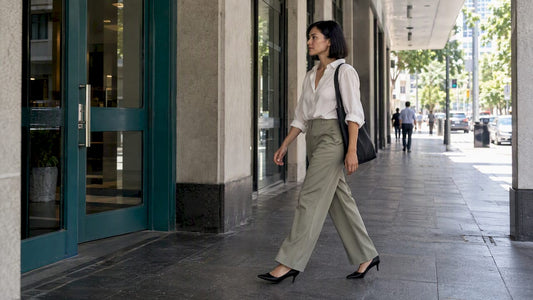
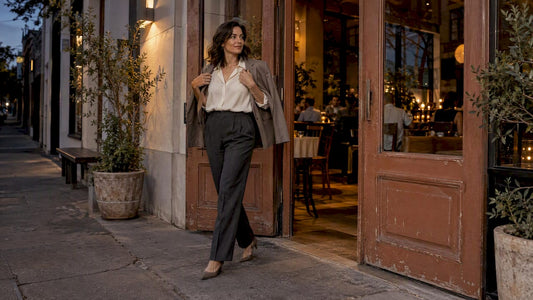
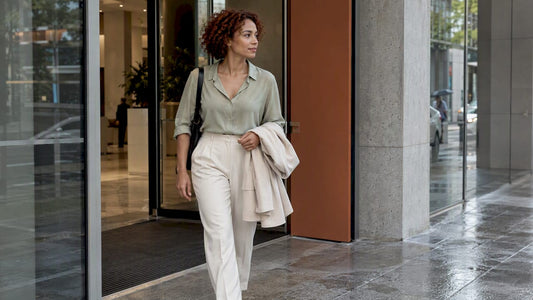
A relaxed shirt in cotton or linen, lightweight straight-leg pants and flat leather sandals or loafers. Offices and meeting rooms here are often strongly air-conditioned, so a light, unstructured layer is useful: an unstructured blazer, a fine cardigan or an overshirt gives you cover without building the outfit around heavy outerwear. We cover this in more detail in our guide to Brisbane summer office outfits.
Lunch and the weekend
A loose midi dress with supportive sandals or clean sneakers. Add a woven bag and a hat and you are ready for a long lunch by the river or a walk through the farmers’ market. The structure comes from the accessories, which frees the dress to be as airy as you like.
Evening, outdoors
Warm nights can stay humid well after sunset. A silk or fine viscose top with wide-leg pants, or a sleeveless dress with a pared-back sandal, keeps you cool without looking underdressed. If a storm rolls in, which happens often given summer is the city’s wettest season, shoes that tolerate wet pavement are far more useful than a heavy raincoat, which can make you hot in humid weather. Carry a compact umbrella instead.
Occasions and events
For weddings, races and long summer lunches, choose fabrics that hold their shape and a silhouette with room to move. Lined linen or a crisp cotton blend can look elegant and still breathe. For a broader planning tool, our 12-piece Australian summer wardrobe shows how to cover day, beach and evening without overpacking, and our practical guide to what to wear in Brisbane summer goes deeper into the season month by month.
Reading a product page before you buy
Online shopping in summer comes down to detail. Before adding anything to your cart, check these:
- Composition. Look for the fibre percentages. A garment made predominantly of linen, cotton or another breathable fibre will behave differently from one dominated by synthetics.
- Weight and weave. Words such as “fluid”, “crisp”, “gauze” or “poplin” tell you how the cloth falls and how see-through it may be.
- Lining. A lining in a light colour can add opacity without much heat. A heavy lining will undo the benefit of a breathable outer fabric.
- Cut and measurements. If a size guide is offered, compare it with a piece you already own and love in the heat. Ease at the bust, waist and hip is what you are looking for.
- Care. Viscose, linen and silk each have their own requirements, so a quick look at the care label tells you whether the piece suits your routine.
- Colour. If you often stand in direct sun, factor in the weave and shade choices above.
This sort of reading is part of how we select for the boutique: a considered edit favours quality of cloth and construction over volume. If you are unsure about a piece, ask us before you buy.
Our perspective: ease is a form of élégance
At Edito, we have always believed that dressing for heat is a question of philosophy as much as fabric. The European labels we stock approach summer with restraint: a clean line, a considered cloth, a proportion that lets the body move. Brands such as Sœur, Sessùn, BA&SH and Vanessa Bruno are French, Sita Murt is Spanish, and Essentiel Antwerp is Belgian, and what draws us to each is a shared respect for craftsmanship and for pieces that are worn often rather than once.
Brisbane summer asks something particular of a wardrobe. It rewards the woman who chooses a few excellent pieces over many forgettable ones: a relaxed shirt that improves with wear, a shift dress that needs no adjusting, wide-leg pants that make a heatwave feel manageable. Our edit is designed with that in mind, and we pair it with styling advice shaped by Australian seasons rather than northern-hemisphere calendars.
When we talk with customers in our Brisbane boutique or online, the question is rarely “what is trending?”. It is “what will I actually reach for on a humid Tuesday?”. Our answer is almost always the same: choose the fabric for how it feels, the cut for how it moves, and the label for how it is made. Everything else follows.
Mickael Martin
Shop the breathable edit
If you are ready to build your summer wardrobe, we have gathered European designer pieces for women across Australia, with the focus on quality, craftsmanship and wearability. Start with dresses for the easiest one-piece outfit, then add tops and pants to mix and match.

You can browse the full clothing collection online, or visit us in Brisbane to feel the fabrics in person. Every product page lists the details you need to judge a piece for the heat.
Building a small, hardworking summer capsule
Breathable dressing is easier with fewer, better pieces that work together. A practical starting point for a Brisbane summer:
- Two dresses: one relaxed and casual, one a little more polished for evenings and occasions.
- Two shirts or blouses: one in a crisp natural fibre, one fluid for dressier settings.
- Two bottoms: wide-leg or straight pants, plus a skirt or tailored shorts.
- One light layer: an overshirt, fine cardigan or unstructured blazer for air-conditioning and sun cover.
- Footwear: a flat sandal, a supportive walking option and a pair of shoes that copes with wet pavement.
- Sun accessories: a wide-brim hat and sunglasses, as discussed above.
This is a shape rather than a prescription, and it flexes with your own routine. Our Australian summer wardrobe guide lays out a fuller capsule with day, beach and evening in mind, and our piece on styling a European summer wardrobe explains how the same principles travel.
Caring for breathable fabrics through a humid season
Humidity is hard on clothes as well as on people. A few habits help your pieces last:
- Let garments dry fully before storing them. Cotton can be slow to dry when saturated, so give it time and air.
- Follow the label for viscose. Because it can shrink, wrinkle and weaken when wet, gentle washing and careful drying matter.
- Air linen between wears. A breathable fibre often needs a rest and a hang in fresh air rather than a full wash each time.
- Hang clothes with space between them. In a humid climate, good air circulation in the wardrobe helps keep fabrics fresh.
These habits protect the investment and keep your best pieces ready for the next heatwave.
FAQ
What is the most breathable fabric for a Brisbane summer?
Linen is highly breathable, and cotton is also breathable and absorbs sweat, according to ABC’s fabric guide. For severe heat, Metro North Health recommends lightweight, loose clothing in breathable fabrics such as cotton or linen. Pair the fibre with a loose cut for the best effect.
Is linen too creased for the office?
Not if you choose well. A mid-weight linen, a linen blend or a relaxed cut will crease softly and look intentional, especially with tailored details such as a clean collar or a crisp hem. Layering an unstructured blazer over it adds polish for meetings.
Do darker colours make you hotter in summer?
They can feel warmer, but ABC’s guide notes that darker, tightly woven fabrics also give better UV protection than light, porous ones. A mid-tone in a tight weave, worn loosely, is a reasonable compromise for long days outdoors.
Can I wear viscose in Brisbane’s humidity?
Yes, with care. Viscose is lightweight and moisture-wicking, but it can shrink, wrinkle and weaken when wet, so follow the care label and save it for dry days or evenings rather than rainy commutes.
What should I wear when a summer storm hits?
Choose shoes that cope with wet pavement and carry a compact umbrella. A heavy raincoat can make you hot in humid weather, so a light layer and an umbrella are usually more comfortable.
Sources
- Weather in Brisbane, Tourism Australia
- Brisbane climate and weather guide by season and month, Virgin Australia
- A quick guide to the best fabrics and fibres for summer, ABC News
- Taking care of yourself in severe weather conditions, Metro North Health
- Heat safety: the best clothing for hot weather, BlueCare