
Brisbane summer asks for light, breathable clothes in natural or fluid fabrics, a slightly relaxed cut, real sun cover and one thin layer for air-conditioning and sudden storms. Get those four things right and everything else is a matter of taste: a linen shirt with tailored shorts by day, a midi dress with flat sandals at night, and nothing that clings when the humidity climbs.
We are based in Brisbane, and we dress women across Australia in European designer fashion. What follows is the way we think about the season: practical first, then polished.
TL;DR
- Choose linen, lightweight cotton, viscose and other fluid wovens, and cut them a little looser than you would in a drier climate.
- Treat sun protection as part of the outfit: a collared long-sleeved shirt, a broad-brimmed hat and sunglasses do more than any accessory.
- Pack for three settings in one day: the heat outside, the cold of air-conditioning and the odd downpour.
- Build around a small group of pieces that mix: one shirt, one pair of shorts, one dress, one pair of trousers, one sandal.
- Dress up by changing the top and the shoe, not by adding more fabric.
Table of Contents
- What Brisbane summer actually feels like
- Fabrics that work in heat and humidity
- Sun protection is part of the outfit
- Outfits for the day, the evening and the water
- Layers for storms and air-conditioning
- Shoes, bags and the small things
- A twelve-piece starting point
- Our perspective: ease is a form of élégance
- Shop the Brisbane summer edit
- FAQ
- Sources
What Brisbane summer actually feels like
Brisbane has a subtropical climate. Tourism Australia puts summer (December to February) at averages of 21 to 29.8°C, and it is also the wettest part of the year, with an average of 426.6 mm of rain, thunderstorms and the occasional flood. Humidity averages 65 to 70 per cent from January to March, and February is the most humid month.
The same source lists average monthly rainfall of 126 mm in December, 158 mm in January and 172 mm in February, with 12 to 14 rainy days. That detail matters for dressing. The average temperature is not extreme, but heat combined with moisture in the air means clothes do not dry on your body, and anything stiff, synthetic or close-fitting becomes uncomfortable quickly.
So the brief for a Brisbane summer wardrobe is not simply “wear less”. It is: wear things that breathe, release heat, dry quickly and still look composed at 6 pm.

Fabrics that work in heat and humidity
Fabric decides comfort more than silhouette does. Our short list:
- Linen and linen blends. Open weave, quick to release heat, and it softens with every wash. The creasing is part of its character, and a blend with a little viscose or cotton relaxes it. If you are weighing it against cotton, our guide to linen versus cotton goes through the trade-offs.
- Lightweight cotton. Poplin, voile and cotton gauze are good for shirts and shirt dresses.
- Regenerated cellulose: viscose, modal and bamboo. The ABC notes these fabrics tend to be absorbent and breathable, which is why a fluid viscose dress often feels cooler than a stiffer cotton one. If you want to understand how modal and bamboo fabrics differ against plain cotton next to the skin, that comparison is a helpful starting point.
- Be careful with synthetics. The same ABC piece says tightly woven polyester or nylon can trap sweat and make you hotter, while knitted synthetics can help draw sweat away from the body. Knit structure matters as much as fibre.
A practical test in the shop or at home: hold the fabric up to the light. If you can see a little through the weave (while the garment remains opaque when worn), it will usually breathe. If it feels dense and slightly slick, it will probably hold heat.
Cut matters too. A slightly looser shape, a shirt with room through the back, a dress that skims rather than clings, lets air move. This is also where European tailoring helps: the ease is designed in, so a garment can look intentional rather than simply big.
Sun protection is part of the outfit
In Australia, clothing is the first line of sun defence, not the last. Cancer Council describes sun-protective clothing as collared, long-sleeved shirts and long pants, worn with a broad-brimmed hat that shades the face, ears and neck, plus SPF 50 or higher, broad-spectrum, water-resistant sunscreen. It recommends combining its five measures (Slip, Slop, Slap, Seek and Slide) when the UV Index reaches 3 and above.
For visitors, Visit Brisbane suggests a shirt, hat, sunglasses and SPF 30+ sunscreen whenever you are in the sun, with regular reapplication on full outdoor days and a sensible avoidance of the strongest midday sun. For sunscreen specifically, SunSmart advises applying it 20 minutes before going outside and reapplying every two hours. Sunglasses should be close-fitting or wraparound and meet the Australian/New Zealand Standard (categories 2, 3 or 4), according to the same Cancer Council guidance.
What does that look like in a stylish wardrobe?
- An oversized, collared cotton or linen shirt worn open over a tank or swimsuit, or buttoned with the sleeves rolled down for a morning on the river. It is the single most useful garment you can own in this climate.
- Loose, lightweight trousers in linen or viscose. Counterintuitively, a wide-legged pant in a fluid fabric is often cooler than shorts in direct sun.
- A wide-brim hat with a proper brim all the way around, not a cap or a visor.
- Good sunglasses that fit the face closely.
You can browse our tops and pants for shirts and trousers that do this work without looking like sportswear.
Outfits for the day, the evening and the water
Brisbane is a casual city, so the smartest move is a small group of pieces that shift register with a change of shoe or top.
Everyday: the city, the markets, the river
For a day of errands, a café or a walk along the river, pair lightweight trousers, tailored shorts or a loose dress with a breathable top and shoes you can walk in. A shirt in a clean colour with tailored shorts is a formula that rarely fails. Our Sidney Shirt in Azure and Graviere Shorts in Ecru show how that pairing reads: cool colour on top, soft neutral below, nothing fussy.

Add flat sandals or clean sneakers. Heat swells feet, and Brisbane is a walking city, so comfort is not optional.
Work and the office
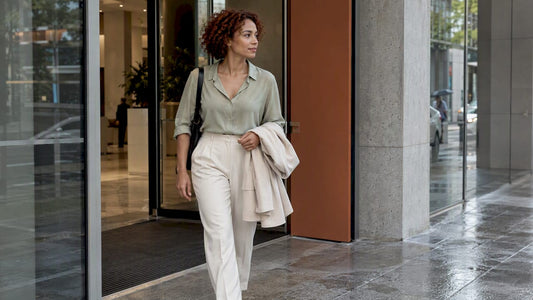
Most Brisbane offices are air-conditioned to a chill, which is a reason to choose a considered fabric rather than a heavy one. A shirt dress, a sleeveless silk-feel top with lightweight trousers, or a fluid midi with a thin knit over the shoulders are all more comfortable than a full suit. Keep the knit in a drawer or a tote so you can put it on indoors and take it off the moment you step outside.
Dinner and evenings
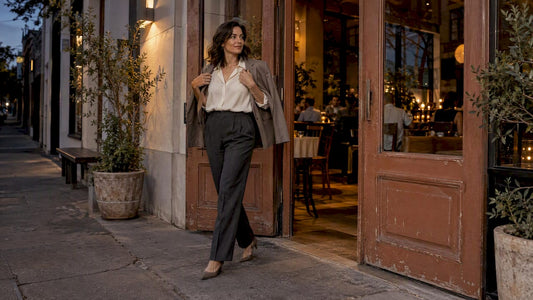
For dinner, lightweight trousers with a polished top, or a midi dress with refined flat sandals, suits most Brisbane restaurants and bars. Dress codes are generally relaxed; as one example, W Brisbane lists smart casual for The Lex and Living Room Bar and casual for WET Deck. Smart casual in summer means a clean line, a good fabric and one detail worth noticing: a sculpted sleeve, a belt, a bag with character.
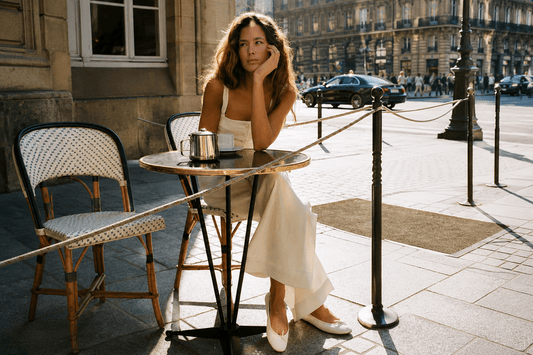
A shift or shirt dress is the quickest way to arrive looking composed. Our Blue Crush Shift Dress in Yamba is the sort of piece that goes from lunch to evening with only a change of shoe, and the wider dresses collection covers lengths from mini to midi.
Weddings, races and summer occasions
Events in Queensland often happen outdoors, so heat management is the real dress code. Choose an unlined or lightly lined dress in a breathable fabric, add a hat or fascinator that offers some shade, and keep shoes stable on grass. Colour does more than embellishment: a strong, saturated hue or a crisp print photographs well and looks deliberate. For more on colour and print, see the relevant section of our Australian summer wardrobe guide.
Beach, pool and Streets Beach days
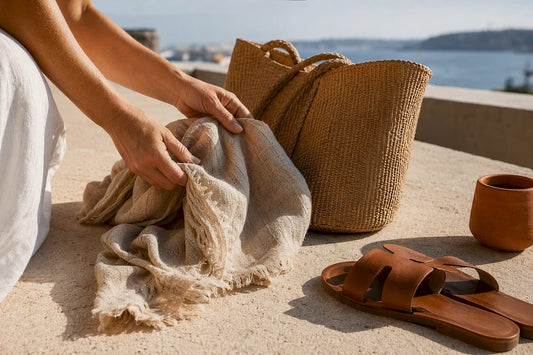
For a swim, pack the swimsuit, a lightweight cover-up or sarong, quick-drying sandals, sunglasses, a hat, sunscreen and a wet bag for anything damp. If you plan to go from the water to a café or the city, a fast-drying towel and a shirt or loose dress you can pull on over the top keep the day simple. We cover what to look for in swimwear in this part of our wardrobe guide.
Layers for storms and air-conditioning
Two things catch people out: the sudden downpour and the over-cooled interior.
For rain, The Guardian’s guidance on dressing for a wet, hot Australian summer recommends a lightweight, water-repellent outer layer, breathable natural-fibre layers you can add or remove as conditions change, and sturdier, waterproofed footwear in place of delicate open shoes. It also suggests avoiding suede and silk in the wet, white cotton that turns sheer when damp, and long wide-leg trousers or maxi skirts that will drag through puddles.
For air-conditioned spaces, the same guidance points to a thin cardigan, overshirt or light knit that is easy to carry outside. In practice:
- Keep one packable layer in your bag at all times, a light knit or an unstructured overshirt.
- Carry a compact umbrella rather than wearing heavy waterproofs all day.
- Choose shoes that tolerate wet pavement, such as leather sandals or closed flats that dry out, rather than suede.
- Pick darker or patterned fabrics for days when rain is forecast, because pale, thin cotton may become see-through.
Our knitwear and accessories are cut for this: fine gauges and open stitches rather than winter weight.
Shoes, bags and the small things
Comfortable summer shoes can include clean sneakers, loafers and flat or supportive sandals. Our rule is to own one sandal you could walk across the CBD in, one you could wear to dinner, and one closed shoe for wet days. A structured but light bag, ideally leather or woven, carries a water bottle, sunscreen and the spare layer. On hydration, The Urban List is blunt: a reusable bottle should be treated as a core accessory in a Brisbane summer.
Keep jewellery light, since metal warms against skin, and choose one statement item rather than several. Sunglasses and a hat are already doing the styling work.
A twelve-piece starting point
If you are building from scratch, a small capsule beats a crowded wardrobe. A workable group, which we explore at greater length in our 12 piece Australian summer wardrobe, looks like this:
| Piece | Why it earns its place |
|---|---|
| Collared linen or cotton shirt | Sun cover, beach cover-up, office layer |
| Tailored shorts | Day wear that still looks considered |
| Lightweight wide trousers | Cooler than you expect, polished for dinner |
| Shift or shirt dress | One piece, no styling required |
| Fluid midi dress | Evenings, occasions, travel |
| Fine tee or tank | Base for every layer |
| Thin knit or overshirt | Air-conditioning and cooler evenings |
| Flat sandals | Walking, heat |
| Refined sandals | Dinner |
| Closed shoe | Wet days |
| Wide-brim hat | Sun |
| Structured day bag | Carrying the essentials |
The logic is simple: every piece should work with at least three others. If it only works with one, leave it.
Our perspective: ease is a form of élégance
French and European dressing treats comfort and polish as one idea, not opposites. The women we dress in Brisbane are rarely looking for something loud. They want a shirt that holds its shape after a humid afternoon, a trouser that moves, a dress that does not need ironing to look right. That is savoir-faire applied to climate.
The labels we choose are curated with this in mind: the French houses Sœur, Sessùn, BA&SH and Vanessa Bruno, Sita Murt from Spain and Essentiel Antwerp from Belgium, among others. Each has its own cut and philosophy, and what they share is a respect for fabric and proportion. We would rather you owned fewer pieces that you reach for every week than a wardrobe that waits for a cooler day. In a Brisbane summer, the most elegant thing you can project is that you are not struggling with the weather.
— Mickael Martin
Shop the Brisbane summer edit
If you are ready to build the wardrobe above, start with our clothing collection, where dresses, tops and trousers sit together by label. You can also visit us in our Brisbane boutique to see fabrics and fit in person, or order online anywhere in Australia.

FAQ
How hot is it in Brisbane in January?
Tourism Australia gives a summer average range of 21 to 29.8°C for December to February, and January averages around 158 mm of rain. Humidity of 65 to 70 per cent in January makes it feel warmer than the figure suggests. Plan for breathable layers and a rain-ready outer.
Can I wear black in Brisbane summer?
Yes, if the fabric is light and the cut is loose. A black linen or viscose dress will feel better than a heavy pale synthetic. Keep dark colours for evening or cloudy days, and use a hat for shade when you are outdoors.
Do I need a jacket in a Brisbane summer?
Not a jacket, but a thin layer is wise. Offices, cinemas and restaurants can be strongly air-conditioned, so a light cardigan, overshirt or unstructured blazer that folds into your bag is enough. A packable water-repellent shell covers sudden showers.
What shoes are best for Brisbane summer?
Choose flat or supportive sandals, loafers or clean sneakers for walking, and something that tolerates wet pavement when storms are forecast. Avoid delicate suede and thin open shoes in the rain.
Sources
- Weather in Brisbane, Tourism Australia
- Weather in Brisbane, Tourism Australia (monthly rainfall)
- Five ways to avoid sweating through your clothes, ABC News
- Sun protection, Cancer Council National Cancer Prevention Policy
- How to be SunSmart when working outdoors, Cancer Council
- Tips and FAQs, Visit Brisbane
- Restaurants and Dining, W Brisbane
- Dressing for a wet, hot Australian summer, The Guardian
- Brisbane’s summer weather forecast, The Urban List
- Modal vs Bamboo Underwear, Breevar