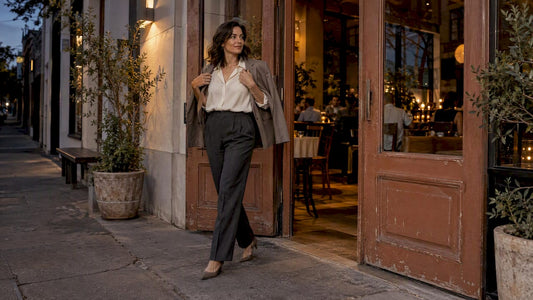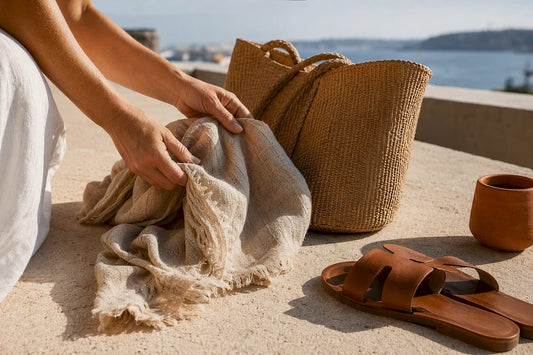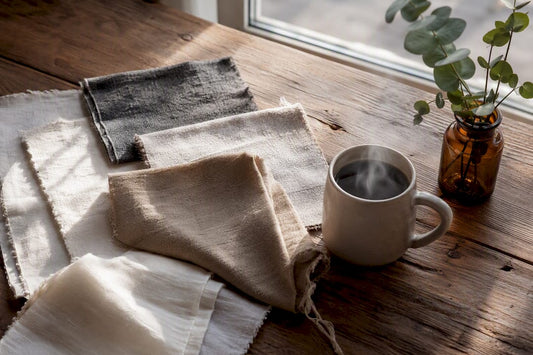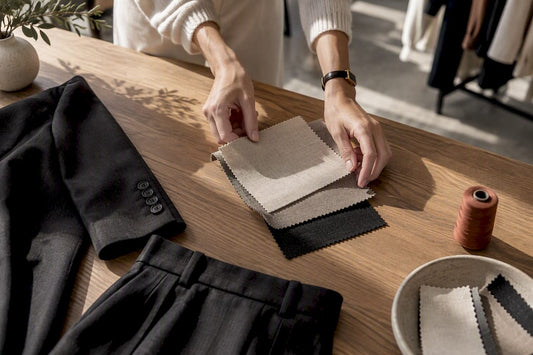

The best Brisbane summer office outfit is a light, breathable base that looks finished on its own, with one removable layer for the air-conditioning. Think linen-blend trousers or a fluid midi skirt, a silk or cotton top, flat shoes you can walk in, and a soft blazer or cardigan that lives on the back of your chair. Below, we set out the fabrics, formulas and small decisions that keep you cool on the commute and composed in the meeting room.
TL;DR
- Dress for the walk from the station first, then add polish indoors with a single light layer.
- Choose natural or natural-blend fabrics (linen, cotton, silk) and judge weight, weave and cut as carefully as fibre.
- Build around three or four neutrals and one or two accent pieces, so a small wardrobe makes many outfits.
- Check your workplace’s footwear and dress code policy before committing to sandals or open shoes.
- Keep a compact umbrella and wet-pavement-friendly shoes close, because summer storms arrive quickly.
Table of Contents
- What a Brisbane summer actually asks of your clothes
- Start with fabric, then weight, then cut
- Five outfit formulas for the Brisbane office
- The air-conditioning layer
- Colour, print and European polish
- Shoes and bags for the commute
- Storms, rain and changing weather
- Adjusting to your dress code
- A small capsule for a summer work week
- Our perspective: ease is the point
- Shop the edit
- FAQ
- Sources
What a Brisbane summer actually asks of your clothes
Brisbane dressing is not a question of temperature alone. The Bureau of Meteorology’s summary for Brisbane’s summer of 2025 recorded a mean daily maximum of 30.4°C, a mean minimum of 21.5°C, a top temperature of 37.4°C and 561.2 mm of rain. That is a warm morning commute, a hot afternoon and, quite often, a sudden downpour on the way home.
Humidity is the quiet variable. WorkSafe Queensland notes that heat stress depends on humidity, wind speed, activity, clothing and hydration, not simply the number on the forecast, and that clothing can insulate the body and reduce the evaporative heat loss that cools you. In practice, a garment that traps moisture against the skin will feel far hotter than the same weather would suggest.

Then you walk into the building. Monash University’s guidance gives 20–26°C as the recommended indoor range for most people, but anyone who has sat under a vent at 3 pm knows offices do not always honour it. Hence the central idea of this guide: a lightweight base, plus a layer you can add or remove.
Start with fabric, then weight, then cut
The familiar advice is to choose natural fibres, and it is sound. SEEK’s smart casual guide names linen, cotton and silk as quality fabrics for polished casual workwear, provided they are wrinkle-free and suit the workplace. Healthdirect’s hot-weather advice is to wear light-coloured, loose-fitting clothes, and WorkSafe Queensland points to lightweight cotton undergarments and light-coloured clothing as useful in the heat.
We would add a refinement from how European garments are made. Fibre is only the first filter.
Linen, and how to stop it looking tired
Linen is the great Brisbane fabric: airy, cool against the skin, and handsome as it softens. Its weakness is creasing by the second meeting. Blends (linen with cotton, or linen with viscose or silk) hold their shape better, and a relaxed, slightly textured finish reads as intentional rather than rumpled. If you like linen but dislike the crease, choose a blend and a cut with some room, so the fabric moves rather than clings.
Our linen pants outfit guide shows ten ways to wear it, and the linen blazer capsule is a good starting point if the layer is your priority.
Silk and fluid weaves
Silk and silk-like weaves drape away from the body and dry quickly. A stylist quoted in Mamamia’s 2026 workwear guide calls silk breathable for warmer months and describes the midi skirt as versatile with a button-up or structured top. A printed silk-feel blouse with a plain trouser is one of the most forgiving office pairings in a humid city, because the print camouflages the odd mark from a rain shower or a packed lift.
Be wary of the synthetic trap
Some blends are excellent; a thick, close-woven or heavily synthetic piece is not. A heavy cotton can be warmer than a light blend, so read the hand of the cloth: if it feels dense or slick in the shop, it will feel it at 2 pm in February. As a general rule, treat the label as a guide and the feel of the fabric as the verdict.
Cut matters as much as cloth
A looser silhouette lets air circulate. Wide-leg or straight trousers, a fuller knee-length or midi skirt and a shirt with a little ease at the shoulder all move air better than a tight pencil skirt or a fitted knit. Polish then comes from proportion and finish (a clean hem, a crisp collar, a considered belt) rather than from structure that traps heat.
Five outfit formulas for the Brisbane office
These formulas assume a smart-casual to business-casual workplace, which is the most common range. Adjust upward or downward for your own dress code.
1. The linen trouser and blouse
Wide-leg or straight linen-blend trousers, a sleeveless or short-sleeve blouse, flat loafers or neat flats, and a lightweight blazer. It is a simple formula that works from a client meeting to a desk day. Keep the palette tonal (sand with ivory, navy with white) and let one piece carry texture.
2. The midi skirt and shirt
A fluid midi skirt with a button-up shirt, sleeves rolled if the office is warm. The skirt moves, the shirt gives structure, and a slim belt defines the waist without constricting it. Our Sidney Shirt in Azure is the sort of crisp, colourful shirt that suits this approach, and you can browse more in tops.

3. The shift or shirt dress
One garment, no decisions. A shift or shirt dress is the quickest route to looking finished in the heat, because there is no waistband trapping warmth. Add a cardigan or soft blazer for the meeting room and flat sandals or loafers for the walk. The Blue Crush Shift Dress in Yamba and the wider dresses collection are good places to look.

4. The monochrome set
Top and trouser in the same colour family (stone, olive, chalk) create a long, easy line that looks considered with very little effort. Monochrome also pairs beautifully with one accent, such as a sharp-toned bag or a patterned scarf knotted at the handle.
5. The relaxed blazer day
For formal offices, keep the cut but lighten the cloth. Look for unlined or half-lined tailoring in linen blends or other fine, open-weave fabrics, with trousers cut slightly fuller. You keep the formality through cut and quality, not through density.
The air-conditioning layer
The layer is not about warmth outdoors. It is about the vent above your desk and the cold lobby. Choose something that weighs almost nothing in a bag and looks intentional when worn:
- An unstructured blazer in linen, cotton or a fine blend, which works over dresses and trousers alike.
- A fine-gauge cardigan or light knit in cotton or a cotton blend, soft enough to drape over the shoulders on the walk in.
- An overshirt in a lightweight weave, which works as a layer indoors and a sun shield outdoors.
Keep the colour neutral so it works with every base. Our knitwear, bags and shoes are curated with this kind of pairing in mind, and the Australian summer wardrobe guide shows how a twelve-piece edit can cover it.
Colour, print and European polish
The most useful wardrobe advice we know is also the least glamorous: build on a few neutrals. Navy, black, tan, grey and white mix with one another, so a handful of basics produces many outfits. Then add one or two accents, such as a printed blouse, a coloured trouser or a distinctive bag.
This is also how European dressing tends to work. The look rests on quality basics worn with ease and one detail that carries personality. In summer, that detail can be:
- a printed or textured top over a plain trouser;
- a bold, saturated colour in a single piece, with everything else muted;
- an interesting shoe or a sculptural earring, rather than a crowd of accessories.
SEEK’s smart casual advice captures the principle neatly: relaxed pieces gain professionalism when paired with tailoring, quality fabric or a structured accessory. For more formulas, our smart casual guide walks through easy combinations.
Shoes and bags for the commute
Footwear is where a Brisbane office look most often goes wrong, in both directions. Thongs are widely regarded as unsuitable for professional offices, and some workplaces do not allow open-toed shoes, so read your policy before packing sandals.
Within the rules, a sensible rotation looks like this:
- Leather loafers or smart flats, the daily workhorse, comfortable over a long commute.
- A neat sandal, only where your workplace allows it, with a secure strap for walking.
- Clean, minimal sneakers for the walk in if you change at your desk.
A structured but light tote holds a layer, a water bottle and a compact umbrella. Healthdirect recommends carrying water in hot weather, so choose a bag that makes this easy. Browse our accessories for bags and finishing pieces.
Storms, rain and changing weather
Summer storms in Brisbane can arrive fast. Check the Bureau of Meteorology forecast before you leave, and make a few small choices in advance:
- Shoes with grip, because wet pavement and polished lobby floors are a poor combination.
- Hems that clear the ground; a midi or ankle-grazing trouser is safer than a dragging maxi.
- A secure, closable bag that sits across the body or on the shoulder.
- A compact umbrella rather than a heavy raincoat, which is miserable in humid heat. Add a light rain layer only when the forecast justifies it.
Quick-drying fabrics and prints that forgive a few drops mean you can arrive damp and still look settled within minutes.
Adjusting to your dress code
Corporate or formal. Keep the structure, lose the weight. A tailored trouser or skirt suit in a light, open-weave fabric, a silk shell and closed shoes will hold the line without wilting.
Business casual (the safe default). Lightweight tailored trousers, a breathable shirt or polished top, loafers or flats and an optional light blazer. If you are unsure what a new workplace expects, this is the safest starting point.
Smart casual. Pair a relaxed piece with a polished one: linen trousers with a fine knit top, or a casual dress with a tailored jacket. Follow your employer’s guidance on what counts as appropriate, and avoid strapless, backless, very short or sheer pieces in professional settings.
Creative or relaxed. This is where print, colour and interesting shapes come into their own, though the same principles of fabric and cut apply.
A small capsule for a summer work week
You do not need a different outfit for every day. A compact set of compatible pieces can be mixed repeatedly:
| Piece | Role | Works with |
|---|---|---|
| Straight linen-blend trouser (neutral) | Everyday base | Every top and layer |
| Wide-leg trouser (second neutral) | Variation in silhouette | Shirts, shells, knits |
| Fluid midi skirt | Movement and ease | Shirts, fine knits |
| Crisp shirt | Structure | Trousers, skirts |
| Printed or silk-feel blouse | Accent | Neutral trousers and skirts |
| Shift or shirt dress | One-piece solution | Blazer, cardigan |
| Light blazer or cardigan | Air-conditioning layer | All of the above |
Two trousers, a skirt, two or three tops, a dress and a layer make well over a fortnight of different combinations. Our work capsule wardrobe guide goes into the full edit.
Our perspective: ease is the point
We select European labels for the way their clothes behave: how a fabric drapes, how a seam is finished, how a garment still looks right after a long day. In Brisbane summer, that matters more than any trend. Brands such as the French labels Sœur, Sessùn, BA&SH and Vanessa Bruno, the Catalan label Sita Murt and Belgium’s Essentiel Antwerp each interpret ease differently, but share a preference for pieces worn often rather than bought and forgotten.
Our view is that a summer office wardrobe should be quiet in construction and distinct in character. Fewer pieces, chosen with care for cloth and cut, will serve you better than a crowded rail of near-identical basics. Dress for the heat honestly, add polish through proportion and detail, and let the layer do the work indoors.
— Mickael Martin
Shop the edit
If you are building or refreshing a summer work wardrobe, begin with the pieces that do the most: a trouser, a shirt or blouse, and a dress that needs no styling. Our clothing collection brings together curated European designer pieces, and you can shop pants for the foundation of most of the formulas above. Visit us at our Brisbane boutique, or shop online from anywhere in Australia.

FAQ
What should I wear to a Brisbane office in summer if the dress code is business casual?
Lightweight tailored trousers or a fluid midi skirt, a breathable shirt or polished top, and loafers or flats form a dependable base. Keep a light blazer or cardigan at your desk for the air-conditioning. Choose linen, cotton or silk blends in light or mid tones.
Can I wear linen to the office without looking creased?
Yes, if you choose well. Blends of linen with cotton, viscose or silk hold their shape better than pure linen, and a slightly relaxed cut makes natural creasing look intentional. Hang pieces as soon as you arrive, and avoid very fitted linen, which wrinkles fastest.
Are sandals acceptable in a Brisbane office?
That depends on your workplace. Some employers do not allow open-toed shoes, and thongs are generally considered too casual for professional offices. Check your policy first, then choose a neat, secure sandal or a closed flat instead.
How do I handle cold air-conditioning without wearing a heavy jacket?
Think in terms of a single, light layer: an unstructured blazer, a fine cardigan or an overshirt in a breathable fabric. Keep it neutral so it works with every outfit, and leave it at the office if you can. Monash’s guidance on indoor comfort notes that thermal comfort depends on several factors, including air speed and clothing, so a small layer is often enough.
What colours work best for summer office outfits?
Lighter colours absorb less heat, and neutrals such as navy, tan, grey, white and black combine easily. Add one or two accent pieces in colour or print rather than dressing head to toe in bright tones, so the wardrobe stays versatile.
Sources
- Brisbane in Summer 2025, Bureau of Meteorology
- Heat stress, WorkSafe Queensland
- Indoor thermal comfort, Monash University
- Hot weather risks and staying cool, healthdirect
- Your complete guide to smart casual work attire, SEEK
- Summer workwear trends 2026, Mamamia
- How to dress for the office in summer, Styled By Sally