
A capsule wardrobe for work is a tightly edited set of pieces, typically 15 to 25 in number, that combine to form a month’s worth of polished outfits without repetition fatigue. The goal is fewer, better garments in a shared palette. Two pieces worth building around right now are the Cargo Pants in Vegetal, for relaxed tailoring, and the Gabrielle Tailored Pants in Navy, for a sharper corporate line.
TL;DR:
- A professional capsule wardrobe typically includes seven core items such as a tailored blazer, high-waisted trousers, and a white button-down to maximize versatility across work settings.
- Building the wardrobe should start with an honest wardrobe audit, focusing on items worn in the last two months, in good condition, and fitting within a neutral palette.
- Prioritize investing in higher-priced, frequently worn items like blazers, coats, and leather shoes, which offer better durability and cost-per-wear value.
- Use the blazer multiplier effect to create multiple outfits from one blazer and a pair of trousers, emphasizing the importance of a well-chosen neutral blazer.
- Construction should be staged over time, with an initial focus on filling three key gaps in the first 90 days and gradually adding pieces over six months to ensure cohesion.
Table of Contents
- What are the core work capsule essentials?
- How do you build a work capsule wardrobe step by step?
- Outfit formulas: the blazer multiplier in action
- Choosing fabrics and fits that survive a full workday
- Investment pieces and cost-per-wear: where to spend and where to save
- Edito’s curated picks for a professional capsule
- Keeping your personality while staying polished
- Shop the capsule: where to start with Edito
- Sources
- FAQ
What are the core work capsule essentials?
Seven categories carry the weight of a professional capsule collection, and each one earns its place through sheer mileage rather than trend appeal. A work capsule wardrobe built well leans on garments that mix across business formal and business casual settings without looking like they’re straining to do both.
- A tailored blazer. This is the piece that shifts an outfit’s register in seconds, dressing up a simple top or softening a structured trouser.
- High-waisted, wide-leg trousers. They sit at the natural waist, hide creasing from a long commute, and pair with almost anything above them.
- A classic white button-down. Under a blazer, alone with trousers, or tucked into a skirt, it’s the most-worn shirt in most professional wardrobes for good reason.
- A midi skirt. It bridges formal and relaxed dress codes and moves easily from desk to after-work drinks.
- A versatile knit sweater. Merino or a fine wool blend layers under blazers in the cooler months and stands alone on casual Fridays.
- Polished loafers or pumps. One low, one with height, both in a neutral that matches your base palette.
- A structured tote bag. It carries a laptop without looking like it’s carrying a laptop.
Within this framework, base neutrals (navy, charcoal, black, camel) do the heavy lifting, while two or three accent pieces, a burgundy knit or an olive trouser carry the personality. The Cargo Pants in Vegetal slot in as that accent trouser, softer through the leg than a classic tailored pant, while the Gabrielle Tailored Pants in Navy anchor the neutral base with a cleaner, corporate silhouette.
How do you build a work capsule wardrobe step by step?
Building a professional capsule collection isn’t a weekend project. It’s a staged process that rewards patience over impulse buying, and it starts with an honest audit of what’s already hanging in your wardrobe.
Step 1: Audit what you own. Run each piece through six quick questions:
- Have I worn this in the last two months?
- Does it fit the way it did when I bought it?
- Can I name two things I’d pair it with today?
- Is it in good enough condition to wear to a client meeting?
- Does it sit within my chosen neutral palette or serve as a deliberate accent?
- Would I buy this again if I saw it in-store now?
Anything that fails three or more of these questions goes into a donate or repair pile. What survives becomes your starting inventory.
Step 2: Choose your palette. Pick one dominant neutral (navy works for most skin tones and seasons), a secondary neutral (charcoal or camel), and no more than two accents. This is the palette strategy Edito’s styling guides return to again and again, because neutral foundations paired with a handful of accent pieces multiply outfit combinations while keeping the whole collection cohesive.
Step 3: Map your gaps. With your audit and palette set, list what’s missing against the seven core categories above. You’ll usually find two or three genuine holes, not seven.
Step 4: Buy in stages. A staged plan protects both budget and wardrobe cohesion. In the first 90 days, buy your top three priority gaps only, typically a blazer, a trouser, and a pair of shoes. Over the following six months, fill in remaining gaps as good pieces present themselves, rather than replacing your entire wardrobe in one spend.
A simple module rule keeps the maths sane: aim for roughly three bottoms to five tops to two blazers. That ratio alone generates dozens of outfit combinations before you’ve bought a single extra piece.
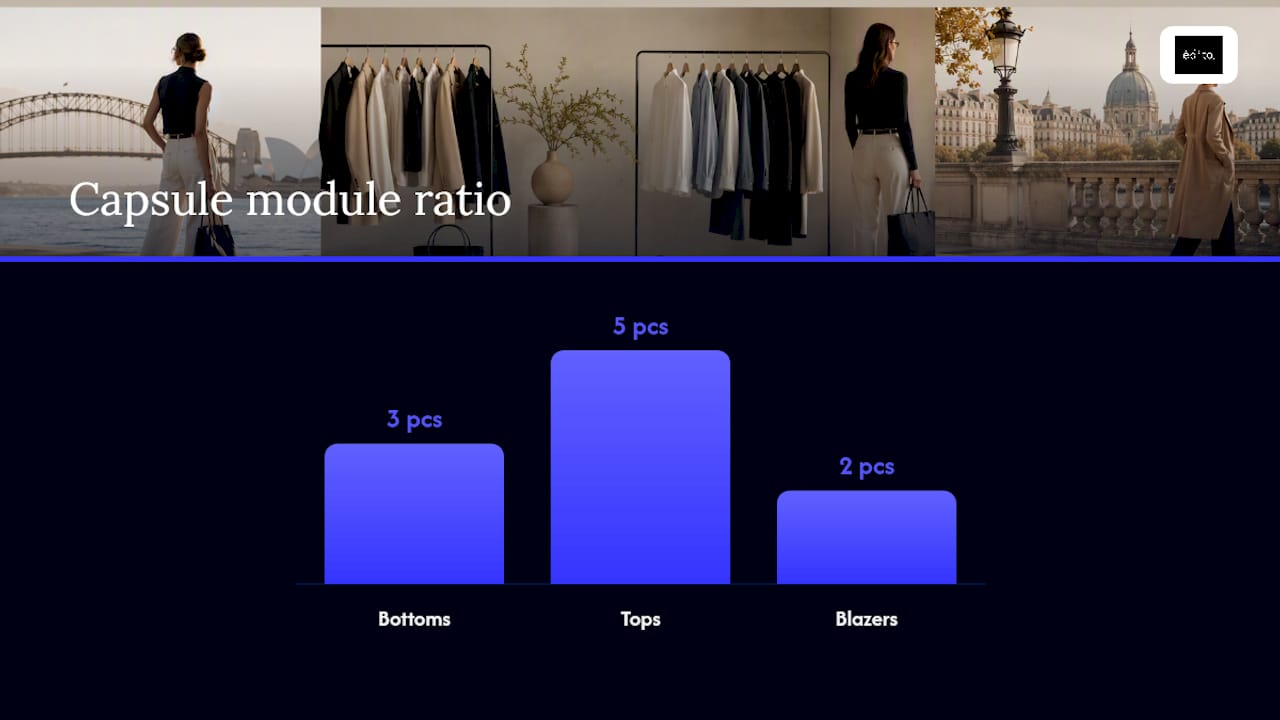
Pro Tip: Buy your first blazer in your dominant neutral, not an accent colour. It needs to work with everything you already own before it earns a personality of its own.
Outfit formulas: the blazer multiplier in action
One well-cut blazer can turn a single pair of trousers into four distinct looks, formal for client pitches, smart-casual for team meetings, relaxed for a Friday, and elevated for after-work drinks. This is the blazer multiplier effect that stylists lean on when building professional capsules, and it’s the single biggest lever in a small wardrobe.
Try these recipes against pieces you likely already own:
- Gabrielle Tailored Pants + white button-down + blazer = client meeting, no adjustments needed.
- Same trousers + fine knit, blazer off = internal team standup.
- Midi skirt + knit + loafers = hybrid day working from a café.
- Cargo Pants in Vegetal + fitted tee + blazer = casual Friday with a polished edge.
- Trousers + button-down, sleeves rolled, no blazer = warm-weather commute.
- Skirt + button-down + loafers = smart-casual for an industry event.
A simple weekly rotation might run: Monday trousers and blazer for in-office presence, Tuesday and Wednesday hybrid combinations built around the knit and skirt, Thursday the accent trouser for a lower-stakes day, Friday a repeat of Monday’s formula with the blazer left at home. Come the warmer months, swap wool knits for a lighter cotton layer and let the blazer stay in the wardrobe more often than not; in winter, that same blazer goes over everything, including the knit itself.
Choosing fabrics and fits that survive a full workday
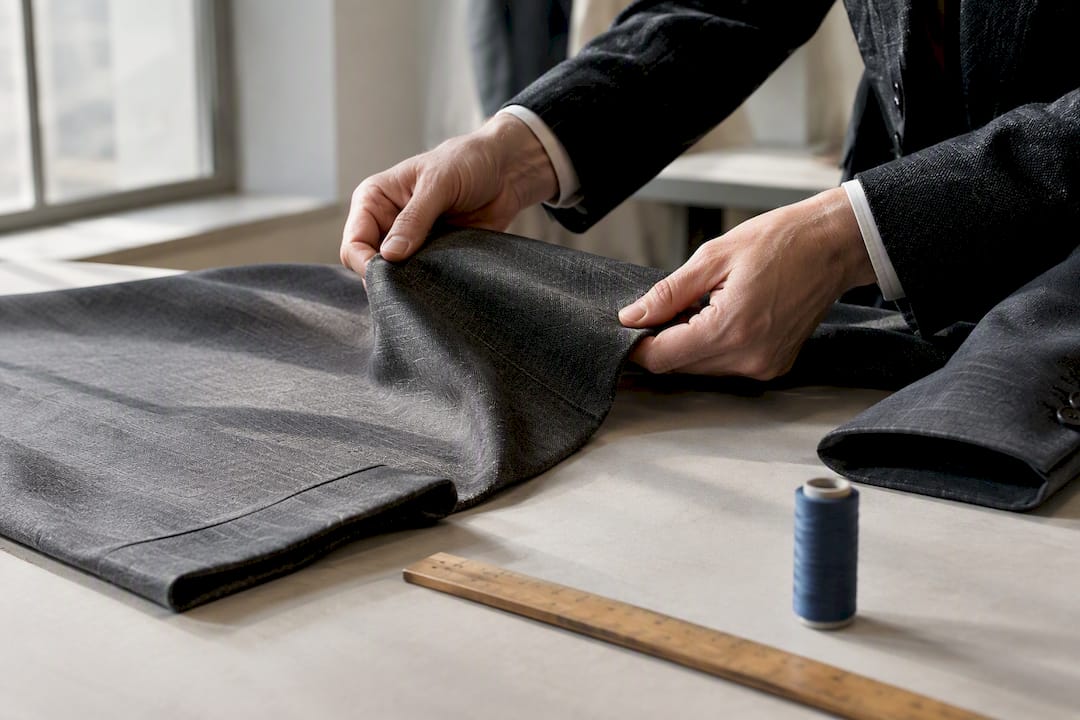
Fabric choice decides whether an outfit still looks composed at 5pm or has wilted somewhere around lunch. For the warmer months, linen blends and structured cotton hold their shape through humidity and air-conditioned offices alike, without the creasing pure linen is famous for. In cooler months, wool and melton blends in blazers and coats add warmth without bulk under layers.
Fit deserves just as much attention as fabric:
- High-rise trousers keep shirts tucked and lines clean through a long day of sitting, standing and commuting, which matters more for a polished look than the exact width of the leg.
- A blazer should sit cleanly across the shoulder with no pulling. Tailoring here matters more than anywhere else in the capsule.
- Midi skirt hems should sit just below the knee for the widest range of dress codes, from conservative corporate to relaxed creative offices.
Pro Tip: If you take public transport or cycle to work, prioritise wrinkle-resistant weaves in your trousers and blazers. A slightly heavier fabric that resists creasing beats a lighter one that needs a steam every morning.
Investment pieces and cost-per-wear: where to spend and where to save
Three categories consistently justify a higher price tag: the blazer, the coat, and leather shoes. These are the pieces worn most often, touched most often, and noticed most often in a professional setting, so spending more on them pays off in cost-per-wear far more reliably than spending more on a basic tee.
The maths is straightforward. A $300 blazer worn twice a week for two years, roughly 200 wears, costs $1.50 per wear. A $60 fast-fashion blazer that loses its shape after twenty wears costs $3 per wear, and looks worse doing it.
- Splurge on: blazer, coat, leather shoes.
- Buy affordably: basic tees, casual knits, everyday accessories.
- Extend garment life through proper hanging, cedar blocks for wool storage, and a trusted dry cleaner for structured pieces.
Edito’s curated picks for a professional capsule
Edito curates each season around craftsmanship, fabric integrity, and fit, favouring European labels whose cuts and fabrics hold their structure and develop a natural patina over years of wear, rather than pieces built for a single season.
The Cargo Pants in Vegetal earns its place through relaxed tailoring that still reads as considered rather than casual, a genuinely useful accent trouser for the days a hybrid schedule calls for something less rigid than a full suit. The Gabrielle Tailored Pants in Navy sits at the other end of that spectrum, a cleaner, more structured line built for the days that call for a sharper silhouette, whether that’s a client pitch or a board meeting.
Both pieces reflect the same editorial standard Edito applies across its collections:
- Fabric weight and drape tested against real wear, not just how it photographs.
- Fit checked across body types, not just a single sample size.
- Versatility prioritised over one-outfit-only design details.
Browse the Clothing collection to see how these pieces sit alongside other curated selections, or get in touch for styling advice if you’d like a second opinion on what your capsule is missing.
Keeping your personality while staying polished
A neutral capsule doesn’t have to mean a quiet one. One accent colour, a burgundy knit or an olive trouser, or a single striking accessory, can carry your personality through an entire week of outfits without disrupting the system underneath.
Try this: this week, swap one neutral piece for an accent in three different outfits and notice which combinations you reach for again. Building a capsule properly takes months, not a weekend, and that’s fine. The wardrobe that lasts is the one assembled with patience, not the one bought in a single spree.
— Mickael Martin
Shop the capsule: where to start with Edito
Edito is the more direct route to a work capsule than piecing one together across a dozen fast-fashion retailers, because every piece in the edit is chosen to work with the others, not just to sell on its own.
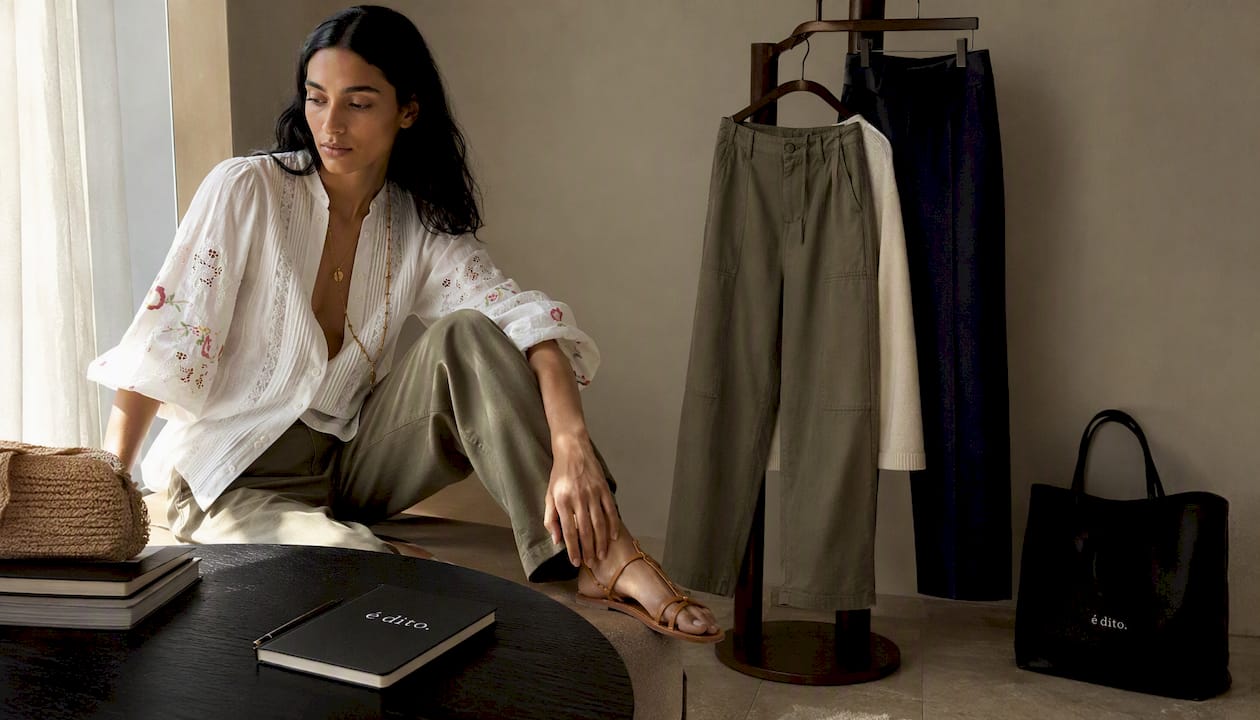
Start with the two trousers already covered here: the Cargo Pants in Vegetal for your accent slot, and the Gabrielle Tailored Pants in Navy for your neutral base. From there, the full Clothing collection covers the blazers, knits and midi skirts a capsule needs, while Accessories and the Pants range round out the gaps your own audit turns up. If you’re building from closer to zero, the Tops and Dresses ranges are worth a look for quick, high-mileage additions. Browse the collection online, or visit the boutique for fitting and styling advice tailored to the dress code you actually work in.
Sources
- Workwear Capsule Wardrobe: 20 Pieces for the Office
- How to build a capsule wardrobe for work
- How to build a work capsule wardrobe in Australia
FAQ
What should I include in a capsule wardrobe for work?
Build around seven core categories: a tailored blazer, high-waisted trousers, a white button-down, a midi skirt, a versatile knit, polished shoes, and a structured tote. From there, fill in with two or three accent pieces, such as the Cargo Pants in Vegetal, to keep the collection from looking flat.
What is the 3-3-3 rule for a capsule wardrobe?
Interpretations vary, but the most common version asks you to pick three tops, three bottoms, and three pairs of shoes and wear only those for three weeks straight. It’s a quick test to reveal how versatile, or how repetitive, your current wardrobe genuinely is.
What is the 5-4-3-2-1 packing rule?
This one belongs to travel capsules rather than work wardrobes: five tops, four bottoms, three pairs of shoes, two dresses, and one jacket, all built around a single palette. Edito’s travel capsule wardrobe guide breaks the shorthand down for a compact plan.
How many pieces should a work capsule wardrobe have?
Most professionals land comfortably between 15 and 25 core pieces, enough for a full month of outfit variety without excess. Readers who want a larger, more editorial range can look at Edito’s 30 to 35 piece capsule guide for a fuller build.
Do I need to buy everything at once?
No, and you shouldn’t. A staged plan, three priority pieces in the first 90 days, then filling remaining gaps over the following six months, keeps spending sensible and avoids buying pieces that don’t earn their place.