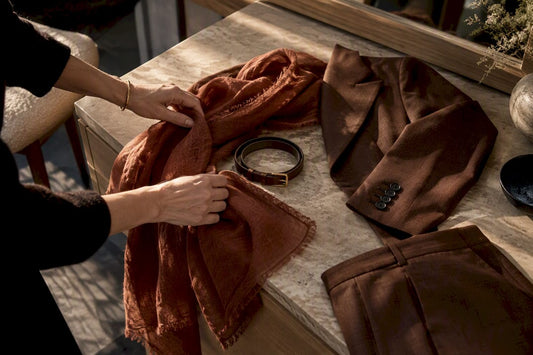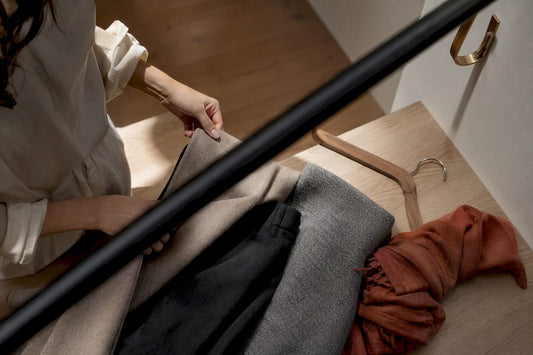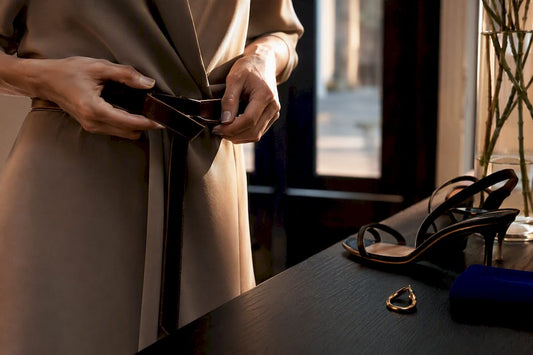

A work capsule wardrobe is a small, deliberate group of garments that all work with one another, so that getting dressed for the office takes minutes rather than a negotiation. The number matters less than the logic: a restrained palette, a few well-cut foundations, and fabrics that cope with an air-conditioned meeting room at nine and a humid commute home at six. Below, we set out how to build one for Australian working life, what to keep from your existing wardrobe, and where a few European pieces earn their place.
TL;DR
- Start by editing what you own. Identify the gaps first, then buy only what closes them.
- Build around one tight palette (two neutrals, one accent) so every top meets every bottom.
- Choose breathable, natural-leaning fabrics for Australian seasons, and treat the cut as seriously as the cloth.
- Aim for roughly 15 to 25 pieces for work, adjusted to your dress code and how often you wear each outfit.
- Buy slowly, check the fit before committing, and know your consumer rights if something arrives faulty.
Table of Contents
- What a work capsule actually is (and is not)
- Step one: cull before you shop
- Choose a palette before you choose a piece
- The foundation pieces
- A sample capsule of 20 pieces
- Outfit formulas that keep mornings simple
- Fabrics for Australian seasons
- Perspective: why we edit rather than accumulate
- Buying well: fit, cost per wear and timing
- Shop the edit at Edito
- Common mistakes to avoid
- FAQ
- Sources
What a work capsule actually is (and is not)
The word capsule suggests austerity, and that is where many attempts go wrong. A capsule is not a challenge to own as little as possible. It is an edit: a wardrobe in which each garment has at least three or four credible partners.
Stylists quoted by Vogue Australia frame the exercise as refining your taste, beginning with a cull of what you already own so the gaps become obvious before anything new is bought. That order of operations is the single most useful habit in this article. Most women do not need a larger wardrobe. They need a more coherent one.
It is also worth separating the work capsule from a general capsule. Your weekend clothes can be as relaxed or as adventurous as you like. The work capsule has a narrower brief: look composed, move comfortably, and carry you from desk to dinner without a change of clothes if the evening requires it.
Step one: cull before you shop
Set aside an hour and take everything you wear to work out of the wardrobe. Sort it into four piles:
- Wear weekly. These are your real foundations. Note what they have in common: colour, cut, fabric.
- Wear rarely, and wonder why. Usually a fit or comfort problem. Be honest about it.
- Damaged, ill-fitting or dated. Vogue’s guide suggests setting aside pieces with unrepairable damage, a poor fit, or a look that has dated. Let them go, or repair them if they are worth it.
- Loved but unmatched. The beautiful skirt that goes with nothing. This pile tells you what to buy next.
The fourth pile is the most valuable. A capsule is built far more reliably from gaps than from a shopping list copied off the internet.
If you want to see how far a small wardrobe can stretch, ABC News reported on a radio presenter who limited herself to six items of clothing for three weeks as part of the War on Waste campaign. It is an extreme experiment, but it makes the point that repetition is far less noticeable to colleagues than we imagine.
Choose a palette before you choose a piece
The quickest way to make a small wardrobe feel generous is colour discipline. Pick:
- Two base neutrals. Navy and ivory, black and stone, or chocolate and cream. Whichever suits your colouring and your office.
- One accent family. A soft blue, a terracotta, a deep green. Use it in a shirt, a knit or a scarf.
- One texture or pattern. A fine stripe, a small floral, a tonal jacquard. Just one, so it reads as a signature rather than a distraction.
The allure of a considered wardrobe lies in this quiet consistency. When everything harmonises, even a simple outfit looks intentional.
The foundation pieces
Vogue Australia’s summer work essentials points to structured blazers, midi-length skirts and classic shirting in neutral, breathable fabrics as the backbone of modern Australian workwear, with a deliberate avoidance of anything that feels like a costume. We agree, and would organise the work capsule into five groups.
Tops and shirting
Three to five pieces: a crisp shirt, a fluid blouse, a fine-gauge tee or shell, and one or two knits. A shirt in cotton or a cotton blend holds a collar through a long day. A softer blouse in a viscose or Tencel-type fibre drapes well under a blazer. Browse our tops for the range we currently carry.
Trousers and skirts
Three to five pieces. One tailored trouser in your darkest neutral, one wide or straight-leg trouser in a lighter tone, and one skirt (a midi in a fluid fabric is the most adaptable). Trousers with a little length and movement suit Australian offices well because they look polished without feeling restrictive on a warm day. Our pants collection is a good place to compare cuts.
Dresses
Two or three. A shirt dress is the quiet workhorse of a work capsule: it is one garment, but it behaves like a complete outfit, and with a belt, a blazer or a knit over the shoulders it changes character entirely. See our dresses, including the Thistle Shirt Dress in Surf, for an example of the idea.

Layers
Two to four. A structured blazer, a lightweight cardigan or fine knit, and, depending on your city and commute, a coat or trench for cooler mornings. Australian offices run cold with air-conditioning even in summer, so a layer is functional as well as stylish. Explore our full clothing range, including knitwear, when you are ready to fill a gap.
Shoes and bags
Three pairs of shoes and one structured bag will carry most capsules: a flat or low block heel in leather, a more refined option for client days, and a comfortable pair that can handle the walk from the station. One bag that holds a laptop without looking like a laptop bag. Our accessories are curated with the same restraint.
A sample capsule of 20 pieces
Use this as a template, not a prescription. Adjust it to your dress code.
| Category | Pieces | Notes |
|---|---|---|
| Shirts and blouses | 4 | One crisp, one fluid, one stripe, one in your accent colour |
| Knits and tees | 3 | Fine-gauge, so they layer under a blazer |
| Trousers | 3 | Tailored, wide-leg, and a lighter neutral |
| Skirts | 2 | One midi, one that works with boots |
| Dresses | 2 | A shirt dress and one more formal option |
| Blazer and layers | 3 | Blazer, cardigan, coat or trench |
| Shoes | 3 | Flat, heel, weather-ready |
That is twenty pieces. With a palette of two neutrals and one accent, they produce well over two weeks of outfits without a repeat, and far more if you allow yourself to wear favourites twice.
If you would like a longer walkthrough, our guide to a 15 to 25 piece work capsule for Australian professionals goes further into the detail.
Outfit formulas that keep mornings simple
A capsule works because it removes decisions. These formulas do the same:
- The tonal column. Trouser and top in two shades of the same colour, a blazer in a third. It lengthens the line and always looks considered.
- The shirt dress, layered. Belted for the office, open over a fine tee for a casual Friday, with a knit tied over the shoulders when the air-conditioning bites.
- The contrast pairing. A structured piece with a fluid one: a sharp blazer over a soft blouse, or a crisp shirt with a flowing skirt.
- The after-work shift. Swap the shoes, add a bold earring, and the same outfit is ready for dinner. That change is where a good accessory earns its cost-per-wear.
The point of a formula is not rigidity. It is a starting position from which a woman can improvise confidently.
Fabrics for Australian seasons
A work wardrobe fails quickly if it is uncomfortable. Queensland summers, southern winters and the shift between a hot street and a cold office all demand fabrics that breathe and layer.
Consumer advice from CHOICE suggests looking beyond the label at the quality of construction: stitching density, fabric weight and spare fastenings. It also notes that denim with added synthetics tends to lose its shape, while 100% cotton stays more structured over time. Apply the same scrutiny to workwear:
- Linen and linen blends for summer trousers and shirts. They crease, so choose a blend if you want a more pressed look.
- Cotton poplin for shirting that stays crisp.
- Silk or silk-feel fibres for blouses that move with you.
- Fine wool or cotton knits for the layering months.
For more on cloth, see our guide to making natural fabrics last in your Australian wardrobe, and our approach to trans-seasonal dressing, which is the logic that lets a capsule work across four seasons without swapping the whole wardrobe.
Perspective: why we edit rather than accumulate
We curate European labels because we believe a garment should be judged by how it is made and how it lives in your wardrobe, not by how loudly it announces itself. The houses we stock come from different places, and it matters that we describe them accurately: Sessùn and Vanessa Bruno are French, Sita Murt is Spanish, Essentiel Antwerp is Belgian. Each has its own savoir-faire, and each brings a distinct sensibility to a capsule.

For work, we look for proportion, drape and a certain ease. A well-cut trouser should not need constant adjustment. A shirt dress should feel as good at four in the afternoon as it did at eight. When a piece satisfies those conditions, it becomes the kind of foundation you reach for without thinking, which is the whole purpose of a capsule.
Our advice is simple: buy fewer things, but buy them with attention. Try the piece with what you already own. If it does not work with at least three other garments, wait.
— Mickael Martin
Buying well: fit, cost per wear and timing
Check the fit, because sizes are inconsistent
There is no Australian standard for adult clothing sizes, CHOICE has reported, so a size 12 in one label can differ markedly from a 12 in another. European labels add another layer, since their sizing runs on a different scale again. Check each brand’s size chart and measurements rather than relying on your usual number, and note which cuts suit you for future purchases.
Think in cost per wear
A work piece you wear forty times a year is a very different purchase from an occasion dress worn twice. Divide the price by the wears you realistically expect. We explain the reasoning in our piece on fast and slow fashion and cost per wear, and list candidates in 12 investment pieces for a capsule wardrobe.
Build gradually
A capsule assembled over a year or two will fit your life better than one bought in a weekend. Add one or two pieces each season, starting with whichever gap was largest in your fourth pile.
Know your rights
If a garment arrives faulty, Australian Consumer Law protects you. The ACCC states that consumer guarantees apply to purchases made online as well as in store, and its faulty fashion advice reminds shoppers that clothing and accessories are covered. If a seller is unresponsive, contact the ACCC or your state consumer protection agency, such as Queensland’s Office of Fair Trading for Brisbane shoppers.
Shop the edit at Edito
If you are ready to fill the gaps your cull has revealed, our clothing collection brings together tops, dresses, pants and knitwear from European labels, available online across Australia and at our Brisbane boutique. A good place to begin is a single foundation: the Saige Wide Leg Crop in Ivory as a lighter neutral trouser, or the Kylie Skirt for a skirt with an easy, wearable character.

Common mistakes to avoid
- Buying the capsule before culling the closet. You will duplicate what you own.
- Choosing a palette that flatters a mood, not you. Hold fabric near your face in daylight before committing.
- Ignoring office temperature. Keep one layer at your desk.
- Treating every piece as an investment. Spend most on what you wear most: trousers, blazers, shoes, a bag.
- Forgetting care. Even the best fabric ages poorly if washed carelessly. Follow the label, and let knits rest between wears.
FAQ
How many pieces should a work capsule wardrobe have?
Most women find that 15 to 25 pieces covers a working week and then some, but the right number depends on your dress code, laundry habits and climate. Start with the categories you wear most, and let your cull guide you rather than aiming at a fixed count.
What colours work best for a work capsule?
Choose two base neutrals, such as navy and ivory or black and stone, plus one accent colour. This allows every top to meet every bottom. Test colours in daylight against your skin and hair, since a neutral that suits one woman can flatten another.
Can a work capsule cope with Australian summers?
Yes, if you choose breathable fabrics such as linen blends, cotton poplin and fluid viscose-type weaves, and keep the cuts relaxed. Keep a light layer for air-conditioned offices. Midi skirts, wide-leg trousers and shirt dresses are practical because they stay cool while looking polished.
Is it worth buying European designer pieces for work?
It can be, when the piece is something you will wear dozens of times and the construction and fabric justify it. Judge each garment on cut, cloth and stitching rather than the label alone, and check the size chart before ordering.
Sources
- Culling your closet: makeover your wardrobe with our 4-step guide, Vogue Australia
- Summer work wardrobe essentials, Vogue Australia
- War on waste: How a capsule wardrobe could help you break your mindless shopping habit, ABC News
- Thrifty op shop clothing steals to save money (and landfill), CHOICE
- Clothing sizes in Australia, CHOICE
- Buying online, ACCC
- Faulty fashion: use your rights, ACCC