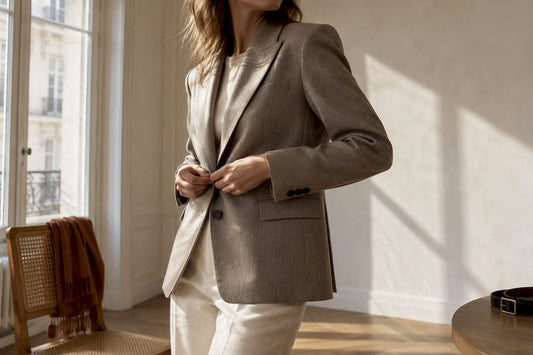

The simplest, most versatile way to wear a women’s suit in 2026 is to treat it as a modular set: wear the matching look when polish matters, split the pieces when versatility does. Three formulas to try immediately: blazer with matching trousers and a silk blouse for the boardroom, blazer with a white tee and sneakers for smart casual days, and a solitary blazer thrown over denim for the weekend. Curated pieces to build these looks follow below.
TL;DR:
- Using a suit as a modular set allows for versatile outfit options, with key swaps like shoes, tops, and accessories enabling transition from work to weekend.
- Pay attention to fit details such as shoulder alignment and sleeve length to ensure the suit maintains a tailored appearance across different body types.
- Wool and linen fabrics offer year-round practicality, with wrinkle-resistant options ideal for travel and maintaining sharpness with minimal care.
- Separates increases wardrobe functionality, enabling combinations like blazer with denim or trousers with a knit for multiple occasions.
- Investment pieces should prioritize construction quality, natural fibers, and minimal alterations for long-lasting value, especially when purchased online or in-store.
Table of Contents
- Six outfit formulas that make a suit work harder
- How to adapt a suit for different occasions
- Separates versus matching sets: multiply your wardrobe
- Fit and fabric: what to look for when buying a suit
- Caring for a suit so it keeps its shape
- What a suit costs and where the value sits
- Buying a suit online versus in-store
- Edito’s curated picks and how to shop the looks
- A styling philosophy worth borrowing
- Sources
- FAQ
Six outfit formulas that make a suit work harder
A tailored suit earns its place in a wardrobe when it can move between very different days without a second thought. A tailor quoted by Fashion Journal notes that a suit becomes genuinely adaptable once you stop treating it as a fixed outfit and start mixing the jacket and trousers with the rest of your wardrobe. These six formulas put that philosophy into practice.
- Boardroom: tailored blazer, matching trousers, a silk blouse and a low heel, kept deliberately understated so the tailoring does the talking.
- Smart casual office: the same blazer over a plain tee, tailored trousers and a white sneaker, a combination recommended for modern Australian workwear because it balances polish with comfort.
- Weekend or coffee run: blazer over the Kurt Jeans in Ecru, a fine knit or tee underneath, finished with loafers for an off-duty read that still looks considered.
- Date night: either the matching set worn as intended, or the jacket alone over a slip dress, with a strappy heel to lift the whole look after dark.
- Wedding guest or event: a coloured or textured suit with the jacket belted at the waist for shape paired with slingbacks for a formal finish that avoids looking corporate.
- Travel: a lightweight linen suit, a packable knit for layering, and a flat ankle boot that can handle transit and sightseeing alike.
What unites these formulas is restraint: one strong tailored piece, one shift in styling, and the rest of the outfit stays quiet. A tailoring specialist makes the point that small swaps, a different shoe, a change of top, a belt added or removed, do more for a wardrobe than buying a second or third suit ever could. That single principle is worth more than any shopping list, because it means one well-chosen suit can cover boardroom meetings, a Friday coffee catch-up and a Saturday wedding without ever feeling repetitive.
How to adapt a suit for different occasions
Moving a suit from a nine-to-five day into evening plans, or from an office week into a weekend away, comes down to a handful of deliberate swaps rather than a wardrobe overhaul.
- Change the shoes. A low heel or loafer reads as workwear; a strappy sandal or slingback shifts the same suit into evening territory.
- Swap the top. Trade a structured shirt for a silk camisole or slip and the entire mood softens, even though the jacket and trousers stay exactly the same.
- Add or remove definition. A belt at the jacket’s waist, or a single piece of statement jewellery, turns a relaxed look formal in seconds, and taking both away does the reverse.
Two things to avoid: heavy, tightly fitted suiting for long days on your feet, which tends to feel restrictive by the afternoon, and fabrics that crease badly if you are packing for a trip. For travel, fold trousers inside the jacket to protect the shoulder line and lean towards wrinkle-resistant fabrics that survive a suitcase without an iron.
Pro Tip: Pack the blazer as your outer layer on the plane. It holds its shape better folded over an arm than crushed inside luggage.
For a fuller walkthrough of moving one outfit through an entire day, our guide to day-to-night outfits covers the swaps in more detail.
Separates versus matching sets: multiply your wardrobe
Buying a suit as a set is only half the value. The real return comes from treating the jacket and the trousers or skirt as two entirely separate wardrobe pieces that happen to match when you need them to.
- The jacket pairs with: denim for a relaxed daytime look, a tailored skirt for a more formal alternative, or its own matching trouser when you want the full set.
- The trouser or skirt pairs with: a fine knit for cooler days, a crisp shirt for the office, or a plain tee when the rest of the outfit needs to stay simple.
The Seema Skirt works this way particularly well, sitting under a blazer for a wedding one week and under a knit for a weekend outing the next, while the Short Sleeves Sweater in Black layers easily under a jacket or over that same skirt. A small capsule of three jackets and three bottoms produces nine distinct outfits, which is the entire logic of modular dressing in one sentence.
Fit and fabric: what to look for when buying a suit
Fit determines whether a suit looks tailored or simply looks like clothing. Before anything else, check the shoulders: a jacket seam that sits beyond your natural shoulder line will never sit right, no matter how it is altered elsewhere.
- Shoulders should meet your own shoulder line exactly, since this is the one element a tailor cannot easily fix.
- Sleeve length should finish at the wrist bone, showing a sliver of shirt cuff if you are wearing one underneath.
- Jacket hem should sit where it flatters your proportions, generally around the hip.
- Trouser break and overall room to move matter more than a snug fit that looks sharp standing still but restricts you sitting down.
On fabric, wool and wool blends are breathable enough for warmer months and insulating enough for cooler ones, making them the most practical year-round choice, while linen suits earn their place for the warmest stretches of the year. Half-canvas construction is worth knowing as a term: it sits between fully fused and fully canvassed jackets, offering better shape and drape than a fused jacket without the higher cost of full canvas. When alterations are needed, shorten sleeves and take in the waist before touching the shoulders, and budget for a hem and a waist nip as standard rather than exceptional costs.
Caring for a suit so it keeps its shape
A well-made suit rewards a little discipline. Wool suiting should be dry-cleaned sparingly, since frequent cleaning breaks down fibres faster than wear does; airing a jacket on a proper shaped hanger after each wear does more to keep it fresh than a trip to the dry cleaner.
Steaming rather than ironing preserves the structure of a tailored shoulder, and a fabric brush used regularly lifts dust and surface marks before they set in. Trousers benefit from being hung by the hem on a trouser bar, which keeps the crease sharp without the fabric having to hold its own weight from the waistband.

Rotating between two or three suits, rather than reaching for the same one every week, extends the life of each by giving the fibres time to recover their shape between wears. Small habits, brushing lint before storage, checking buttons and hems each season, matter more over a few years than any single expensive cleaning treatment. Treated this way, a good suit is one of the few wardrobe pieces genuinely built to outlast a passing season.
What a suit costs and where the value sits
Suit pricing varies enormously depending on fabric, construction and label, and the honest advice is to think in terms of cost per wear rather than sticker price alone. A fast-fashion suit bought for a single event will need replacing within a season or two, while timeless suiting in navy and neutral tones is repeatedly flagged as a worthwhile investment precisely because it pairs across so many outfits and seasons.
Where the money goes matters as much as how much you spend. A half-canvas construction, a natural fibre like wool or linen, and a fit that needs minimal alteration are worth prioritising over a lower price with a fused interior that will lose its shape within a year. Buying fewer, better pieces and using the separates approach outlined earlier gets more mileage from each dollar than chasing multiple cheaper sets that all look similar. For anyone building a suiting wardrobe gradually, one well-made jacket and one well-made trouser or skirt, chosen in neutral tones first, forms a foundation that colour and pattern can be added to later.
Buying a suit online versus in-store
Both routes have a genuine place, and the right one depends on how confident you already are in your sizing. Buying in-store means trying a jacket on properly, checking how it moves when you sit and reach, and having a tailor mark alterations on the spot, which is particularly useful for a first structured suit purchase.

Buying online works well once you know your measurements and how a particular brand’s cut tends to run. Check the size guide against your own measurements rather than your usual size label, read the fabric composition carefully, and confirm the returns policy before purchasing, since a suit is one of the few garments worth trying in two sizes and returning one. Whichever route you choose, always try the jacket and trousers together rather than separately, because the two pieces are designed to sit in proportion to each other.
Edito’s curated picks and how to shop the looks

The modular approach only works when the pieces themselves are worth building around. A good collection favours trans-seasonal fabrics and considered cuts from quality labels, so a single jacket or trouser can be worn in several ways rather than just one.
Three pieces worth building a capsule around this season:
- The Seema Skirt works belted under a blazer for a wedding or event, then softens under a knit for a weekend look.
- The Short Sleeves Sweater in Black layers cleanly under a jacket for office days or sits alone over the skirt when the weather turns warmer.
- The Kurt Jeans in Ecru pair naturally with a blazer for smart casual days or with the same knit for an off-duty weekend.
Browse the full Clothing collection to build out a capsule around these pieces, or explore Pants and Tops to round out the mix.
A styling philosophy worth borrowing
The suits that earn their keep are rarely the most elaborate ones. They are the pieces built with enough restraint in cut and fabric that they move between a boardroom, a wedding and a Saturday without ever looking like they are trying too hard. That is the principle behind every formula in this guide, and it is worth testing with just one piece before committing to a full capsule. For a deeper look at building outfits this way, our guide to smart casual outfit formulas is a natural next stop.
— Mickael Martin
Sources
- Seven ways to style a suit, according to Miss Taylor the tailor
- Finding the perfect suit: A how‑to guide - ABC News
- Workwear, But Make It Cool: 9 Aussie Office Outfit Formulas
- The timeless suits you should have in your wardrobe
FAQ
How should a woman wear a suit?
A suit works best worn as a modular piece rather than a fixed outfit: wear the jacket and trousers together for polish, or split them and mix each with other wardrobe items for everyday versatility. Small changes like swapping shoes or the top underneath shift the same suit between office, weekend and evening settings.
What is a female suit called?
There is no separate industry term. It is simply referred to as a women’s suit, a tailored suit or a pantsuit or skirt suit depending on whether the bottom half is trousers or a skirt.
What are the trending suits for women in 2026?
Soft suiting with relaxed, breathable fits is a leading direction this year, alongside a genuine revival of the skirt suit in lively colours and modern, knee-length silhouettes. Relaxed blazers and wide-leg trousers are also appearing widely as an easier, more wearable take on tailoring.
How do you dress up a women’s suit?
Add a strappy heel, a silk camisole in place of a structured shirt, and one piece of statement jewellery to lift a suit from daytime to evening. Belting the jacket at the waist also adds a formal shape suited to events like a wedding.