
The Parisian knot is the everyday default: fold the scarf in half, drape it around your neck, and pull both ends through the loop for a flat, tailored finish under any collar. It’s the starting point for everything else in this guide, which walks through ten reliable knots, the scarf sizes worth owning, and how to match technique to fabric and occasion. Three Edito scarves feature throughout as practical examples of the sizes and weights that suit each look.
TL;DR:
- The Parisian knot is the most versatile style, sitting flat under various necklines and coats while adding minimal bulk.
- A 90cm square silk scarf is the best all-purpose size for most knots, with a smaller 45cm twilly useful for bags and wrist ties.
- Heavier fabrics like wool and cashmere support casual knots, while lighter silks are ideal for warm-weather and decorative styling.
- Properly secure knots with pins in windy weather and consider adjusting asymmetry for a more intentional look.
- Focus on wearing one statement scarf piece at a time to maintain a balanced and polished outfit.
Table of Contents
- Scarf tying styles for everyday wear: the step-by-step knots
- Scarf sizes and materials: a practical guide
- Which scarf knot suits your neckline and outfit?
- Beyond the neck: scarves as belts, bag charms and hair wraps
- Seasonal scarf tying styles for changing weather
- Scarf tying styles for face shapes and hair lengths
- The cultural history behind these knots
- Getting the trickier knots right with visual guidance
- An editorial view on wardrobe rules and quality scarves
- Shop the looks: three scarves that suit every knot in this guide
- Sources
- FAQ
Scarf tying styles for everyday wear: the step-by-step knots
Most women rotate through three or four scarf tying styles without realising there are a dozen worth knowing. Each one below solves a different problem, whether that’s warmth, neatness under a jacket, or a decorative finish for evening. Stylists consistently point to the Parisian knot as the most versatile professional styling technique because it sits flat and adds almost no bulk at the throat.
- Parisian (French) knot. Fold the scarf lengthwise into a band, drape it around your neck with uneven ends, then pull both tails through the loop at the front. This is the one to master first; it works under blazers, coats, and crew necklines without adding bulk.
- Once-around (single loop). Drape the scarf around your neck, wrap one end once around the other, then let both tails fall loose. It reads as casual and warm, ideal for wool or cashmere over a coat.
- Italian twist. Fold into a band, cross it behind your neck, and tie the ends at the front in a simple knot. It sits flat enough to disappear under a collar, which makes it a smart alternative to the Parisian knot when you want a slightly softer line.
- Neckerchief or bandana fold. Fold the scarf diagonally into a triangle, then tie it loosely off-centre at the throat. This one is made for open-neck shirts and works especially well with a square around 65cm.
- Bow or shoulder bow. Fold the scarf, shift the knot toward one shoulder instead of centring it, and tie a soft bow. It’s a deliberately feminine touch that pairs well with a plain crew neck.
- Infinity conversion. Knot the two ends together first, then slip the loop over your head and tuck the knot inside the fabric so it disappears. The result looks like a purpose-made infinity scarf, without owning one.
- Double drape. Wrap the scarf twice around your neck, leaving both tails hanging forward for a long vertical line. It’s a good trick for elongating a shorter torso in winter layering.
- Headscarf tie. Fold into a triangle, position the long edge along your hairline, and knot the ends at the nape of your neck. Secure with a small pin on windy days so it doesn’t work loose.
- Bag twilly. Fold a narrow scarf on the bias into a slim band, then knot or bow it around a bag handle for a hit of colour.
- Ponytail or wrist wrap. Fold a small scarf into a narrow band and tie it around a ponytail or wrist like ribbon, finishing with a neat, compact bow.
Pro Tip: Shift any knot slightly off-centre and let one tail drop lower than the other. That small asymmetry reads as far more considered than a perfectly centred knot, and it takes no extra time.
Scarf sizes and materials: a practical guide
Knowing which scarf sizes to own matters more than knowing ten knots, because the wrong dimensions make even the simplest tie look awkward. A useful rule of thumb, drawn from professional sizing guidance, runs like this:
- 45cm square — small accessory scale, best for bag twillies, ponytails and wrist wraps.
- 65cm square — the neckerchief size, ideal for the bandana fold and open-collar shirts.
- 90cm square — the workhorse size, the one that handles the Parisian knot, once-around and double drape with ease.
- 140cm and larger — better treated as a wrap or shoulder throw than a neck knot.
Fabric changes the equation as much as size. Silk slips, so featherweight twills benefit from a scarf ring or a discreet pin to hold a knot in place, while a heavier momme weight holds its shape far more reliably through a day of movement. Wool and cashmere hold a knot well but add visible bulk, so they suit looser, casual ties rather than anything neat. Cotton and viscose sit somewhere in between and forgive an imperfect fold.
If you’re building toward a genuinely versatile collection, one 90cm square and one small twilly cover the great majority of everyday styling needs.
Which scarf knot suits your neckline and outfit?
Choosing the right knot doesn’t need to be complicated. Run through three quick checks before you tie anything, and the decision usually makes itself.
- Check the neckline. A V-neck or open collar suits a loose neckerchief fold; a crew neck or turtleneck suits the Parisian knot or a shoulder bow.
- Check the coat structure. Soft, unstructured coats and cardigans handle a double drape or once-around comfortably. Structured blazers and tailored coats need something flatter, like the Parisian or Italian twist.
- Check the volume you want. A low-key finish calls for a knot tucked close to the throat; a statement finish calls for a loose bow or an oversized wrap left open.
A Parisian knot under a soft cardigan can look accidental rather than intentional, in the same way a bulky once-around under a fitted blazer creates an awkward lump at the collarbone. Clashing prints between scarf and blouse, and a scarf that’s simply too short for the knot you’re attempting, are the two most common styling missteps worth avoiding.
Beyond the neck: scarves as belts, bag charms and hair wraps
Scarves earn their place in a capsule wardrobe by doing more than one job. Runway and street style through 2026 have pushed scarves well past traditional neckwear, with designers using them as tops, belts and bag accents across multiple collections.
- Bag twilly: fold a narrow scarf on the bias and knot it at the handle for a quick colour hit against a plain leather bag.
- Scarf belt: fold a long scarf diagonally into a band, thread it through your belt loops, and tie it off-centre over jeans or a trench for a look that reads more considered than a standard leather belt.
- Ponytail or wrist wrap: a small folded band tied firmly enough to survive movement, useful for anything from a beach walk to a weekend errand run.
Save the bag twilly and wrist wrap for casual, everyday outfits, keep the scarf belt for weekend layering over denim or a trench, and reserve a full shoulder drape for occasions where you want the scarf itself to be the statement.
Seasonal scarf tying styles for changing weather
Winter calls for wool or cashmere and knots that add warmth without strangling your neckline. The once-around and double drape both trap air against the throat, which matters more on a genuinely cold morning than any decorative flourish. A heavier scarf also holds a loose, casual knot better than silk, since the weight stops it sliding as you walk.
Spring and autumn suit a mid-weight scarf worn looser, often as a light layer rather than for warmth. The Italian twist works well here because it sits close enough to look deliberate without adding bulk under a light jacket, and it comes undone easily when the day warms up.
Summer is where lighter silk and cotton scarves come into their own, and where scarves start doing jobs that have nothing to do with warmth. The neckerchief fold looks right against a bare collarbone, and a scarf tied at the wrist or through a bag handle adds colour without adding heat. Search interest for silk scarf styling spiked by 249% in one sample week over recent northern summers, largely driven by exactly this kind of low-effort, high-impact styling.
Wind and rain change the calculation regardless of season. Any headscarf or neckerchief tie benefits from a discreet pin at the nape or under the knot, since a gust can undo an hour of careful styling in seconds. A slightly tighter, more secure knot always beats a looser, prettier one on a genuinely windy day.
Scarf tying styles for face shapes and hair lengths
The right scarf knot can soften or sharpen the line of your face, in much the same way a neckline does. Rounder faces generally suit knots that create length, such as the double drape or an asymmetrical Parisian knot with one tail left noticeably longer than the other, since the vertical line draws the eye downward. Angular or square faces often suit softer, looser ties, like the once-around or a shoulder bow, which round out sharper lines rather than echoing them.
Hair length changes how a headscarf or neckerchief tie reads more than most people expect. Short hair leaves a headscarf knot fully visible at the nape, so it’s worth choosing a smaller, neater knot rather than a bulky bow that competes with a cropped cut. Long hair, particularly worn down, tends to suit a looser headscarf tie pushed slightly further back, since a tight knot close to the hairline can look severe against loose length.
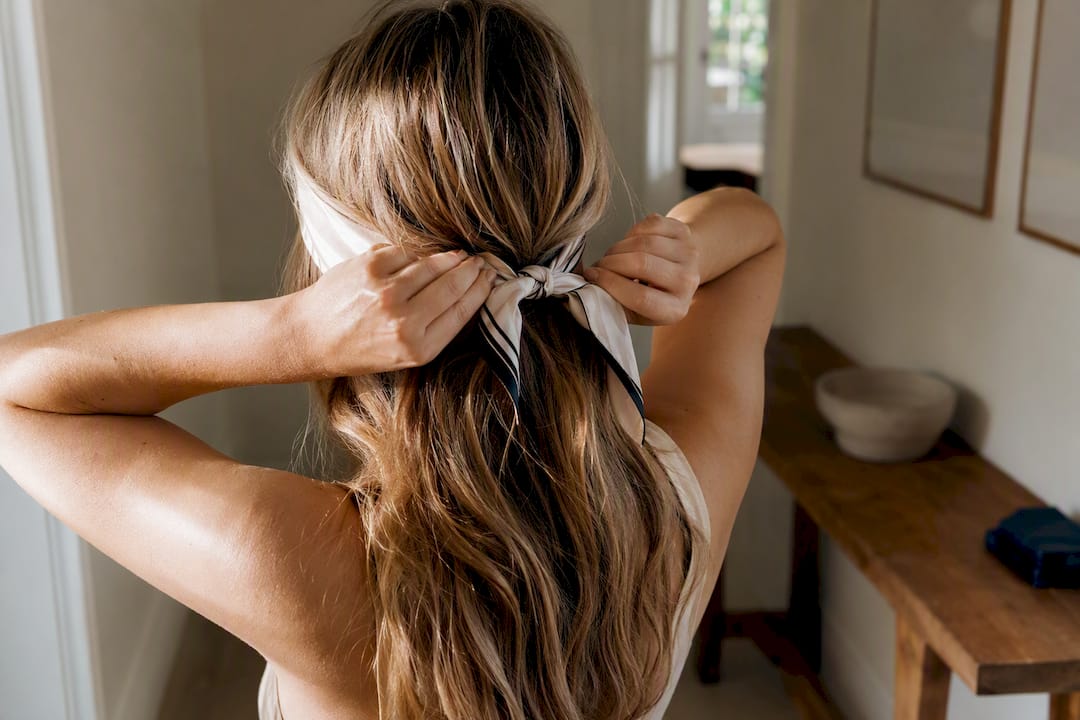
Fringe or no fringe matters too. A headscarf worn close to the hairline works cleanly with a fringe, framing it rather than fighting it, while hair worn back from the face suits a scarf pushed further from the hairline for more breathing room. None of this is about rigid rules; it’s about noticing which knots create the visual balance you actually want on a given day, and adjusting from there.
The cultural history behind these knots
Several of the scarf tying styles used every day carry more history than most people realise. The Parisian knot takes its name from French street style rather than any single designer, evolving over decades as a practical way to wear silk scarves under coats without disturbing their line. Its enduring popularity says something about French dressing more broadly: the emphasis on looking put-together without looking effortful.
The headscarf tie has a longer, more layered history, worn for decades across European fashion as both a practical head covering and a deliberate style statement, later adopted by film and fashion icons through the mid-twentieth century. The neckerchief fold traces back further still, to utilitarian workwear where a simple triangle fold kept dust and sun off the neck long before it became a fashion choice.
Understanding where a knot comes from doesn’t change how you tie it, but it does explain why certain scarf tying styles feel timeless rather than trend-driven. A Parisian knot doesn’t date the way a fast-fashion styling trick does, because it was never built around a single season’s silhouette. That’s worth remembering the next time you’re deciding whether to invest in a quality scarf versus a disposable one: the good knots have already outlasted several fashion cycles.
Getting the trickier knots right with visual guidance
Written instructions only go so far with anything involving folds and tension, particularly the infinity conversion and the double drape, where the order of steps matters more than the description suggests. If you’re new to a knot, watching it tied in real time removes most of the guesswork that a paragraph of instructions can’t quite resolve.
Step-by-step photography or a short video sequence works better than text alone for two reasons. First, it shows exactly how much fabric to leave loose before the final tuck, which is the detail most people get wrong on a first attempt. Second, it shows the knot from multiple angles, which matters for anything tied behind the neck or at the nape, where you can’t easily see your own hands.
Pro Tip: Practise a new knot in front of a mirror before you need it for an outfit. Muscle memory for scarf ties builds fast, usually within three or four attempts, and a knot you’ve rehearsed once looks far more deliberate than one you’re improvising for the first time.
Many of the most useful knot libraries online organise their guidance as concise step-by-step sequences across dozens of variations, which is a reasonable approach to follow when practising at home: pick one knot, repeat it a handful of times, then move to the next rather than trying to learn several at once.
An editorial view on wardrobe rules and quality scarves
The single biggest mistake in scarf styling isn’t choosing the wrong knot; it’s wearing too much at once. One statement piece at a time, whether that’s a bold print scarf or a sculptural bag, keeps an outfit legible rather than busy. That principle sits behind Edito’s approach to curating Parisian style: fewer, better pieces, worn with intention.
Quality also changes how forgiving a knot is. A well-woven silk twill holds a Parisian knot’s shape through a full day in a way a thin, cheap synthetic never will, which is part of why Edito’s curated scarves are chosen for weight and drape as much as print.
— Mickael Martin
Shop the looks: three scarves that suit every knot in this guide
You don’t need a drawer full of scarves to work through every technique here, just three well-chosen pieces in different sizes. Edito’s curated edit includes three that map neatly onto the knots covered above, each one a genuine styling tool rather than a decorative extra.
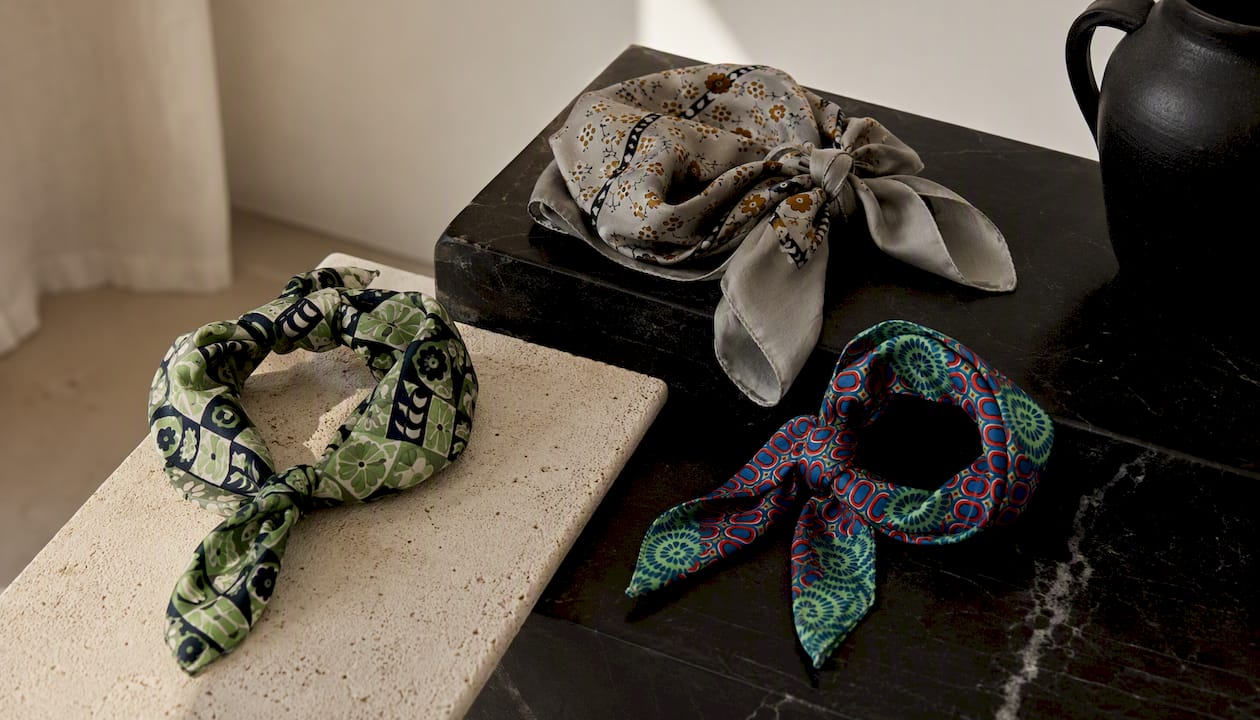
The Mini Tempo Silk Scarf in Khaki is scaled for the neckerchief fold and the bag twilly, small enough to knot cleanly at the throat or the handle of a bag without excess fabric bunching. The Mini Astrid Silk Scarf in Khaki suits the ponytail wrap and a subtle shoulder bow, its narrower cut ideal for looks where a smaller, tidier knot reads better than a bulky one. For anything requiring more fabric, the Classic Scarf in Grey is the workhorse size, built for the Parisian knot, the double drape and a full shoulder throw over a coat.
If you’d rather browse a wider range of accessories before deciding, Couch & Dumbbells stocks a broader accessories category worth a look. To start practising with a piece built for it, head to Edito and pick the scarf that matches the knot you want to master first.
Sources
- Silk scarf styling: fold, knot, wear. - Buro 24/7
- The definitive guide to men’s silk scarf dimensions & knots — Gentleman’s Gazette
- Every way to style a silk scarf — Vogue
FAQ
What are trendy ways to tie a scarf right now?
The infinity conversion and the scarf-as-top styling seen across 2026 runways are the most current looks, alongside the bag twilly for a low-effort colour hit.
How should you tie a scarf in 2026?
The Parisian knot remains the most reliable everyday choice, but this year’s trend has pushed larger scarves into new roles as belts and even tops, not just neckwear.
How do the French tie their scarves?
French styling favours the Parisian knot precisely because it sits flat under tailoring and looks deliberate rather than fussy, a technique that’s become the benchmark for neat, professional scarf styling.
What is the most stylish scarf knot?
The Parisian knot is widely considered the most versatile and polished option, though the shoulder bow and infinity conversion offer softer, more decorative alternatives for evening wear.
What size scarf should I buy first?
A square around 90cm is a versatile single purchase, handling popular knots such as the Parisian knot, once-around and double drape, with a smaller twilly scarf as a useful additional piece for bags and ponytails.