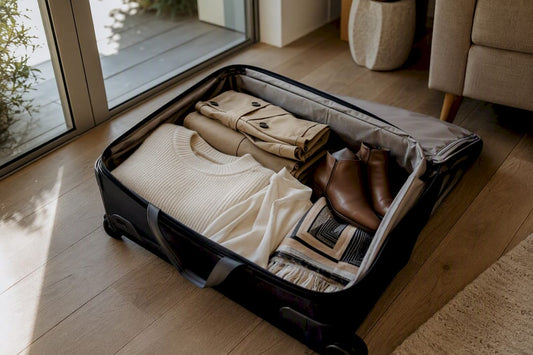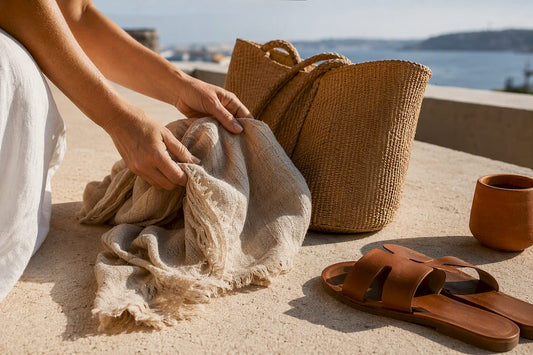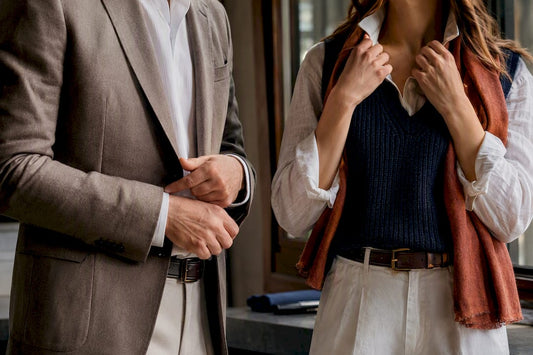

A capsule wardrobe for travel of around ten to twelve considered pieces is the right starting point for most trips, letting you pack light, dress well and avoid decision fatigue at 6am in a hotel room. Before you choose pieces, check your airline’s baggage rules, confirm your actual itinerary and note the climate you’re heading into. Smartraveller, Tourism Australia and Edito’s own styling guidance all point to the same conclusion: plan around what you’ll actually do, not what you might.
TL;DR:
- Most travel capsules consist of ten to fourteen carefully chosen pieces that adapt to the trip’s climate, activities, and laundry options.
- The 54321 method suits seven to ten-day trips with varied settings, while the leaner 3-3-3 rule works best for carry-on-only or short, active escapes.
- Prioritize fabrics like merino wool, recycled nylon, and linen blends that dry quickly and withstand repeated washing to extend capsule longevity.
- Shoes should be limited to three versatile choices, worn on the plane to save space, and selected based on your itinerary and climate needs.
- Organize packing with cubes, optimize rolling for soft fabrics, and test all garments at home to prevent wardrobe surprises during travel.
Table of Contents
- What is a travel capsule wardrobe, and which packing formula suits you?
- Core pieces and the best fabrics for a travel capsule
- Shoes and accessories: the pieces that make or break your case weight
- Packing techniques that keep a small capsule organised
- Sample capsule lists you can copy for your next trip
- Laundry and care that keep your capsule wearable
- Styling tricks that stretch a small capsule further
- How Edito Boutique thinks about travel-ready dressing
- A stylist’s honest take on packing for a trip
- Shop Edito’s capsule-ready pieces for your next trip
- Where these packing recommendations come from
- Sources
- FAQ
What is a travel capsule wardrobe, and which packing formula suits you?
A travel capsule wardrobe is a small, deliberately chosen set of clothing where every piece works with several others, cutting down on both luggage weight and morning decision making. The idea borrows from the broader capsule wardrobe philosophy but tightens the focus specifically to a trip’s length, climate and planned activities. Several packing formulas have become shorthand for this, and picking the right one saves you from either overpacking or arriving without the right layer for a cold evening.
The 54321 method allocates five tops, four bottoms, three layers or outerwear pieces, two pairs of shoes and one hat or accessory set. It suits trips of around seven to ten days where you’ll move between a few different settings, say a city break with one nicer dinner planned. The maths works because five tops paired against four bottoms already gives you twenty possible combinations before you’ve touched a layer or an accessory.

The 3-3-3 rule is leaner again: three tops, three bottoms, three pairs of shoes (sometimes three “outfits” total, depending on who’s explaining it). This suits carry-on-only travel or short, active trips where you genuinely won’t need variety, think a long weekend hiking or a quick work trip with back-to-back meetings in similar settings.
To pick the right formula for your own trip:
- Count your travel days and note how many distinct occasions you need to dress for (business meetings, dinners, sightseeing, exercise).
- Match that count to a formula. Under five days or carry-on only, lean 3-3-3. A week to ten days with mixed activities, lean 54321.
- Adjust the shoe and layer allowance for climate. Cold-weather trips need one more layer than the formula suggests; hot climates usually need one less.
Applied to a seven-day city trip, 54321 looks like five tops in a shared palette, four bottoms (two trousers, a skirt, a pair of denim), three layers (a blazer, a cardigan, a light coat), two shoes and one scarf that works across half the outfits.
Core pieces and the best fabrics for a travel capsule
Get the fabric right and the piece count almost sorts itself out. The garments that earn their place in a capsule are the ones that survive a long flight, a hand wash in a hotel sink and three wears in a row without looking tired.
Prioritise these categories, regardless of which formula you follow:
- Tops: a mix of short and long sleeve, one in a slightly dressier fabric for evenings.
- Bottoms: at least one tailored trouser, one pair of jeans or dark denim, and a skirt or dress for versatility.
- Layers: a blazer or structured jacket, a lightweight knit, and a coat suited to your destination’s coldest expected day.
- A dress or two: does the work of a top and bottom in one piece, and packs flat.
On fabric, Tourism Australia’s packing guidance recommends merino wool and recycled nylon specifically because they dry fast and tolerate repeat wear without holding odour. Linen blends earn their spot for warm climates: they breathe well, though pure linen creases hard, so a linen and cotton or linen and viscose blend behaves better across a long day of travel. Silk has a place too, particularly in a scarf or a light blouse, because it packs into almost no volume and elevates a plain outfit for dinner.
Pro Tip: Before you pack anything new, wear it around the house for a full day. If a “breathable” top clings after an hour or a “wrinkle-resistant” trouser creases the second you sit down, you’ve just saved yourself a wardrobe disappointment on day two of your trip.
Avoid heavy denim (it’s slow to dry and takes up disproportionate case space) and anything dry-clean only. The Sydney Morning Herald’s packing advice makes the same point bluntly: if you can’t wash it yourself in a sink, it doesn’t belong in a travel capsule.
Shoes and accessories: the pieces that make or break your case weight
Decide your shoes before you decide anything else. Footwear is the heaviest, most space-hungry category in any suitcase, and building your clothing capsule around your shoe choice, rather than the other way round, is the single biggest space-saver available to you.
A workable rotation for most trips:
- One comfortable walking shoe or sneaker for daytime and transit days.
- One smarter flat or low heel that moves from daytime to dinner.
- One sandal, if your climate calls for it, worn in place of the sneaker on warmer days.
Wear your heaviest pair on the plane. It’s the one piece of advice that shows up across nearly every practical packing feature, because a shoe worn on your feet costs nothing in luggage weight.
Whether to pack a dedicated evening shoe comes down to your itinerary. If you have one confirmed dinner or event that calls for it, bring it. If you’re packing “just in case,” leave it home. That’s the same discipline that should govern every accessory decision.
Accessories are where a small capsule earns its versatility without adding bulk. A silk scarf in a neutral tone, like the Mini Capucine Silk Scarf in Khaki/Beige, can be knotted at the neck for a daytime look, tied to a bag strap for texture, or worn as a light head covering on a cool evening, all from one piece that weighs next to nothing. A single pair of statement earrings does similar work, shifting a plain top from daywear to dinner-ready in seconds.

Packing techniques that keep a small capsule organised
Once you know your pieces, how you pack them matters almost as much as what you chose. Good organisation means you can find an outfit in seconds rather than unpacking half a case at a hostel reception desk.
Packing cubes are the simplest upgrade most travellers haven’t made. Group by outfit rather than by garment type, one cube per full look, and you’ll dress faster and repack faster too. Tourism Australia lists packing cubes and a compact daypack among its practical additions for exactly this reason.
On rolling versus folding: rolling suits knitwear, T-shirts and casual trousers, and it’s genuinely more space-efficient for soft fabrics. Structured pieces, blazers, shirts with collars, tailored trousers, hold their shape better folded flat. Compression bags squeeze in more volume but they crush delicate fabrics, so save them for gym gear and casual basics, not your one good jacket.
Before you zip the case, run through these checks:
- Weigh your bag at home against your airline’s limit, with a kilogram or two of buffer for souvenirs.
- Pack power banks and spare batteries in cabin baggage, never checked luggage, per Smartraveller’s guidance.
- Split essential medication between carry-on and checked bags where practical, so a lost case doesn’t strand you without it.
- Keep your passport, itinerary and travel insurance details in an easily accessible pocket, a detail Tourism Australia’s own checklist flags as commonly forgotten.
Sample capsule lists you can copy for your next trip
A carry-on weekend (two to three nights) works well as a tight 3-3-3: three tops, three bottoms, one dress, one layer, two shoes worn and packed. Swap a linen top for a merino long sleeve if you’re heading somewhere cool.
A 7-day city trip suits the full 54321 spread: five tops (three casual, two dressier), four bottoms, three layers (blazer, cardigan, coat or raincoat depending on season), two shoes, one scarf or accessory set that ties the palette together.
A two-week mixed-activity trip (city plus some outdoor time) needs a slightly expanded twelve to fourteen piece capsule: add one extra layer for temperature swings and one activewear set if hiking or exercise is on the agenda, but keep the palette identical to your other pieces so everything still cross-matches.
If laundry access is confirmed at your destination, halve your top and bottom counts and plan a wash partway through. Without laundry, stick to the fuller counts above rather than assuming you’ll find a machine.
Round out any of these with a short tech and toiletry kit: phone charger, universal adaptor, a travel-sized detergent sheet, and any toiletries your accommodation doesn’t confirm it supplies.
Laundry and care that keep your capsule wearable
A capsule wardrobe for travel only holds up if you can wash it on the road. Hand-washing in a hotel sink with a leaf-style travel detergent works for merino, linen blends and most synthetics, and a lightweight top wrung out well will usually dry overnight on a hook near a window or a running air conditioner.
- Merino and recycled nylon dry reliably overnight in most climates.
- Cotton and linen dry slower and may need a full day, so wash them earlier if you’re on a tight schedule.
- Avoid packing anything you haven’t already test-washed at home; a “hand wash cold” label doesn’t guarantee it survives a sink wash on day four of a trip.
- The more reliably your pieces wash and dry, the smaller your capsule can afford to be, since you’re recycling the same tops rather than packing extras to avoid laundry altogether.
Styling tricks that stretch a small capsule further
The palette rule does most of the heavy lifting here: build your capsule around two neutrals plus one accent colour, and nearly everything you’ve packed will mix with everything else without a second thought. It’s a method stylist Sally Mackinnon recommends specifically because it keeps a small wardrobe looking considered rather than random, while silhouette contrast (a fitted top with a fuller skirt, a slim trouser with a boxier jacket) stops every outfit looking the same shape.
The maths rewards you quickly: three tops, three bottoms and two layers give you eighteen distinct combinations before an accessory changes anything.
- Layer a button-up under a knit for daytime, then remove the knit and add the scarf for dinner.
- Swap a day bag for a smaller evening clutch to shift the whole outfit’s register.
- Keep one blazer in rotation; it turns a T-shirt and jeans into something presentable for a nicer restaurant.
Pro Tip: Pack one piece slightly outside your usual comfort zone, a bolder print scarf, an unexpected colour block. It becomes the “accent” that keeps five days of the same neutral rotation from feeling repetitive by day four.
How Edito Boutique thinks about travel-ready dressing
Edito Boutique curates European fashion with trans-seasonal wearability front of mind, which happens to be exactly what a good travel capsule demands. When we select pieces for the edit, we prioritise fabrics that hold their shape across a long day, silhouettes that move between casual and smart occasions, and a palette that talks to itself across a season rather than a single outfit.
A scarf is one of the most efficient pieces you can add to a travel capsule, and it’s worth choosing one with real versatility. The Mini Capucine Silk Scarf in Khaki/Beige is a practical example: a neutral tone that sits comfortably against most of a capsule’s palette, light enough to fold into nothing, and equally at home knotted at the neck for a daytime look or looped through a bag for evening.
Building a capsule for travel isn’t about owning less for its own sake. It’s about choosing pieces considered enough that you never open your case wondering what to wear.
Edito’s own guide to a 12-piece travel capsule walks through this selection process in more depth for readers building a wardrobe from scratch.
A stylist’s honest take on packing for a trip
The pieces that fail travellers most often aren’t the cheap ones, they’re the untested ones bought specifically for a trip and worn for the first time at the airport. Test everything at home first, and settle your shoes before anything else; the rest of the capsule falls into place once footwear is locked in. If you’d rather start from a curated shortlist than build one from scratch, curated collections are a sensible place to look.
— Mickael Martin
Shop Edito’s capsule-ready pieces for your next trip
This guide offers an alternative to piecing together a travel wardrobe from a dozen different retailers: choosing European clothing and accessories selected for versatility and fabric quality suitable for a travel capsule, helping avoid uncertainty about which pieces will endure travel conditions.

Start with the categories that do the heaviest lifting in any capsule. Our clothing collection covers the tops, dresses and layering pieces most travel capsules are built around, while accessories is where a scarf like the Mini Capucine Silk Scarf in Khaki/Beige earns its place across half your outfits. Browsing dresses, tops or pants individually is useful once you know your palette, and our guide to a 30 to 35 piece capsule is worth a look if you’re building a wardrobe that extends beyond travel too. Start with the scarf, then build outward from there.
Where these packing recommendations come from
The practical rules in this guide draw on Smartraveller’s official baggage and safety guidance, Tourism Australia’s packing recommendations, and packing features from ABC News and the Sydney Morning Herald, each chosen for verifying a different piece of the puzzle, from airline rules to real-world garment testing.
Sources
- Smartraveller — The basics
- Tourism Australia — Ultimate Australia packing list
- How to build a capsule wardrobe for carry-on only travel — ABC News
- How to pack for travel — SMH
FAQ
What is the 54321 travel wardrobe formula?
It’s a packing ratio of five tops, four bottoms, three layers, two shoes and one hat or accessory, designed to give a week to ten-day trip enough variety without excess. It suits mixed itineraries better than very short or very active trips, where the leaner 3-3-3 rule works better.
What is the 3-3-3 rule for capsule wardrobes?
The 3-3-3 rule pares packing down to three tops, three bottoms and three pairs of shoes, aimed at carry-on-only or short trips where variety matters less than efficiency. It’s tighter than 54321 and suits travellers who want minimal decision making each morning.
What should I pack for a 7-day trip using a capsule wardrobe?
A 7-day trip suits the full 54321 spread: five tops, four bottoms, three layers, two shoes and one versatile accessory like a scarf, all chosen in a shared two-neutral, one-accent palette. Edito’s 12-piece travel capsule guide sets out one version of this list built from European staples.
How many pieces should be in a travel capsule wardrobe?
Most travel capsules sit between ten and fourteen pieces for a week or two-week trip, adjusted up slightly for cold climates or mixed activities and down for carry-on-only travel. The right count depends more on confirmed activities and laundry access than on a fixed rule.
Does Edito sell travel capsule pieces?
Edito’s curated edit includes clothing, dresses, tops, pants and accessories suited to travel capsules, including versatile pieces like the Mini Capucine Silk Scarf in Khaki/Beige. Current prices for individual pieces are listed on each product page.