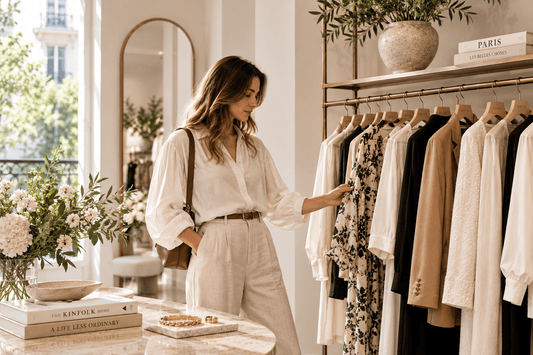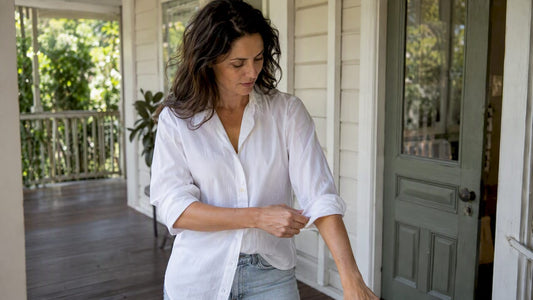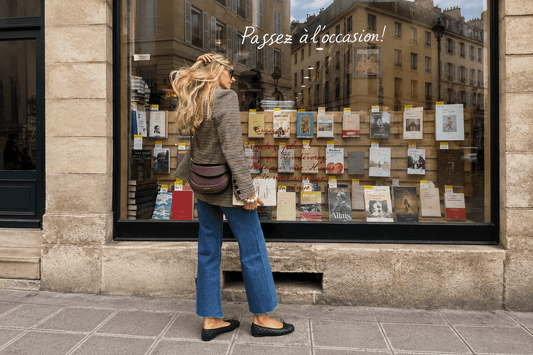

The modern way to wear classic French designer pieces is to keep the pieces and change the proportions, the finish and the company they keep. A tailored blazer sits with relaxed denim. A silk blouse meets flat shoes. A trench is worn open over a slip dress. Nothing is replaced wholesale; each piece is simply styled so it reads as current rather than inherited. Below, we set out which pieces earn a place, how to style them, which colours and fabrics suit an Australian wardrobe, and what to check before you buy.
TL;DR
- Start with a small group of versatile pieces: a tailored blazer, a crisp shirt or blouse, straight-leg denim, a trench, flat shoes and a silk scarf.
- Modernise by contrast: pair something structured with something relaxed, and avoid logo-heavy or very trend-driven items.
- Keep the palette narrow and the fabrics natural, so every piece works with the others and with Australian weather.
- Buy to fill genuine gaps in your wardrobe, and check sizing, because French cuts can run slimmer through the shoulder and hip.
- Browse our clothing collection for French and European labels chosen for craftsmanship and wearability.
Table of Contents
- What makes a French piece a classic
- The foundation: pieces worth owning
- How to make classics feel modern
- Colour, fabric and fit
- Building a capsule that suits an Australian year
- How to judge quality before you buy
- Our perspective
- Finishing the look
- Shop the edit
- FAQ
- Sources
What makes a French piece a classic
A classic is a piece that has outlasted several seasons of fashion without needing to be rescued by them. In French dressing, that usually means a clean line, a considered fabric and a cut that flatters without announcing itself. The designer’s name matters less than the way the garment behaves on the body and in a wardrobe.
British Vogue’s guide to French style lists Breton stripes, ballet flats and silk scarves among the signatures of the look, alongside a camel coat and a black blazer. Marie Claire UK’s feature from a Parisian fashion editor names an oversized blazer, high-waisted jeans, a Breton top, a little black dress, elegant heels and ballet flats as capsule staples. The lists differ in detail, but the logic is constant: few pieces, many combinations.
It is worth being precise about heritage. Our own edit is European rather than exclusively French. Sœur, Sessùn, BA&SH, Vanessa Bruno and Hartford are French houses, Sita Murt is Spanish (from Catalonia) and Essentiel Antwerp is Belgian. Each brings its own sensibility, and the modern look often comes from mixing them rather than dressing from a single label.
The foundation: pieces worth owning
Condé Nast Traveler’s conversation with French designer Jeanne Damas, and the style notes around it, point to a good-quality blazer, navy cashmere, smart shoes, minimal jewellery, high-waisted jeans, a trench coat, ankle boots and a wrap dress. Translated into an Australian wardrobe, we would organise the foundation like this.
The tailored blazer
The blazer is the single most useful piece in the French repertoire, because it changes the register of whatever sits beneath it. Over a T-shirt and denim it looks deliberate. Over a slip dress it looks relaxed. A slightly oversized cut feels more current than a sharply fitted one, and a soft shoulder keeps it wearable through a long Queensland working day.
The shirt or blouse
A crisp white shirt is the quiet workhorse, and a printed or contrast-detailed blouse is its more personal sibling. In a natural fibre, either will breathe through an Australian summer. If you want a place to begin, our French cotton blouses and shirts collection is built around exactly this kind of piece, and the Chorus Blouse in White/Black and Chorus Blouse in Navy/White show how a simple blouse can carry graphic contrast without feeling loud.

Straight-leg denim and tailored trousers
Broadsheet’s 2024 guide by an Australian stylist recommends a loose straight-leg jean, neutral tailored trousers and a co-ordinated blazer as building blocks that work together or apart. That advice maps neatly onto the French approach. Denim gives the relaxed counterweight; a neutral trouser gives polish. You can explore the latter in our pants collection.
The dress that works for any occasion
Jeanne Damas has said a wrap dress suits almost any occasion, and the slip dress belongs in the same family. Both are easy to layer: a blazer for the office, a knit for a cooler evening, flat sandals for the weekend. Our dresses edit is the place to look for a silhouette that moves well and does not need constant adjusting.
The trench, lightly
The trench is the French classic most easily over-bought for Australia. In Brisbane and much of the north, a trench is a few weeks of use at best. Further south, it earns its keep through autumn and winter. We would treat it as a considered second purchase, not a first.
Shoes, scarf and a good bag
Ballet flats, loafers and low heels do more for a modern look than a statement shoe. A silk scarf adds colour at the neck, in the hair or on a bag handle. The Mini Capucine Silk Scarf in Grey is the kind of small, neutral accent that lifts a plain outfit. For finishing touches in general, see our accessories.

How to make classics feel modern
The difference between a classic and a costume is usually a matter of contrast. The French idea of effortlessness depends on something slightly undone: a tailored piece offset by a relaxed one, a polished outfit with tousled hair, or bold lipstick against a plain outfit. Used well, this controlled imperfection is what keeps a look from feeling like a uniform copied from a catalogue.
Here are the adjustments we find most useful.
- Change the proportion. Pair a cropped or boxy jacket with a longer, fluid skirt or wide-leg trouser. Or tuck a relaxed shirt into a slim straight trouser. A small change in proportion makes a familiar piece look new.
- Mix registers. A silk blouse with denim, a blazer over a plain tee, a slip dress with flat boots. Each pairing has one dressy element and one casual one.
- Keep the pieces, vary the finish. The same blazer in a softer fabric or a more relaxed cut reads differently. Modernising rarely requires replacing a wardrobe; it means adjusting how the pieces sit together.
- Avoid the obvious signals. Logo-heavy pieces and very trend-specific items date quickly. A classic wardrobe stays current by being quiet.
- Wear things repeatedly. Jeanne Damas describes French style as simplicity, wearing more or less the same things as a kind of everyday uniform. Repetition is not a failure of imagination; it is the point.
If you want fuller outfit formulas, our guide to styling classic French designer pieces for a modern look goes further, and Shop French Fashion in Australia sets out six outfit formulas with specific picks.
Colour, fabric and fit
A narrow palette
The French wardrobe tends to be built from a small set of tones: navy, ecru, camel, black and white, with perhaps one accent such as burgundy or cobalt. This is a style convention rather than a rule, but it has a practical effect. When every piece belongs to the same family, almost everything goes with everything, and you dress faster. Marc Freeman of Camilla and Marc, profiled in the Sydney Morning Herald, builds a monochromatic wardrobe of simple, intentional pieces and prioritises fabrication, fit and form over trends. The same principle applies on a woman’s rail.
Natural fibres for a warm country
Linen and cotton suit the long Australian summer; silk suits blouses and scarves; wool and cashmere handle the cooler months where you need them. In Brisbane and across Queensland, lightweight layers matter more than heavy ones, so a fine knit that can be draped over the shoulders is often more useful than a thick coat. Our knitwear range is worth a look for exactly this kind of mid-weight layering.
Fit: loose but not shapeless
The most useful fit principle is balance. A piece may be generous in the body and still look considered if one part, the shoulder, the waist or the hem, is defined. Fitted pieces work best when they are not tight. Because French cuts can run slimmer through the shoulders, arms and hips than some sizing readers may be used to, checking the size guidance before ordering is sensible. We have written brand-specific notes on Sœur sizing and Sessùn sizing for Australian shoppers.
Building a capsule that suits an Australian year
A capsule wardrobe is not a fixed shopping list. Australian stylist Walford, quoted by Broadsheet, argues that it should be personalised, built around fit and genuine gaps rather than a universal formula. We agree. Start by looking at what you already wear, then fill the gaps.
A sample framework, adjustable to your climate and work life:
- Two or three tops: one crisp white shirt, one patterned or striped piece, one fine knit.
- Two bottoms: straight-leg denim and a neutral tailored trouser or skirt.
- One dress: a wrap or slip style that layers.
- One structured layer: a blazer, and a trench if your winters justify it.
- Shoes: flats or loafers for daily use and a heeled option for evenings.
- Accessories: a silk scarf, a good bag, minimal jewellery.
That is fewer than fifteen pieces, and the combinations run well into the dozens. If you live somewhere warm for most of the year, shift weight from outerwear to breathable layers; if you live in Melbourne, Canberra or Hobart, give the coat and the knit more of the budget.
Dressing the Australian occasions
- Office and client lunches: blazer, silk blouse, straight trouser, loafers.
- Weekend markets and coffee: striped top or relaxed shirt, denim, flat sandals or flats.
- Race days, weddings and long lunches: a dress with a distinctive cut, a scarf or minimal jewellery, and a heel with some comfort built in.
- Evenings by the river or on the coast: a slip dress, a light knit across the shoulders, small bag.
The same few pieces carry across every one of these. What changes is the supporting cast.
How to judge quality before you buy
Price alone does not tell you whether a piece will last. These checks are more reliable.
- Fabric first. Natural fibres, cotton, linen, silk, wool, generally age more gracefully and breathe better in heat.
- Seams and finishing. Look for even stitching, tidy inside seams and buttons sewn securely.
- Drape and structure. A blazer should hold its shoulder; a blouse should fall rather than cling.
- Versatility. Ask whether the piece works with at least three things you already own. If not, it is probably a one-wear item.
- Fit on your body. Broadsheet’s stylist guidance puts fit first, especially with denim. Compare the measurements against the brand’s size guidance, not just the size label.
These checks are practical rather than scientific, and they fit the philosophy we apply when selecting each label.
Our perspective
We select European labels at Edito because we believe elegance is cumulative. It comes from one good blouse worn many ways rather than twenty items worn once. The pieces that tend to endure are those with a clear point of view in their cut and fabric: a Sœur jacket with an easy line, a Sessùn blouse with softness in its drape, a Vanessa Bruno piece with a quiet detail, a Sita Murt knit with Catalan colour and texture.
The modern look is rarely a matter of finding something new. It is a matter of letting a classic breathe: slightly looser here, slightly more casual there, with an honest sense of how you actually live. In Brisbane that means lightness, natural fibres and layers that can be removed. Our Brisbane boutique lets you see how a piece moves and how the fabric feels before you decide, and online we aim to describe each piece with the same care.
Fashion, as one Parisian living in Sydney put it, brings together savoir-faire, talent, expression and storytelling. We would add that it should also be wearable.
— Mickael Martin
Finishing the look
The small things carry more than they seem to. A silk scarf knotted at a bag handle, minimal gold at the wrist, flat shoes you can walk in. Scent belongs here too: some people like to complete a French-inspired outfit with a fragrance in a classic style, and Chanel-inspired fragrance dupes are one way to explore that territory without a designer price tag.
Shop the edit
If you are ready to build your own version of this wardrobe, we would begin with a blazer or a blouse and add from there. Our Brisbane boutique and our online store both carry French and European labels chosen for craftsmanship, quality and long-term wearability, with fast shipping and easy returns for Australian customers.

Browse clothing, or go straight to tops and dresses to start with the pieces most easily worn across seasons. For more on the style behind the clothes, read French wardrobe staples: the pieces worth owning in Australia, The Complete Guide to Parisian Style and Why French women always look effortlessly stylish.
FAQ
What are the most important classic French pieces to buy first?
Begin with a tailored blazer, a crisp shirt or blouse and straight-leg denim or neutral trousers. These three can be combined in many ways and will work with almost anything you add later. Then add flat shoes and a silk scarf.
How do I stop French-style clothing looking dated?
Balance polished pieces with relaxed ones, such as a blazer with denim or a silk blouse with flat shoes. Avoid logos and very trend-driven items, and adjust proportions rather than replacing pieces. A little deliberate imperfection keeps the look alive.
Is French fashion suitable for Australian summers?
Yes, when you choose natural, breathable fabrics like cotton, linen and silk, and lighter layers. Skip heavy outerwear in warm regions and keep a fine knit or scarf for air-conditioned rooms and cooler evenings.
Are all the brands on Edito French?
No. Many are French, including Sœur, Sessùn, BA&SH, Vanessa Bruno and Hartford, but Sita Murt is Spanish and Essentiel Antwerp is Belgian. We describe each label according to its own heritage.
Do I need a full capsule wardrobe to get the look?
No. A capsule should be built around your own gaps and lifestyle rather than a fixed list. Start with two or three pieces you will wear weekly and add gradually.
Sources
- Condé Nast Traveler: What to Wear in Paris, according to a French fashion designer
- Marie Claire UK: French fashion brands, picked by a Parisian fashion editor
- British Vogue: Fashion staples every French girl has in her wardrobe
- Broadsheet: A stylist’s guide to building a capsule wardrobe
- Sydney Morning Herald: Marc Freeman style profile
- Ouishopp: Style interview with Gaelle Treguer
- 2A Magazine: The definitive guide to French brands clothing