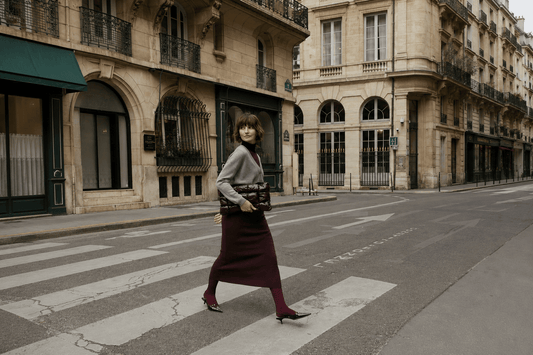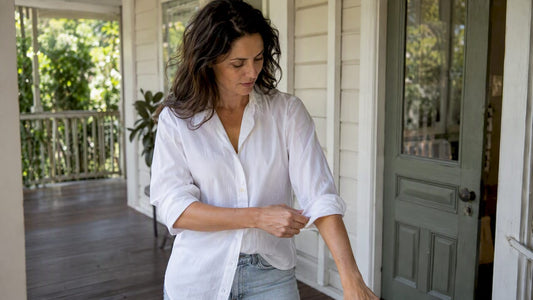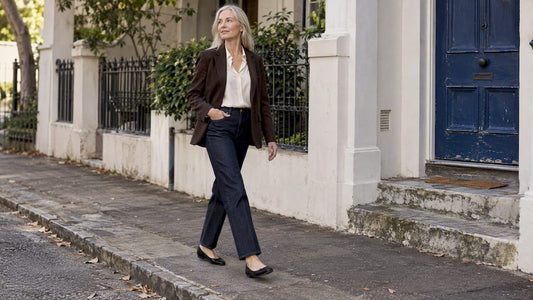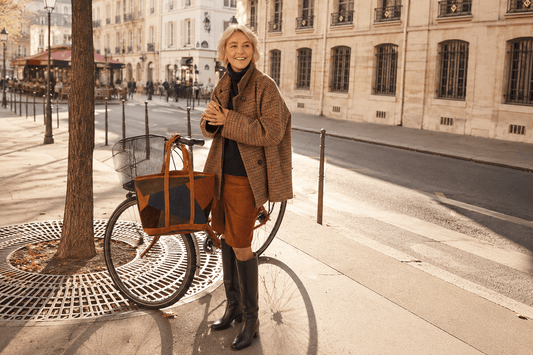

French style in Australia works best as a way of dressing rather than a costume: a calm palette, a few well-made pieces, considered proportions and one detail left slightly undone. It translates beautifully to our climate once you adjust fabric weight and layering for the season, and we see it every day among women who shop with us from Brisbane to Perth.
TL;DR
- French style is about restraint and ease: fewer, better pieces in a neutral palette, worn with an unforced attitude.
- The core wardrobe is short: a white shirt or tee, a stripe top, straight or wide trousers, a blazer, a trench, flat or low shoes and one good bag.
- For Australia, favour breathable cotton, linen, silk and fine merino, and rely on lightweight layers (a trench, an unstructured blazer) rather than heavy coats.
- Add one accent, such as a silk scarf or a print, and keep everything else quiet.
- Buy the pieces you will wear weekly, in the best quality you can, and have them tailored if needed.
Table of Contents
- What French style actually means
- The pieces that define it
- Why it suits Australian life
- Adapting the look to Australian seasons
- A short wardrobe that does the work
- Fabric and fit: where quality shows
- The art of the undone detail
- Our perspective
- Shop the look at Edito
- Common mistakes when borrowing French style
- Wearing French style by occasion
- FAQ
- Sources
What French style actually means
The phrase is easily reduced to stripes and berets, but the idea is older and more subtle. In a 2022 feature on French dressing, the AFR described the famous je ne sais quoi as resting on Chanel’s principle of restraint: elegance as a form of refusal. Take away the excess, and what remains is posture, fit and intent.
It is also not a single look. Women interviewed by The Zoe Report describe Paris as having a strong sense of individualism, with a subtle touch of spirit and eccentricity. The same article makes the point that Parisian women are many and varied, and that style and personality go together. That is the part we find most useful for Australian women: you are not copying a type, you are borrowing a philosophy and applying it to your own life.
Elle’s long-running guide to French women’s style adds a quieter observation: the appeal comes from how they walk and hold themselves, not from being overtly sexy. Confidence, attitude, posture and ease do as much work as the clothes.
The pieces that define it
Magazines return to the same small group of garments again and again. Taken together, the lists give a reliable picture.
- Shirts and tees: an oversized button-up shirt and a white t-shirt appear among the essentials The Zoe Report’s French interviewees called out repeatedly.
- Tailoring and outerwear: British Vogue’s list of staples includes a camel coat, a black blazer and a silk shirt, alongside a nautical stripe and straight-leg jeans.
- Shoes: Sydney Morning Herald’s guide to French dressing says every wardrobe needs classic ballet flats and that cheap shoes are never worn. Elle’s 2024 essentials add loafers and a demure kitten heel for moving about with grace.
- Accessories: a silk scarf, worn through the year or tied to a handbag, is the same SMH guide’s signature Parisian accessory. Who What Wear suggests tying it at the neck or around a bag as the ultimate French trick, and classic gold jewellery appears on The Zoe Report’s list.
- Palette: Elle notes a simple range of beige, grey, navy, black and white.
Notice what is missing: logos, novelty cuts, anything that dates within a season. The pieces are chosen to be worn for years.
Why it suits Australian life
There is a practical reason the French approach travels well here. Our lifestyle is relaxed and often outdoors; we move from the office to a long lunch to the water without changing. French dressing is built for exactly that kind of day: easy shapes, flat or low shoes, a bag that holds everything, nothing that fights you.
The quality-over-quantity principle matters here too. The Good Trade notes that French style goes hand in hand with sustainable fashion: investing in pieces you love, mixing and matching a small wardrobe and tailoring clothes so you wear them again and again. For a woman who wants to dress well across a long, warm year without a crowded wardrobe, that is a sensible way to shop.
The place where adjustments are needed is weather. Paris wardrobes lean on wool and heavy layers for months at a time. In most of Australia, and especially in Queensland, we need the same silhouettes in lighter fabrics.
Adapting the look to Australian seasons
Remember that our seasons are reversed. A French article’s “trench for autumn” lands in our March to May, and a July guide to summer dressing in Paris is our winter wardrobe in reverse. Here is how we think about each season.
Summer: linen, cotton and silk
Humid summers call for fabrics that breathe. The French vocabulary of the silk blouse, the loose white shirt, the simple dress and the woven bag adapts without effort. Elle’s 2024 list highlights Bermuda-style shorts and a woven raffia basket bag, both natural fits for a Queensland summer. Keep the palette pale (ecru, sand, stone, soft blue) and let a single print or a stripe provide the interest.

In our edit, a dress such as the Muriel Dress in Rose or the Poem Dress in Blue is the one-piece answer, and the dresses collection is where to look first. For a bag, a natural-fibre option like the Vanessa Bruno raffia cabas tote keeps the look light.
Autumn and spring: the trench and the blazer
These are the seasons in which French dressing is most at home. A trench over a shirt and fine knit is the classic formula, and it is not only a Paris idea: Fashion Weekly’s 2026 report on Brisbane winter street style says the city’s fashion crowd favours lightweight trench coats, oversized blazers and relaxed wool coats that can be layered as temperatures shift through the day. That adaptability is the whole point. Choose a trench in a weight you can carry over your arm by lunchtime.
Trousers do the quiet work here. A straight or wide leg in stone or black, such as the Palerme Pants in Stone or the Tancrede Pants in Black from Sessùn, will pair with a white tee in October and a fine knit in April.
Winter: knitwear and one good coat
Winter in Brisbane is mild compared with Paris, and in Melbourne or Canberra it is serious. The same Fashion Weekly guide suggests an instantly wearable winter wardrobe built on tailored trousers, quality knitwear, a relaxed cardigan, a structured blazer, dark-wash denim, a wool-blend coat, ankle boots and loafers, in a neutral palette, with layer-friendly basics. That is French dressing by another name. Look at our knitwear and shoes for the pieces that carry you from June to August.
A short wardrobe that does the work
A French-inspired wardrobe does not need dozens of items. The SMH guide advises buying one or two key items of the best quality each season, such as a tailored jacket or a Breton stripe tee, and mixing in affordable trends. Here is a version tuned for Australia.
| Piece | Why it earns its place | Australian note |
|---|---|---|
| White shirt | Worn open, buttoned or over a tee | Cotton or linen for warm months |
| Stripe top | The nautical stripe is a perennial staple | Year-round with a blazer or alone |
| Straight or wide trousers | Anchor of most outfits | Lighter weights for Queensland |
| Blazer | Instantly sharpens a relaxed outfit | Unlined or soft-shouldered |
| Trench | Cover for shoulder seasons | Lightweight and showerproof for storms |
| Fine knit | Layer for air-conditioning and winter | Cotton or fine merino blends |
| Flat or low shoe | Loafer, ballet flat or mule | Comfort for walking, heat-friendly |
| Structured bag | The finishing piece | Leather or raffia |
For a deeper dive into building this set, our guide to building a French capsule wardrobe walks through it piece by piece, and our French wardrobe staples list covers what is worth owning here. If you prefer a broader frame, see the European capsule wardrobe guide.
Fabric and fit: where quality shows
The Good Trade writes that French women choose quality cotton, wool, leather and silk that can be worn for years, and that pants, button-downs and blazers should fit neither too tightly nor too loosely, with tailoring where needed. We agree, and would add a local point: natural fibres are not only a matter of longevity in Australia, they are a matter of comfort. A silk blouse or a linen trouser in a humid January is simply more pleasant than a synthetic.
Fit is the second half. A shoulder that sits correctly and a hem at the right length make a modest piece look intentional. A small alteration is often the difference between a garment you like and one you reach for weekly.
The art of the undone detail
Polish alone looks stiff. The French answer is a deliberate imperfection: a pushed-up sleeve, an open collar, a scarf tied slightly off-centre. Style.me.uk puts it simply, advising you to leave one thing slightly undone because polish needs a little life in it. The same guide gives a balancing rule: pair one polished piece with one relaxed piece, add a single accent, and stop.
In practice:
- Start with a base of two neutrals, for example navy and cream.
- Add one polished piece (a blazer, a tailored trouser).
- Add one relaxed piece (a tee, a loafer, a slouchy knit).
- Choose one accent: a print, a scarf or a bag in camel.
- Undo one thing.
A print can be that accent. A piece such as the Floco Floral Shirt in Sand over simple trousers needs nothing else. For more outfit formulas, see our guide on styling classic French designer pieces.
Our perspective
We approach French style as an editor would: by subtraction. The most wearable European wardrobes we see are not the largest, they are the ones where every piece has been chosen with care, for its cut, its fabric and the way it ages.
That is why our boutique in Brisbane is built around a considered edit of French and European labels, among them Sœur, Sessùn, BA&SH, Vanessa Bruno and Hartford from France, Sita Murt from Spain and Essentiel Antwerp from Belgium. Each house has its own savoir-faire, and we describe them by their real heritage, because French style is one thread in a wider European story rather than the whole of it.
For Australian women, we believe the best investment is the piece that works in three seasons: a trouser that moves from linen shirt to fine knit, a dress that takes a blazer or goes alone, a bag that carries a whole day. Our editorial styling advice is written with our seasons and our lifestyle in mind, not Paris in November.
Start with one or two pieces you would wear every week. The rest of the wardrobe follows naturally.
Mickael Martin
Shop the look at Edito
If you would like to see these ideas in fabric, our clothing collection brings together European designer dresses, tops, pants and knitwear chosen for quality and wearability, with shipping across Australia and a boutique to visit in Brisbane.
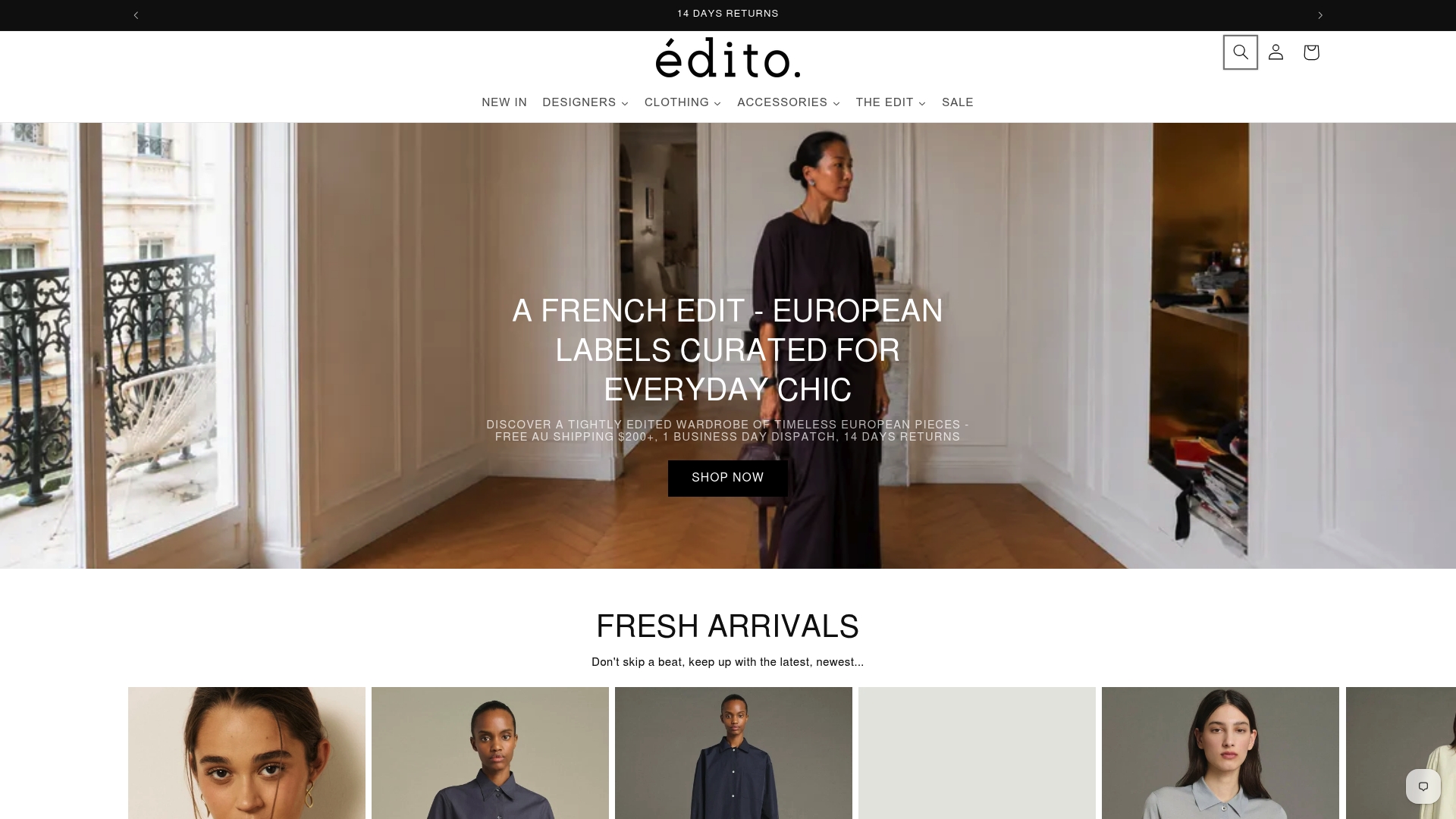
A good place to begin is a single anchor: the Florin Handbag in Camel for the tan-and-camel bag that so many French style guides recommend, or a pair of trousers from our pants collection. Our guide to Parisian style is a good companion if you want the broader philosophy.
Common mistakes when borrowing French style
- Copying Paris weather. A heavy wool coat in a Brisbane June is rarely worn. Choose the lightweight trench, the cardigan and the unlined blazer.
- Buying the look rather than the piece. Costume items, such as a beret worn for effect, fade fast. Choose pieces that carry on after the trend.
- Too many accents. One print, one scarf, one bright lip, not all three. Who What Wear lists a bold lip among its staples, which is a reminder that the accent can be beauty rather than clothing.
- Wrong shoe for the day. Elle’s 2015 guide observes that jeans are worn with heels, not flats, while a 2022 interview-based list leans toward walkable shoes. The common thread is intention: choose the shoe that fits the day, and walk well in it.
- Ignoring fit. An oversized shirt is intentional; an ill-fitting one is not. Tailoring a hem or a sleeve costs little compared with a piece that sits unworn.
Wearing French style by occasion
At work. Tailored trousers, a crisp shirt and a blazer over the shoulders cover most offices. Keep the shoes simple and the bag structured. A fine knit works under the blazer in air-conditioned buildings.
Weekend lunch. A shirt dress or a simple dress with flat sandals and a raffia bag. Add a scarf tied to the handle if you like. This is the most natural territory for French dressing in a warm climate.
Evening. Underdressing is the French approach: a silk blouse with dark trousers or a slip-style dress with a blazer, rather than something overly formal. One piece of gold jewellery is enough.
Travel. A capsule palette makes packing straightforward. If every piece mixes with every other, a carry-on goes a long way. Our guide to a Parisian capsule wardrobe for Australia looks at three pieces for each season.

FAQ
What is French style in women’s fashion?
It is a philosophy of restraint and ease more than a set look. The AFR traces it to the idea that elegance is refusal: fewer, better pieces, a neutral palette and a relaxed attitude. Individuality matters as much as the uniform.
Can I wear French style in a hot Australian climate?
Yes, by changing fabrics rather than silhouettes. Choose cotton, linen and silk, lighter trench coats and unlined blazers, and flat sandals or loafers. In Queensland, the layers you carry matter more than the layers you wear.
Which French style pieces should I buy first?
Start with what you will wear weekly: a good white shirt or tee, a pair of straight or wide trousers, a blazer and a bag. Many guides, including SMH’s, suggest buying one or two quality pieces each season rather than many at once.
Are all European designer brands French?
No. Sœur, Sessùn, BA&SH, Vanessa Bruno and Hartford are French, Sita Murt is Spanish and Essentiel Antwerp is Belgian. Each has its own design character, which is part of why a European edit feels more individual than a single-country wardrobe.
How do I keep a French-inspired outfit relaxed rather than formal?
Pair one polished piece with one relaxed one, add a single accent, and leave one thing slightly undone, such as rolled sleeves or an open collar. Then stop adding.
Sources
- AFR: French style and je ne sais quoi
- The Zoe Report: What French woman style really entails
- Elle: How French women define French style
- British Vogue: 10 fashion staples every French girl has
- Sydney Morning Herald: The art of French dressing
- Elle: 10 French fashion essentials
- Who What Wear: The 12 French girl style staples
- Fashion Weekly: Brisbane winter street style
- The Good Trade: How to dress in French girl style
- Style.me.uk: Parisian chic style guide